The Gap Trap: Why The Space Between Feels So Loud
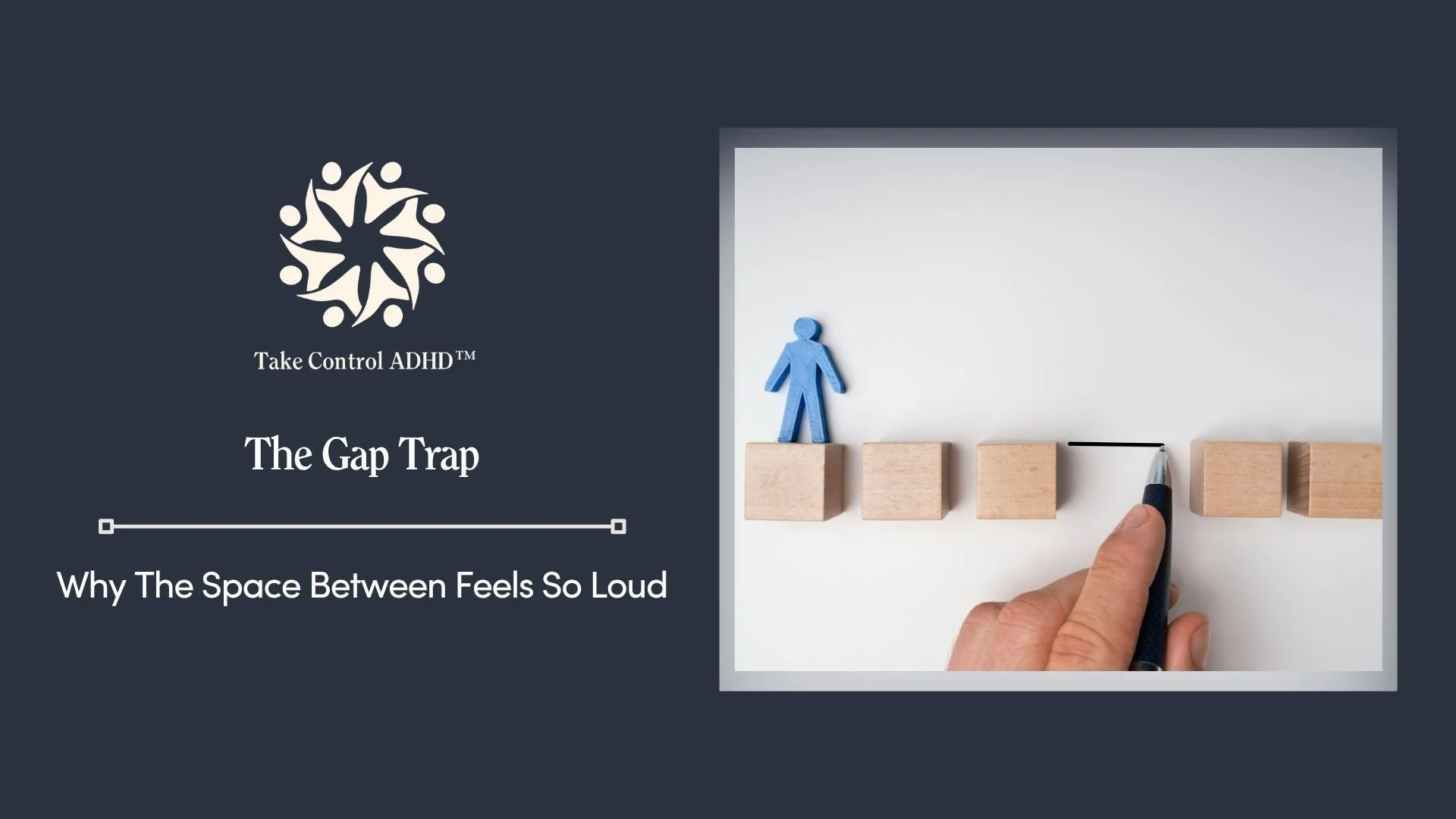
There's the version of you that exists right now. And there's the version you're pretty sure you should have become by this point.
That space between them is what we call the gap trap.
Here's the thing worth knowing about that space: the gap itself isn't the problem. Everyone has one. The problem is what grows inside it. Shame does its best work in that gap, and for ADHD brains, it does that work fast.
🔄 Where the Gap Shows Up
You know the feeling. It's a new year, a new Monday, a fresh start, and suddenly everything feels urgent all at once. Not just one thing to work on, everything. A new planner. A new app. A new system someone recommended. Real hope, every time, that this is the version of the plan that finally sticks.
Then the same list shows up again next year. Not because you didn't care. Because the gap was never about effort. It was about the space between where you are and where you think you're supposed to be, and that space fills with shame long before it fills with progress.
❄️ Freeze Isn't a Character Flaw
When you're stuck in the gap, it's easy to believe the freeze means something is wrong with you. It doesn't. Freeze is a nervous system response, not a personality trait. Your body is doing exactly what bodies do under pressure. It's shutting down, not by choice.
That's also where black-and-white thinking gets loud. If it's not going to be perfect, why start. If you already missed a week, the whole thing is done. None of that is true, but inside the freeze, it feels true, and that feeling is convincing enough to keep you stuck.
🧭 A Real Example: What Restarting Actually Looked Like
A client came to me recently after finishing a genuinely hard stretch. Months of long hours, then a move, downsizing an entire life into fewer square feet. By the time the boxes were unpacked, she expected to feel like herself again. Instead she felt flat. No energy, no motivation, and underneath that, shame for not already being back on track.
She knew, intellectually, that ADHD brains need more time and gentler transitions after a disruption like that. She felt ashamed anyway. That's the gap trap exactly: knowing the truth doesn't automatically quiet the shame.
So we started with a different question. What would you tell a friend who just went through this? Not what she was telling herself. That's where self-compassion comes in: understanding that nothing was wrong with her. She was tired.
From there, we stopped looking for motivation and started looking for a visit. One small way in. What could wait. Who in her community could help carry some of it. She already had the answers. My job wasn't to hand her new ones. It was to help her move from "I don't want to do this" to "what can I do to move forward."
🌀 Two Questions to Ask Instead
You don't have to close the whole gap today. You just need one small move back toward yourself, right now, in this moment. Two questions help:
What am I afraid of? Not what do I need to fix, what am I actually afraid of, right now?
What do I need right now? And if you don't know, that's allowed. Not knowing is still an honest answer.
Not the absence of failure. Just the willingness to keep showing up to it.
P.S. If this stirred something for you, I put together a guide to help you work through it: When You Feel Frozen: A Guide to Restarting Without Shame. It walks through reflection questions and a few common roadblocks, with ideas for working through them. [Download here]