Why “I’ll Deal With It Later” Is an Energy Leak with Ari Tuckman
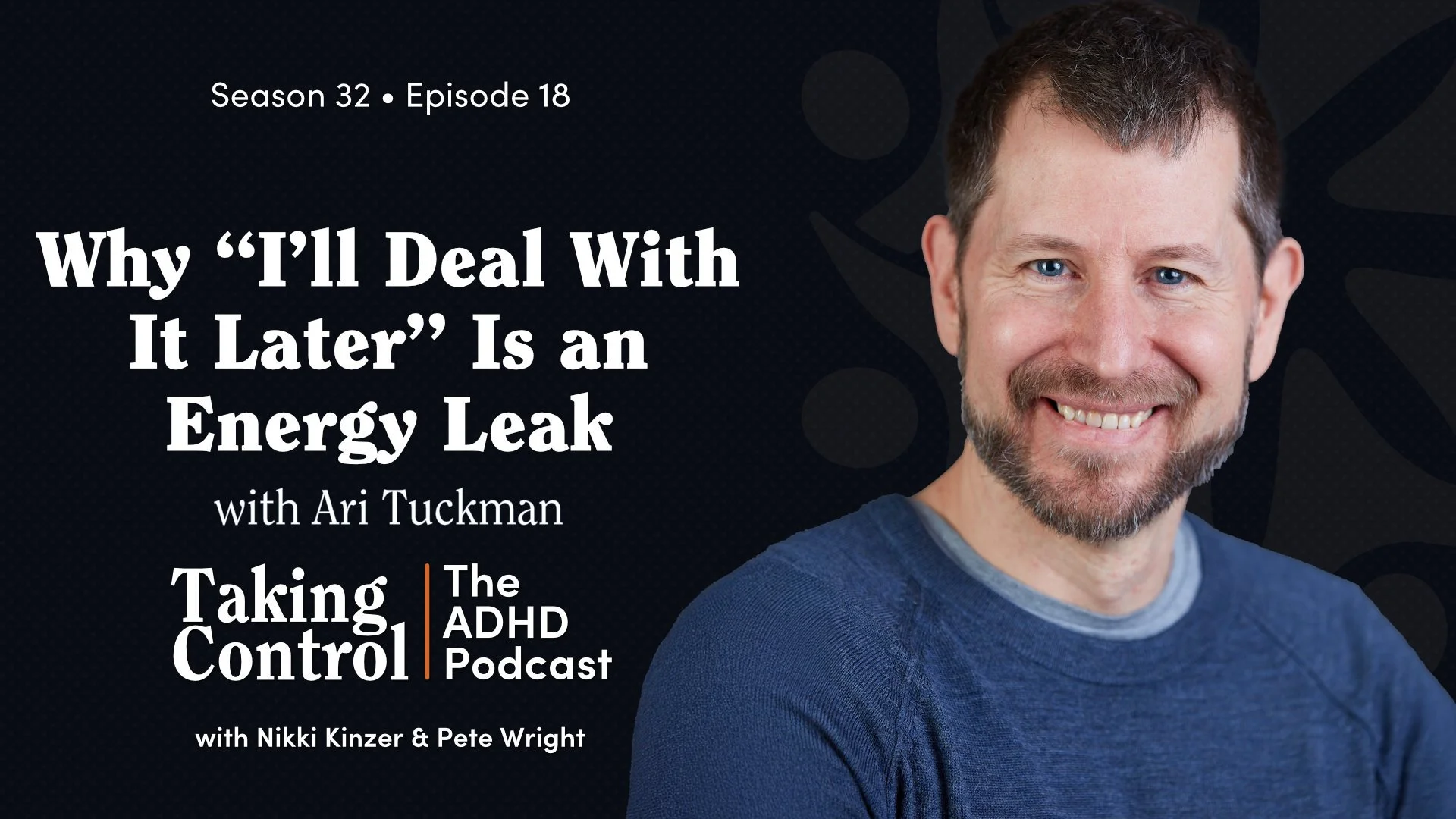
We've all said it. "I'll deal with it later." And somehow, later never comes. The thing just sits there — not in your calendar, but in your head. It pings you in the shower. It shows up right before you fall asleep. That's an energy leak.
This week, Ari Tuckman returns for his sixth appearance to unpack what's actually happening when we tell ourselves "later." What is the ADHD brain doing in that moment? Are we making a real decision, or just kicking the can? And how do we tell the difference?
We dig into:
The two flavors of procrastination — not feeling the future vs. avoiding the discomfort
Why "later" needs a "when," and what specificity actually changes
The difference between a task that needs doing and a decision that needs making
How to close an open loop that's been open way too long
Going toward positives vs. avoiding negatives, and why one of those is more sustainable
Time estimation, and why some things aren't knowable until you start
Ari's new book, the ADHD Productivity Manual
Guest Spotlight
Ari Tuckman, PsyD is a psychologist, author, and international presenter specializing in ADHD. He's given more than 600 presentations and podcast interviews across America and nine other countries, and is the author of four books: ADHD After Dark, Understand Your Brain, Get More Done, More Attention, Less Deficit, and Integrative Treatment for Adult ADHD. He chairs the CHADD Conference Committee. This is his sixth appearance on the show.
Links & Notes
Ari's website: https://drarituckman.com
Ari on Instagram: @AriTuckmanPsyD
Books by Ari Tuckman:
-
Pete Wright:
Hello, everybody, and welcome to Taking Control: The ADHD Podcast on TruStory FM. I'm Pete Wright, and I'm here with Nikki Kinzer.
Nikki Kinzer:
Hello, everyone. Hello, Pete Wright.
Pete Wright:
Do you forget? I noticed there was a lag before you said your line, and I wonder if vacation has caused you to forget your role here.
Nikki Kinzer:
You know, I'm just gonna deal with it later.
Pete Wright:
Okay, all right, so we're already gonna start teasing the topic.
Nikki Kinzer:
Yes.
Pete Wright:
I like it because that fits.
Nikki Kinzer:
Yes.
Pete Wright:
That's on brand.
Nikki Kinzer:
Yes.
Pete Wright:
We're talking about "I'll deal with it later." It's a mantra for the modern ADHD age and beyond. And we're gonna talk about why it's an energy leak and why it's kind of dangerous language to work into your own head canon.
And before we get into the show today, I want to tell you about our Patreon community. Because if you're a regular listener, this is your next move. Our Patreon members get early ad-free access to every episode, get access to the member-only channels in our Discord server, and a seat in the live stream so you can ask questions directly to us and our guests as we chat and as we record. Plus we throw in special bonus episodes throughout the year as well. But honestly, the thing I hear people talk about the most is about our community. It is an incredibly special place. It's an incredibly special group of people, all living with ADHD, all who show up for each other in a way that's pretty hard to describe. If you have ever wanted to be more than just a listener, if you've ever been more than listener-curious, this is where it happens. Visit patreon.com/theadhdpodcast to learn more and join us. And if you're not ready for that, no shame. Find us at takecontroladhd.com, connect with us on social, join the Discord for free, or sign up to the weekly email. We would love to have you wherever you land.
Our guest today is one of those folks we just can't keep from inviting back, for a very good reason. Ari Tuckman is a psychologist, author, and international presenter who's given more than 600 talks and podcast interviews around the world. He's author of some pretty important books in our field, including ADHD After Dark, Understand Your Brain Get More Done, More Attention Less Deficit, and the ADHD Productivity Manual. He's also the chair of the CHADD Conference Committee. And fun fact, this is his sixth appearance on this show. And if he turns in his punch card, he might get a smoothie at participating establishments. Ari Tuckman, welcome back.
Ari Tuckman:
It is always fun to hang out with you guys. Glad to be here.
Pete Wright:
We are thrilled to have you. About this topic — it seems like kind of anodyne language. Like, surely this can't be in any way offensive language to our ADHD sensibilities. It is utility language. "I'll deal with it later." It sounds like a commitment. It sounds like we're doing good work. And today we're here to talk about how maybe it's not. What do you hear when you hear people say that?
Ari Tuckman:
The thing of it is, like you said, "I'll deal with it later" might actually be a commitment, but it also could just be one of those sort of empty phrases — like "Hey, how are you doing?" "Fine, good, awesome." So maybe that's the first question. Is this actually a thing that, no, really, I'm actually gonna deal with this later? Or is this just sort of like we're kicking the can down the road, but don't want to admit, "I'm never gonna deal with this," or "The odds are against it," or "I have no plan, and I just hope the world ends before I have to deal with it."
So I think it's about really just sort of being honest with ourselves of, what are we really doing here? And I think it is okay — I think we should get this in early — it's okay to say, "I'm not going to deal with this." This is just, it ain't going to make the cut. It's not gonna happen. This is a thing I'm letting go. But that's a real decision as well. And cutting things loose without being crushed by guilt is an important skill as well.
Nikki Kinzer:
I agree, because I was thinking about this when we were first talking about the topic. I was thinking immediately, oh, this is procrastination and avoidance. But then at the same time, because I do so much work with planning, I recommend that people deal with things later too. You can't do it all today. And so we do have to make some decisions on what needs to be postponed. So there's two parts to this for sure.
Pete Wright:
There's an interesting thing though. If we step back one level, Ari, you said something that has me noodling — that it's the importance of specific language that we internalize as our own norms. Because if we equate "I'll deal with it later" as something like "How you doing?" then we now have a category of language that we say to ourselves, and we don't mean. And that seems to be potentially the more damaging part. Because sussing out what is, like — the alternative to "I'll deal with it later" is actually not "I'm not going to deal with this." The alternative to "I'll deal with it later" is effectively nothing. It's nothing words that have no alternative. We're just saying it so that we can move to the other side of it without having commitment problems.
Ari Tuckman:
Yeah, it's that stuff we tell ourselves that sort of feels a bit better in the moment, but it doesn't really actually do anything. And even to say "I don't know what's happening with this, I'll figure it out later" is actually okay to say if that's really what you're meaning. As in, this isn't making the cut right now of a thing that I'm actually going to figure out.
I think the red flag here is when it's either, in general, something you say to yourself too often, or at least on a specific kind of a task, it's always getting sort of pushed and pushed and pushed. And the issue is that it then continues to sort of hang over. That's the energy leak part. Emotionally, it feels bad. Cognitively, it sort of chews up bandwidth. It just takes too much space.
Pete Wright:
This is the big challenge. Because you end up with — you're saying something, "I'll deal with it later," but you're saying it in such a cavalier fashion that you don't recognize: you know what, that "deal with it later" list that I'm not actually paying attention to is stacking up.
Nikki Kinzer:
How is this affecting the ADHD brain more than somebody that doesn't have ADHD? How does ADHD come into this?
Ari Tuckman:
The way that ADHD makes it feel more — not uniquely different, but just more than any other random person — is the whole issue of sort of feeling the future. Here's something, there's maybe some deadline, there's some time element to it. Just not feeling that the pressure of that future deadline, the sort of consequences of that future deadline, until you get much closer to it. So whether it's that big English paper due in a week, or the thing for work, or taxes, or "We're having people over for a barbecue on Saturday at three" — just sort of feeling it early enough to then be activated by it, and to actually start doing some things to be ready.
So as a result, if you don't feel it early enough, then you get to kind of my unofficial slogan of ADHD time management: by the time you feel it, it's too late. As in, "Oh my God, people are going to be here in two hours, and I haven't even vacuumed or showered, let alone prepped any of the food." So when that push kicks in, it might be too late to do it, at least in a less stressful, more optimal kind of a way.
Pete Wright:
There's a funny word here. We say "later," and what you're describing is, in two hours — that is specific language. "Later" is nonspecific. It's one of the things I love when I snooze an email in my email app. I can snooze an email — I know I'm not gonna have to deal with it today, so I can hit snooze on it. And I know, because I've configured this in my settings, that when I snooze it to next week, it's 9 a.m. Monday morning. I'm gonna see it again 9 a.m. Monday morning. When I say the words "I'll do it later," I have no algorithm for that. It's just bleeding energy and activity. And the only way I feel it later is because I'm being burned by it.
Ari Tuckman:
When it shows up is when you're really feeling it, which may not be the most convenient time otherwise. So yeah, there is something to be said for specificity. As in, you know what, I'm gonna deal with this on Saturday. Or I'm going to deal with it after that meeting. Or I'm going to deal with it whenever. Things that are made specific are just much more likely to happen. And things that are left vague are much less likely to happen.
Nikki Kinzer:
What do you say to the person that really believes that the only way they can get things done is to wait until the last minute?
Ari Tuckman:
On the one hand, sure, yes. That is part of ADHD — feeling the pressure when you're much closer, and it makes it much easier to sort of activate and get the wheels spinning. And also, it's not a hundred percent true. It's not a thing where it's only possible to get stuff done at the very last minute.
So I use a bit of a both-hand on that. There's something to be said for planning to procrastinate. Meaning, "We're having people over at three o'clock on Saturday. So Saturday morning, I'm blocking that out. There's no soccer practice, there's no whatever. Once we get up on Saturday, we're just doing all this stuff." Or "I've got this big presentation for work on Tuesday. So on Monday, I'm blocking that time."
You're right — you can be using that procrastination in a good way, as long as you can actually protect the time. As long as you know that other things won't get crammed in there. And maybe also, as long as you have some predictability about how long it's going to take. Or at least you have an acceptance of the risk. If it doesn't work out, it's going to take me longer to prep for the meeting, but it's not the biggest deal if I'm not a hundred percent. That can be an effective strategy.
But if that isn't really an option, then you've got to find some other ways to sort of feel a bit of the pressure earlier, or to sort of break it down a little bit. So at least I'm going to start it. I'm going to start touching it. I'm going to start working on this a little bit. We'll see where it goes. Oh, look at that — sometimes I actually get going.
Nikki Kinzer:
Right. So believing that it isn't always true, that there are maybe some things that you can do without having to do it a week ahead of time. We're not asking to do something that feels impossible. But just something.
Ari Tuckman:
Yeah, and it's sometimes just these incremental changes that might make enough of a difference. Like you said, if I'm gonna get this done a week ahead, if that just feels like never a thing that's gonna happen — let's not set you up to fail. That doesn't actually move the ball at all. But is there a way to make it a little bit easier? Is there a way to make it less stressful? Are there other strategies or supports you can use to maybe at least get some of it done a bit earlier, so there is less of that mad-dash scramble at the end.
Pete Wright:
I want to go back to some of the emotional realities and the emotional dysregulation that comes from this stuff, because I imagine both of you see this in the people that you work with. They can't deal with the thing because they feel rotten when they think about it. And that of course perpetuates the both-and scenario you were talking about. But also, now they're living in this space of shame, making it harder and harder to come back to the thing that they know — if they could just accomplish it, they could actually move to the other side of it. For me, I call those the declogging tasks. They're clogging everything else. And as soon as I do them, there's a wave of stuff that gets done. Constant wave. But I am deeply curious how you coach and guide through that, so that we can break down clogging tasks more efficiently, more effectively, and with less cognitive crud. And you're sitting there nodding your head, and God, I hope that means you have a silver bullet answer.
Ari Tuckman:
What I was talking about before — feeling the future — that's more the sort of ADHD brand of procrastination. It's more about apathy, of not feeling the motivation enough. What you're talking about is a different kind of procrastination. Now, certainly having ADHD and not getting stuff done can add to this emotional part of it, but this is more about, rather than not enough feeling, not enough motivation, this is about too much. And it's too much uncomfortable feelings — shame, guilt, confusion, frustration. All that stuff that we all want to be like, ugh, no, no, no, stay away. So this is really more the avoidance side of procrastination.
The hard truth of it is, as much as our natural response is to go away from things that make us feel uncomfortable, this is really a "go towards the discomfort" kind of a moment. As in, I feel really bad about the fact that I haven't done this thing. And I just need to bite the bullet and do it. So some of it is accepting the discomfort, being okay with it, and just doing it anyway.
Some of it also — whether you're talking to someone else or someone's just talking to themselves — is talking down some of those negative feelings. Feeling really guilty about it: well, some guilt means you have a conscience. You're not a sociopath. That's good. But how guilty do you need to feel?
Nikki Kinzer:
Right.
Ari Tuckman:
Or how ashamed? Are you adding on these extra layers that maybe don't have to be there, but certainly aren't helpful? Or if you're feeling guilty, maybe we just sort of go towards the person and say, "Look, I know I was supposed to do this a couple weeks ago. I really feel like crap. I don't actually have any good reasons other than I've just been avoiding it because I feel so bad about it. So I know that has kind of screwed you up, or it's stressed you out, or whatever. I am really sorry. I'm just biting the bullet and I'm doing it. This is a thing I'm taking care of." Just addressing the social part of it, or whatever the impact is on somebody else, so that we can then take that away.
Most people, if you were to approach them about that, would actually be really good about it, and they would say, "I really appreciate it. Yeah, it really has been hard." Nobody's gonna get out the stick and hit you more. And if they are, then I don't know, maybe that's a bigger discussion.
Pete Wright:
No, I'm doing that myself.
Nikki Kinzer:
It's not the right environment. It's not the right person to be around, whether that's a boss or a friend or whatever.
Pete Wright:
As we're talking about this, I'm very called out with this whole conversation. Let me just say that this is very personal.
Ari Tuckman:
Right.
Pete Wright:
When I get in this state of avoidance, when I have stacked up the "I'll do it later," usually it's behind a clogging task. And I feel it so acutely in my intestinal tract. It comes up through my lungs to my chest. I feel like I sort of dissociate. I get so nervous and work myself up so much with the shame and the self-loathing and all of the negative self-talk, that I sort of step outside my body, and just look at myself and say, "That guy's not getting anything done. He is — just put a fork in him. He's useless right now."
Nikki Kinzer:
Well, because let's be honest, I'm over here hitting the stick on you harder and harder, saying, "Come on, Pete, come on."
Pete Wright:
Yeah, right, because you are a very harsh, harsh partner in this entire endeavor.
Nikki Kinzer:
No, I'm kidding.
Ari Tuckman:
Great, exactly.
Nikki Kinzer:
I'm that bad person. No, I'm kidding.
Pete Wright:
And this is coming from somebody who's been talking about this stuff for 17 years.
Nikki Kinzer:
Right.
Pete Wright:
It is a resonant and repetitive experience. And what you described is one of the key accommodations — having someone that you trust enough to be able to help you use the language of talking you down. The language of reality.
Ari Tuckman:
That's an important point. It's about reality. It's not simply saying nice things. Because the problem with just saying nice things is, if it doesn't really line up with reality, reality's gonna smack that down pretty quick.
So it's kind of one of those situations of: there's the situation itself — "I was supposed to get this thing to them two weeks ago and I haven't." But then there's all the added feelings, all the history, all the million other examples. Whether it's "I feel bad about myself because I didn't do it," or, if I'm the one waiting, "Here we go again, another thing I'm pissed at you for."
All these feelings get piled on top, but they're not necessarily from the specific situation. They're coming from somewhere else. So that might be some of the reality of sort of parsing that out, and putting some of that old guilt and the old anger and the old whatever over there. That's not a thing we can address right now. But what is the deal with this one specific situation? Maybe that feels a little bit more manageable.
Pete Wright:
Right. I always go back to that — what is fact and truth? Am I living in fact and truth? And generally when I feel that way, when I start feeling the anxiety rush up and the "I'll do it later" stack up, it's because I'm not living in fact and truth.
Ari Tuckman:
And there's a part of this as well — this really sort of came into focus for me in writing the new productivity book — that too much of managing ADHD, or whatever one circumstance of struggle is, too much of it winds up about avoiding the negatives. As in, ugh, I haven't done this thing. It's gonna suck to do it. Or, they're really mad at me. I hope they don't yell at me. Or, I sent my payment in late and now am I going to get a late fee. So too much is about avoiding the negatives, which is not especially motivating. I mean, it's kind of, but living under the axe is too stressful.
Rather, what is the positive? If I did have to apologize to you guys for, "Oh man, I'm sorry I didn't get that to you" — rather than simply "I don't want you to be mad at me," that's avoiding the negative. Maybe it's more like, "You know what, I want to show up in a better way in this relationship. I want to be able to be honest and direct. I want to be able to take responsibility for things, and hear the effect of my actions on others in a non-defensive way." That's going towards a positive. This is how I want to show up in this relationship or in these kinds of situations. And if I do that in a good enough kind of way, at least I can feel good about that.
Now, if you guys take it well, then that really reinforces it, and that's awesome. But frankly, if you guys were total jerks about it and you just piled on and you're like, "You're the worst, I can't believe, everybody else is better" — now that obviously doesn't feel as good. But I think it's also important to be clear: dropping the ball does not give someone else permission to just let it rip. And in that case, maybe it tells me more about you than about me. Now, that's not dodging responsibility. So it's making that honest assessment of, "Yes, I really should have addressed this earlier. I should have told you guys, I shouldn't have dodged your calls, blah, blah, blah. That part is mine. But the rest of it is yours."
So I can still maybe feel good about how I handled it, even if this whole thing ended in a big messy fight. It's being able to parse out all these pieces. Because there's a tendency, if you've had too many struggles over the years, to kind of be the one who's always the bad guy, or the one taking the blame, even for other people's bad behavior.
Pete Wright:
Well, that's a default stance as a people pleaser. I'll please people I don't even need to please, on behalf of other people. What's wrong with me?
Ari Tuckman:
Yeah.
Nikki Kinzer:
It's so interesting that we're talking about this, because my daughter — she's a young adult, she has ADHD — and we've been having a lot of conversations around this. What is her part in something? And what is the other person's part? Trying to get her to see that this isn't her problem, this is a problem on this other person. And being able to separate that — it's not all you. There's two people in this relationship. It's hard to understand when you're 20, and it's hard to understand when you're 50. When we start getting into those dynamics, for sure.
Pete Wright:
It's also a different skill. The primary skill associated with the "I'll deal with it later" syndrome — that's a thing — is learning the language of specificity, and reminding yourself that if you're gonna drop the "I'll deal with it later" bomb, it better be associated with specific outcomes and timelines, if you're not gonna just watch that list stack up. But dealing with the emotional response of others and your own internal cycles of shame is a different muscle.
Nikki Kinzer:
And I like how Ari is saying to look at the positive and not just the negative. Because I think that that's so much what happens — we're only looking at the shame and what we're feeling. But what about that energy leak? What happens when we do do it? What is the positive? That clogging task all of a sudden opens up everything else, and we can feel better.
Pete Wright:
Fear the stick, love the carrot.
Nikki Kinzer:
I mean—
Pete Wright:
I'd love to work towards something, and remind myself in the moment when I'm feeling at my lowest and my most fearful and anxious, that the feeling on the other side of the declog is great. Is aspirational.
Nikki Kinzer:
I'm gonna start saying that. We've got to look more at the positives. What is the positive of getting it done?
Pete Wright:
Good.
Nikki Kinzer:
Not just the negative of how it feels of not getting it done. It seems so simple, Ari.
Pete Wright:
It sure does.
Nikki Kinzer:
You should have been here a long time ago talking about this.
Ari Tuckman:
Yeah. My joke here is, I've never seen one of those inspirational posters with a kitten hanging off a branch that says, "Don't get in trouble."
Nikki Kinzer:
Right.
Pete Wright:
Or hanging off the branch and saying, "You should have done better."
Ari Tuckman:
Right, exactly.
Pete Wright:
"How did you let yourself get into this situation?"
Ari Tuckman:
Yeah.
Pete Wright:
They just get longer and longer.
Ari Tuckman:
"Why did you put yourself there?"
Nikki Kinzer:
Yeah.
Pete Wright:
"I'll bet you feel dumb now."
Ari Tuckman:
Right.
Pete Wright:
We should start a line of our own posters. It's all the same picture.
Nikki Kinzer:
The little squirrel.
Ari Tuckman:
Exactly.
Pete Wright:
Gangbusters.
Ari Tuckman:
Yeah.
Pete Wright:
What does it look like, when you're working with folks — if we go back to a little bit of the specificity around building this muscle — to actually put practices in place to help people close these open loops of shame? How do you help people figure out, "Today I'm talking to you and I'm struggling. Tomorrow's going to be different." How?
Ari Tuckman:
That is exactly it. Is there a real plan? Is there a real commitment to actually get it done? And like we've said, it is okay to make a decision that, "Look, I'm just not dealing with this. This is just not on my radar right now." But that's a real choice. Where we get in trouble is when we're half in and half out.
So, is this really a thing that's going to get done? Are you committed to doing it? If so, let's actually think about when it will actually get done. This could be a specific task — here's this thing I need to do, some meeting I have to prep for. Or it could be more of an ongoing thing — "I need to do my billing, or I gotta catch up on emails, or I need to do marketing." A repeating thing, every week you gotta do a certain amount of that.
Really being intentional about thinking, when is it actually gonna happen? Where in my schedule is it going to happen? And maybe even to block it out. This is sort of a thing I often recommend. You're almost making an appointment with yourself: this is a thing I'm gonna do, and here is specifically when I'm gonna do it.
And trying to be smart about when it is. Generally things earlier in the day are less likely to get bumped out by the day's events compared to things later in the day. Or thinking about, are there natural transition points? Ending this activity, then I'm gonna slide right into it — versus just randomly at 10 a.m. I'm gonna start it. But how do you even notice 10 a.m.? And thinking about what comes before it. If you've got a meeting that always runs late and there's always lots of action items, maybe you don't plan it after that, because you're stacking the deck against you. So it's a lot of that kind of stuff. The things that make it a little bit more likely to happen.
Pete Wright:
The elephant metaphor always comes back. Being able to see the whole elephant, being able to eat the whole elephant. You may not even know what the entire shape of your effort looks like in order to take the first step. You don't need to know the entire shape before you take the first step. That's really important.
Ari Tuckman:
Sometimes you can't.
Pete Wright:
Yeah.
Ari Tuckman:
The reason why you don't know it is because it is unknowable until you start it.
Nikki Kinzer:
We see that trap with trying to estimate time, because I get that question a lot. "I don't know how to estimate how long something's gonna take me." And the reality is, you may not know. You may never know, until you actually do the thing and see how long it takes you. And then a different day, it could have taken you a different amount of time. It is inconsistent. And it is hard to know. With that specific situation, you just have to keep showing up and keep putting it into your schedule until it is done.
Ari Tuckman:
And it also depends, when it comes to estimating. There are certain things that roughly take the same amount of time, because it's the same stuff. Think about my morning routine — I kind of do the same thing every morning. There's not a big swing on what I'm doing. So that one I can predict fairly accurately, plus or minus five or ten minutes. But then there's other activities that it's hard to predict because you don't know until you're there. It's not knowable. That could be a thing where, if I get lucky, it's an hour, but it could be like three or four, depending.
Nikki Kinzer:
Right.
Ari Tuckman:
Those are harder. That's the part that's sort of inherent to the task. But if you yourself, and your ability to stay on task, is also very variable, then even the predictable activities could feel like there's too big a range. Because if you wind up getting distracted and looking at your phone, or reading the New York Times, or whatever, in the morning routine, then it could take a lot longer. But not because the task itself took longer, but because of other things. So is it a variability you can do something about, or is it just inherent in the activity? And then not beating yourself up when it just — no, it was just bigger. I thought this was going to be easy, but it actually turned out it was many more steps than I could have known.
Pete Wright:
We're using "activity" sort of as an umbrella term, but I'm really curious — in your experience, what happens or what is the difference between folks who get wrapped up in decisions that have to be made versus things that have to be done? Is there a difference?
Ari Tuckman:
That is a really good point. That's an important nuance. Because making a decision is a different process than just doing the task. On the decision making, there's sort of a range. There are the people who are sort of impulsive and make decisions too quickly, with not enough information and consideration. And then there are other folks who are a bit more indecisive or perfectionistic, and they're always looking for more information, because they want to be able to make a decision with real clarity and no doubt. But lots of decisions in life don't have that objectivity. There's no objectively right answer and the rest are definitely wrong.
This is where we maybe get into a bit of ambivalence — part of me feels like this, but part of me feels like that, and I don't know. And some decisions just feel bad. They do. As in, this sucks. I really hate this. This is really the thing I need to do, but I'm not happy about it. Or, these are both good options and I really can't tell the difference. So I guess eeny, meeny, miny, moe, and I just gotta be okay with it.
That indecisiveness can spur a lot of either avoiding it — "I'll deal with it later because I don't want to take it on" — or, "I'm delaying the decision because I want to get more information," because I'm looking for a comfort with it that isn't to be found.
Nikki Kinzer:
All right, before we wrap up though, I do have a couple questions about your book, the most recent one — the productivity manual, the ADHD Productivity Manual. Who doesn't want that, Ari, really? Like, that is it. What have been some of the things that you've learned by readers — what have been their favorite takeaways, or something you could leave with our audience today, just to get them thinking about productivity and all of that?
Ari Tuckman:
I think it's just that the reason why productivity is hard, or feels hard, is because it is. We live in a distracting, messy world. We're always juggling way too many priorities and goals and hopes. So it is hard to get things done. In the book, I have 36 chapters addressing 36 different broad areas that impact our ability to get things done or not. Because there's a lot of things that go into, in each moment, am I doing this or not doing it?
The hope of the book is that I cover enough of these areas that it sort of puts those ideas in the back of your mind. So when you're in that situation, you can say, "Oh, this is what it is." If you have a project for work and you're not working on it — I could rattle off a bunch of reasons now. Maybe you just don't want to do it. Maybe you're scared of doing it wrong. Maybe your phone keeps pinging you, or Teams keeps pinging you and you're getting distracted. Maybe you have too many other things to do and you're not getting to it. Maybe you're not sleeping enough, so it's too hard to motivate yourself to work on it now. Maybe you're worried that you don't really understand the project, and you don't want to ask your boss for help because you already feel like you're on thin ice, so you're just avoiding dealing with it, and you don't know where to begin anyway. We could all sit here and rattle off 50 or 100 different reasons.
So the key then is to step back, to really sort of figure out: what is getting in the way? What do I need to smooth over a little bit? Or, what are my strengths and compensatory strategies that can sort of nudge me over the line here, to kind of get going on this thing?
That's the hope — that it gives readers this broader view of productivity and a deeper understanding of themselves, and all the nuances and interactions that influence what we do and what we decide moment to moment.
Pete Wright:
There's a defining, foundational statement that you just made that I'm going to be using again, Ari. The reason productivity feels hard is because it is. It is hard. And it's okay for us to acknowledge that. And there's nothing we can do that will maybe make it feel easy. It's just — it's like what our friend Dr. Dodson says: it's not your fault, but it is yours. Productivity is ours to deal with, and we can deal with it the best way that we can. And feeling is sometimes a choice. I love it. I love it. I love it.
Nikki Kinzer:
That's great.
Pete Wright:
Where do you want to send people to see your latest work? drarituckman.com.
Ari Tuckman:
Sure. That website is — I've condensed my other two websites into that one. So, drarituckman.com. And I'm also on Instagram at AriTuckmanPsyD. I've been putting some good stuff up there as well.
Pete Wright:
Love it. All the links in the show notes, including links directly to the books. Ari Tuckman, we so, so appreciate you being here, as always.
Ari Tuckman:
Always fun hanging out with you guys. Got number six in the can. Can't wait for number seven.
Pete Wright:
On our way to the smoking jacket.
Nikki Kinzer:
That's right.
Pete Wright:
On our way to the smoking jacket.
Ari Tuckman:
Yep.
Pete Wright:
We appreciate y'all for downloading and listening to this show. Thank you for your time and your attention. Don't forget, if you have something to contribute to the conversation, we are heading over to the Show Talk channel in our Discord server. You can join us right there by becoming a supporting member at the Deluxe Level or better — patreon.com/theadhdpodcast. On behalf of Nikki Kinzer and Ari Tuckman, I'm Pete Wright, and we will see you right back here next week on Taking Control: The ADHD Podcast.
Subscribe to Taking Control: The ADHD Podcast