What Changes About Executive Function After 40 with Dr. Brandy Callahan
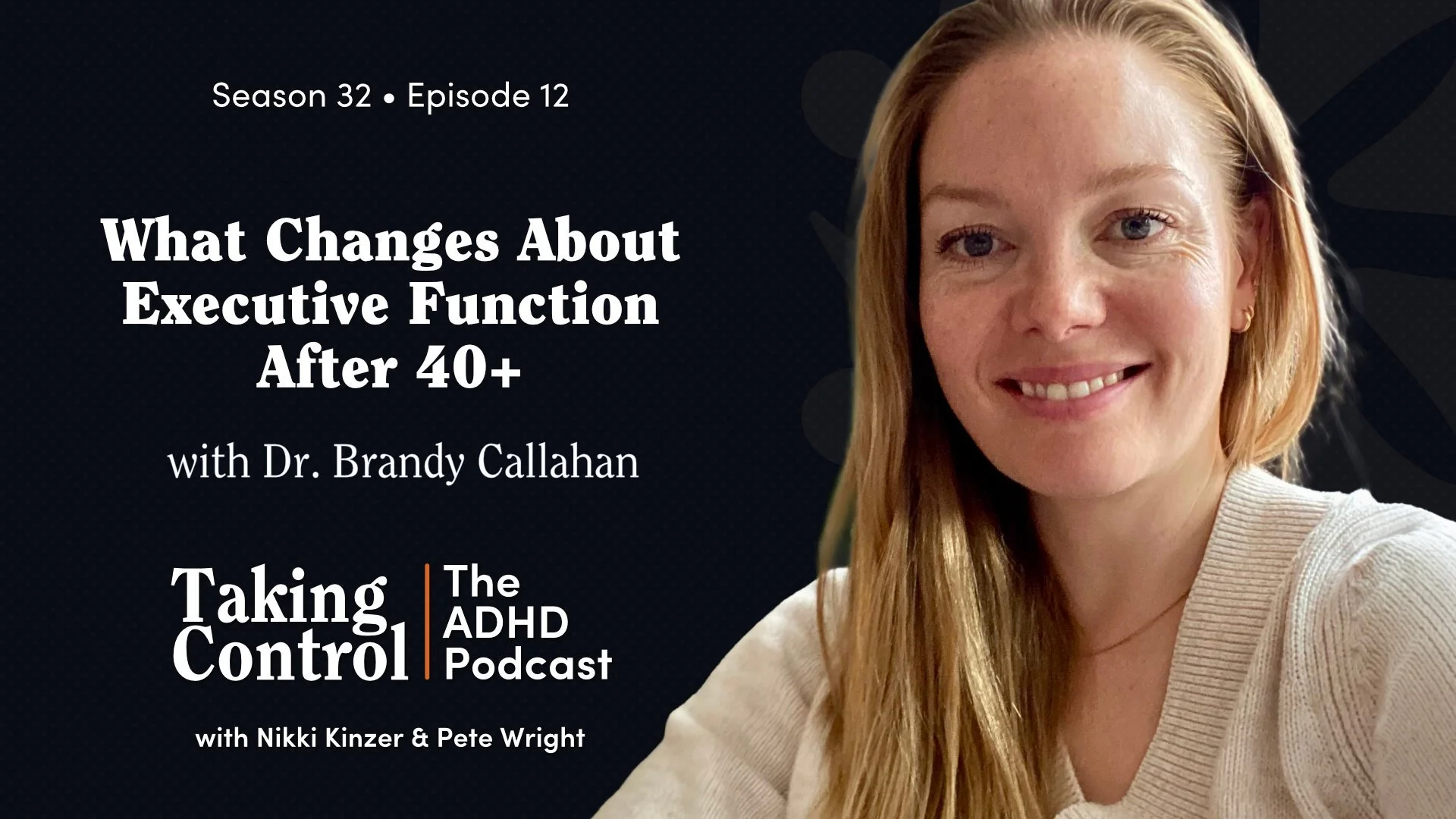
Here's something nobody tells you about aging with ADHD: the part that feels like decline might not be decline at all. It might be retirement. Or perimenopause. Or just the fact that the external structure that quietly managed your symptoms for thirty years finally disappeared — and nobody warned you it was doing that much work. The question isn't whether your brain is changing. It is. The question is whether you understand why, and what the research actually says about where it leads.
Dr. Brandy Callahan is a clinical neuropsychologist, Canada Research Chair in Adult Clinical Neuropsychology, and the founder of the LiBra Lab — the Lifespan Brain Health Lab at the University of Calgary. Her research sits at the intersection most researchers haven't bothered to explore: what happens to the ADHD brain across decades, and specifically, what connects ADHD to elevated dementia risk. What she's finding — about allostatic burden, about the gap between how people perform in a lab versus how they function in a grocery store on a Sunday afternoon, about what a lifetime of navigating a neurotypical world may actually cost the brain biologically — is the conversation this series has been building toward. There is hard news in here. There is also, genuinely, a lot of hope.
Guest Spotlight
Dr. Brandy Callahan, PhD, RPsych, is a clinical neuropsychologist, Associate Professor of Psychology at the University of Calgary, and a Canada Research Chair in Adult Clinical Neuropsychology. She is the founder and principal investigator of the LiBra Lab — the Lifespan Brain Health Lab — which focuses specifically on ADHD in women and in older adulthood, and she came to ADHD research not through personal experience but through a memory clinic, where she kept meeting older adults being evaluated for dementia who turned out to have lived their whole lives with undiagnosed ADHD. Her current research is investigating what may drive elevated dementia risk in adults with ADHD — including allostatic burden, cerebral small vessel disease, and the biological cost of decades of chronic stress. She is also currently running ADHD Her, an online study about girls and women with ADHD across the lifespan, open to participants from age 8 to 87. Learn more at libralab.ca, and find the ADHD Her study by searching "ADHD Her" online.
Links & Notes
-
Pete Wright:
Hello, everybody, and welcome to Taking Control: The ADHD Podcast on TruStory FM. I'm Pete Wright, and I'm here with Nikki Kinzer.
Nikki Kinzer:
Hello, everyone. Hello, Pete Wright.
Pete Wright:
Hi, Nikki. How are you?
Nikki Kinzer:
It's gonna get smarter.
Pete Wright:
It's gonna get smarter.
Nikki Kinzer:
I just know it.
Pete Wright:
Our guest is awesome and is sitting quietly because I haven't actually introduced her yet. And I'm going to say the one question I want her to answer — I'm going to say it because I know she'll want to answer it right away, because it's the only question I'm sure anybody ever asks: Is an ADHD brain squishier than a regular brain? Like, in your hand? I want to know the answer to that.
Dr. Brandy Callahan:
Maybe, yeah.
Pete Wright:
Nope, you can't answer yet. That was a test. I trolled you.
Dr. Brandy Callahan:
Oh no.
Pete Wright:
Okay. Here we go. I'm very excited to get to this conversation. We're talking about executive function as we age, continuing our series, and today we're talking brain stuff, and I'm very excited about it. But before we get into the show, I want to tell you about our Patreon community — because if you're a regular listener, this might just be your next stop. Members get early, ad-free access to every episode. They get access to member-only channels in our Discord server, and they get a seat in the live stream — you can join us and watch as we record, and you can ask questions of our guests at the end of the show. That's a member-only thing nobody else gets access to. Plus, we throw in special events along the way all the time. But honestly, the thing we hear people talk about most isn't any of that — it's the community itself. This is a group of real, amazing people, all living with ADHD, who show up for each other in a way that is pretty hard to describe and find anywhere else. If you have ever wanted to be more than just a listener, this is where it happens. Visit patreon.com/theadhdpodcast to learn more and join us. And if you're not ready to do any of the joining yet, that's just fine. You can find us at takecontroladhd.com, connect with us on socials, join us in the free part of our Discord, or sign up for the weekly email. We would love to have you wherever you land.
Our guest is Dr. Brandy Callahan, a clinical neuropsychologist, Associate Professor of Psychology at the University of Calgary, and a Canada Research Chair in Adult Clinical Neuropsychology. She's founder and principal investigator of the LiBra Lab — the Lifespan Brain Health Lab — which focuses specifically on ADHD in women and in older adulthood. Her current research is investigating the mechanisms that may drive elevated dementia risk in adults with ADHD, including the role of brain health, physiological stress, and what a lifetime of navigating this kind of brain may actually cost us biologically. She is the person who's trying to answer the question this series has been building toward. Dr. Callahan, welcome to The ADHD Podcast. You may now answer the squishy brain question.
Dr. Brandy Callahan:
Thank you so much for having me. Yeah, I like to imagine that an ADHD brain is maybe squishier than a regular brain. I don't know — what do you think?
Pete Wright:
I love that. Oh my gosh. I imagine it just bouncing around up there. Who even knows. We are so glad you are here today. First of all, let's talk a little bit about the LiBra Lab. This is explicitly about brain health across time — yes? Not just a clinical snapshot.
Dr. Brandy Callahan:
Yeah, so the idea of the LiBra Lab — the Lifespan Brain Health Lab — is to try to understand basically how brains age. I'm a geriatric neuropsychologist. I'm interested in how people experience brain aging, both normally and also looking at things like dementia. But to understand how people develop dementia, how they experience aging, you sort of have to look at the rest of their life — what's happened to them in their 20s and 30s and 40s. That's exactly what we do. We look at how lifespan factors impact how people age. And for the last nine or ten years I've been focusing specifically on ADHD — although my background is not in ADHD. My background is in dementia research. How I got interested in ADHD is that I was working at a place that had an affiliated memory clinic, and people were being referred to that clinic for dementia workups because they were experiencing cognitive changes they were worried were dementia. We started asking them to describe the history of these changes, and through the clinical interview, we realized a lot of these changes had been around for a long time — their whole life. We realized that a lot of these people had undiagnosed ADHD.
Pete Wright:
Oh no.
Dr. Brandy Callahan:
And so at that time I became really interested in the question of: what do we actually know about people who used to be kids with ADHD and now are 50- and 60-year-olds with ADHD? I realized there's almost no information out there. So that became my passion project, and it's become my career.
Pete Wright:
You don't have ADHD yourself, right?
Dr. Brandy Callahan:
Not that I know of.
Pete Wright:
Just a fan. Okay.
Dr. Brandy Callahan:
Just a fan.
Nikki Kinzer:
I'm that fan too, yeah.
Pete Wright:
I just want to make sure I know who I'm talking to. I'm living with the ADHD, you two are fans — okay, this is very telling. Plain English: we talk to a lot of psychiatrists, psychologists, and practicing therapists. What does a neuropsychologist actually do day to day?
Dr. Brandy Callahan:
Good question. Neuropsychology is a sub-specialty of clinical psychology. I followed the same clinical psychology training as a regular psychologist, but the "neuro" piece means I did some additional training in cognitive testing and brain-behavior relationships. What a neuropsychologist does day-to-day is try to use — usually pen and paper — tests to understand what is going on in the brain, because we know that certain performance on specific kinds of tests should reflect activity and functioning in specific brain areas. A clinical neuropsychologist will spend usually a few hours with a client administering various tests and try to understand from that performance where the person is experiencing weaknesses and what their strengths are.
A neuropsychological assessment is usually performed when there's some suspicion of some sort of brain abnormality. In my experience, it's usually been older people who are worried they may be in the beginning stages of dementia — they'll come in and we'll do testing to determine that. But you might also undergo a neuropsychological assessment if you've had a concussion, if you've been having strange symptoms and your doctor suspects something neurodegenerative, or for a number of other reasons.
Pete Wright:
Okay. So it seems like, as we're aging, where those blips in our cognitive performance are going to show up will be in a place that ADHDers live — which is in executive functioning. I'm making some assumptions there, but that's my understanding.
Dr. Brandy Callahan:
That is a correct assumption, yes.
Pete Wright:
Good — nailing it. We also know that executive function is not just one thing: it's working memory — we've talked about memory with Dr. Daniella Karidi — inhibitory control, cognitive flexibility, being able to juggle a lot of things. From your perspective, how do these elements of executive function age differently from one another, or do they?
Dr. Brandy Callahan:
Processing speed — and I don't know if I would actually call this an executive function, but it's controlled by some of the same brain substrates as executive function, specifically the frontal lobes — is where we see the most notable declines with age. People just generally get slower at thinking and doing things, and that's pretty normal. We also see things like multitasking and controlling attention decline. People may become a little more distracted as they get older, or have difficulty doing two things at once or switching from one task to another.
But really what we see in healthy aging is that if you give people enough time, they're usually just as accurate as when they were young. So it's a trade-off of speed and accuracy, where accuracy remains the same as long as you give people more time. Whereas when we're young, we can usually be pretty accurate and pretty fast.
Pete Wright:
That's really hopeful to me. Because what it says — assuming we're not dealing with a neurodegenerative condition — is that ADHD symptoms aren't necessarily changing. I already have systems in place to help with my ADHD symptoms, and those systems should continue to function.
Dr. Brandy Callahan:
Yeah. As a rule of thumb, if you're kind to yourself and you continue using those strategies and mechanisms, and give yourself the time and space to carry out whatever you're trying to do — the evidence we do have suggests that in normal aging, ADHD symptoms themselves shouldn't really get worse. Although you mentioned something really interesting, which is that strategies and coping mechanisms can change as we get older, by virtue of the fact that our environment is changing.
One example: how I became interested in ADHD was older adults being referred for dementia workups. One of the things we were hearing a lot was, "Yes, I've had some of these problems for a long time, but I noticed it got a lot worse when I retired." When you're in a job with clear expectations, you're held accountable to someone, you have a schedule, built-in mechanisms to ensure you're getting things done — you have to meet deadlines, you don't want to get fired. When those structures fall away after retirement, that can lead to changes in ADHD symptoms. They may pop up where they weren't popping up before, if that makes sense.
Nikki Kinzer:
Definitely. Because it feels like when you're really busy, you're able to figure out how to fit in the things you have to. But when you have a full open day, you don't really know what to do.
Dr. Brandy Callahan:
Yeah, exactly right.
Pete Wright:
My distraction will fill available hours.
Dr. Brandy Callahan:
Exactly right.
Pete Wright:
For sure. Which is why it sounds misleading to say "my ADHD is getting worse as I age." I have said this — I hit my fifties and thought, well, here it is, my ADHD is getting worse. But "I'm just getting older and changing" sounds like the more apt description of my day-to-day experience.
Dr. Brandy Callahan:
Yeah, I would agree with that. That reminds me — I was at a community event a few years ago, at a booth talking about our research, and an older woman came up to me in a frustrated tone and said, "I can't do any of the things I used to do when I was younger. I'm having trouble remembering things. I'm always forgetting my words." I thought I was being reassuring when I said, "Oh, that's just normal — that's normal aging." And she looked at me with daggers in her eyes and said, "I don't care if it's normal. It's difficult. It sucks and I hate it." And that was really a poignant moment for me, because she was right. Getting older, things change in a very normal way. But just because it's normal doesn't mean it's fun.
Pete Wright:
We have a regular guest, Dr. Dodge Rea — therapist out of Nashville — and he has this thing he says: it's not your fault, but it is yours. None of this is your fault, but it is yours to live with. And once that layer of acceptance is applied to whatever the emergence of our conditions looks like as we age, I think it becomes easier to acknowledge: this is my reality, it's different from when I was 20, and that's okay.
Dr. Brandy Callahan:
Yeah.
Pete Wright:
So let's chart the decades. You said we don't know very much, but we do know some things. What does the research actually look like for executive function trajectories in adults with ADHD across the 40s, 50s, 60s, and onward?
Dr. Brandy Callahan:
I don't know if I can answer that question with evidence, because there have been only a small handful of studies measuring cognitive functioning — including executive functions — in people with ADHD over the age of 40. In that small handful of studies, a lot of them were my own. And even those were limited in some important ways. We're redesigning the studies, trying to get better at how we do them. But we don't really have a lot of information.
Most of the scientific literature that has been published about age-related outcomes linked to ADHD has not actually measured cognition. These have mostly been population register studies — basically looking at people's medical records. If a person has a diagnosis of ADHD recorded in their chart, what other health conditions do they have? What are they likely to develop as they age? So we do know there is some emerging evidence — still very new, but seemingly pretty robust — that ADHD is a risk factor for some poor aging outcomes. We talked about dementia: these population register studies suggest that a person with a diagnosis of ADHD, followed over time, is more likely than people without an ADHD diagnosis to have a subsequent diagnosis of dementia in their medical chart. But again, we don't have any measurements of cognitive outcomes per se, so it's hard to say more than that.
I'll say one important thing specifically about ADHD: the executive difficulties that people with ADHD report to us very clearly do not align well with the measurements of executive function we collect in the lab.
Pete Wright:
Say what now?
Dr. Brandy Callahan:
Yes — it seems paradoxical, but I think it makes sense when you think about what ADHD is and what our tests measure. People with ADHD will tell me, "I'm a terrible planner, I'm so disorganized, I can't keep track of anything, I start one thing and lose track of another." What it sounds like they're describing is difficulty multitasking, difficulty planning, difficulty with organization. When we bring them into the lab and administer neuropsychological tests that are supposed to measure those things — a lot of our participants do fine. And this is not just in my lab. This is a very well-documented phenomenon in the ADHD literature, in kids, young adults, and older adults.
When you think about what cognitive testing is: we bring people into a quiet room, with no distractions, a novel test that's pretty interesting, clear instructions. They do fine.
Pete Wright:
But there's no world there, right?
Dr. Brandy Callahan:
Exactly. It's not the real world. So when I try to answer what executive functions look like as people get older with ADHD — in most of our studies, the answer is: fine. In almost all of the studies I have run personally, I can't see any measurable executive deficits on the group level. There is quite a bit of individual variability — some people are doing a lot better or worse than others — but on average, most of the research that I have done and am aware of does not show measurable deficits in executive function in adults with ADHD.
Pete Wright:
Have you considered actually holding the tests in a grocery store — aisle five, Sunday afternoon around 3:30?
Dr. Brandy Callahan:
In my research studies we give feedback to our participants after the testing. And a lot of them have gotten quite frustrated when I say, "Good news, actually — clean bill of cognitive health."
Pete Wright:
Oh, yeah.
Dr. Brandy Callahan:
And they say, "What do you mean, clean bill of cognitive health? I am struggling, lady."
Pete Wright:
Right.
Dr. Brandy Callahan:
I don't think what we're seeing on our tests means that people with ADHD don't have executive difficulties — I don't think that's true at all. I just think the tests we have measure your optimal performance under optimal conditions. And that's actually good news — that under optimal conditions, things can go well.
Nikki Kinzer:
You're able to perform, right?
Dr. Brandy Callahan:
Yeah.
Pete Wright:
At least it's illustrative that I could create optimal conditions at my house sometimes and be better at stuff. Nikki, go ahead.
Nikki Kinzer:
I have a question around emotional dysregulation in ADHD, because I think sometimes you may be able to do the executive function, but you feel horrible doing it. And that's part of the shame cycle we see with so many ADHDers. From my understanding, the emotional piece doesn't get studied either.
Dr. Brandy Callahan:
No — and that's something I've become really interested in recently. That's something our group will be looking at. But you're right that studies of cognition usually look at cognition and not a lot else. I think there are lots of experiences that are maybe not unique to ADHD but are definitely a part of it that we're not doing a great job of measuring. You had an episode recently on masking — that's something where you can maybe do a thing, but the energy it takes, the cognitive and emotional resources you need to put in to appear like you're able to do the thing that everyone else does so much more easily — that hasn't gotten a lot of research attention.
Pete Wright:
I'm so glad you're here because it gives me an excuse to use some big words I don't really know what they mean. One of the things that stuck out to me in your research is allostatic burden — not because that phrase means anything to me on its own, but my understanding is that it's saying a lifetime of neurological stress may accumulate as a non-trivial biological cost. Is that a fair assessment?
Dr. Brandy Callahan:
That is a fair assessment, and that's something we're looking at right now — we're just wrapping up a research study looking at exactly that. Allostatic load refers to basically the cumulative wear and tear on your physical body from exposure to chronic stress.
Pete Wright:
And doesn't that define the kind of generalized stress that people living with ADHD have in their lives almost all the time? Which is exactly why Nikki's question is so important to me.
Dr. Brandy Callahan:
Well, that's exactly why we're looking at allostatic burden as a marker of interest in ADHD — to my knowledge, it's not been studied before. Something we were seeing in one of my previous research studies is that — and I'm hesitant to put too much weight on this because we're having some trouble replicating the finding, though other groups have shown it as well — it seems like a little bit of brain pathology, age-related brain damage, in ADHD has much more devastating consequences than to a non-ADHD brain. In other words, there seems to be something about the ADHD brain that makes it more vulnerable to certain types of age-related brain pathology.
My hypothesis — which is why we're studying allostatic load — is that maybe the ADHD brain is more vulnerable to age-related changes because of chronic exposure to stress. This idea comes from the fact that navigating a neurotypical world with a neurodivergent brain is really hard. There's a lot of stress that comes with masking, with having to work harder than other people to do the same job. And as a group, people with ADHD are exposed to all kinds of other stressors: more financial stress, more job instability, more relationship stress. We're basically exploring the idea that maybe living with ADHD for six or seven decades — these are the people we're studying, who are older and who've been living with ADHD for many decades — maybe six decades of stress from being a neurodivergent person in a neurotypical world is making your brain more vulnerable to certain brain changes.
Pete Wright:
How does the duration of living with ADHD — and compensating for so long — confound the cognitive testing? You dropped masking on us, so I have to probe that. People who've been masking for so long may not be amenable to capturing what's actually happening in daily life, right? What kind of assessment captures through to what someone in habituated chronic stress just feels like Monday — that's just life?
Dr. Brandy Callahan:
Are you talking about how we measure the stress?
Pete Wright:
Yeah, how do you study that stress when people may not even notice it anymore — just the dysfunction?
Dr. Brandy Callahan:
We're measuring biological markers of stress. We're collecting people's blood, taking samples of their hair to look at cortisol. We have blood markers of inflammation, metabolic indicators, and things like that. But you're right — people may not realize they're stressed because that's their baseline.
Pete Wright:
I know day to day I'm an unreliable narrator about my own condition. I'm not a good documentarian of my own experience.
Dr. Brandy Callahan:
Yeah. That's why in my research group we feel strongly that we need to complement people's self-report of their experience with more quantifiable measures of what's going on in their body.
Pete Wright:
So someone's in their 40s, maybe 50s. Is there a case for establishing a neuropsychological baseline to understand where you're starting as you age?
Dr. Brandy Callahan:
Forties and fifties is a tricky time, actually, because particularly for women, there's a lot going on — and that's something my group is really interested in right now. That transitional hormonal period of perimenopause leading into menopause, where there's a lot happening. There's emerging evidence — and it's a very hot topic in ADHD right now — about how menopause impacts ADHD-related outcomes. Some emerging evidence suggests that women with ADHD may experience exacerbated menopause symptoms relative to women without ADHD: more brain fog, more emotional dysregulation.
Nikki Kinzer:
And can I just say to those people: I am so sorry.
Dr. Brandy Callahan:
Yes — same. It's not fun.
Nikki Kinzer:
No, and like you said earlier, you can normalize it all you want, but it's still not fun.
Dr. Brandy Callahan:
Yeah. And it's tricky because — we started this conversation talking about executive functioning, and one of the most important neurotransmitters in the brain that supports executive functioning is dopamine. Dopamine and estrogen work really closely together: estrogen enhances the efficacy of dopamine. More estrogen, more dopamine, clearer thinking, better mood. So I think it makes a lot of sense that perimenopause or hormonal transition periods could be more difficult for women with ADHD, because we know that dopamine signaling is already abnormal in ADHD. There is already abnormal dopamine signaling impacting emotional dysregulation and cognition at ADHD's core. Then you add in declining estrogen, and dopamine is even less able to support cognition and mood. So it can be a tough time for women with ADHD.
Putting that aside — for people in their 40s, 50s, and 60s with ADHD, I think recognizing that aging is happening — it's not your fault, but it's yours — is important. Being kind to yourself, allowing more time and space to get things done, and managing your expectations about what things should look like or what you should be accomplishing. Also being open to shifting strategies: becoming perimenopausal, transitioning through retirement — those things happening in the periphery of an already-ADHD life can change the effectiveness of previous coping strategies and require shifting gears and trying something new.
Talking to your doctor about a neuropsychological assessment is most warranted if you are worried about your cognition. As I said, many people with ADHD will do fine on a neuropsychological test — so cognitive testing isn't necessarily very informative about your ADHD per se. But if you're worried that something else might be going on — if you feel like your memory, for example, is worse than people of a similar age, or worse than you think it should be — then it's always a good idea to talk to your doctor about those concerns, and they can do some screening. The usual first step is asking your family doctor, who will do a screening test to gauge whether there's any indication of weakness. If the screening suggests there may be some weaknesses, then usually you're referred for a full neuropsychological assessment.
Nikki Kinzer:
I think that's really great advice, because especially when you're in your 40s and 50s, you can go to worst-case scenario. But I know for me personally, once I got my blood work done and my doctor said, "This is what's going on" — it all started to make sense. We went through how to treat it, knowing it wasn't dementia, knowing it was perimenopause, the hormonal shift. Knowledge — just understanding what's happening to your body — makes such a difference. Knowing you're not going crazy, that there are reasons for it.
Dr. Brandy Callahan:
Absolutely. And a really good rule of thumb to protect your brain health as you get older, with or without ADHD: whatever's good for your heart health is good for your brain health. Managing hypertension, diabetes, high cholesterol — making sure those things are well controlled. Getting enough sleep, good exercise, eating healthy. What feeds your brain is your heart — your heart pumps oxygenated blood to your brain, and if you don't have a healthy heart, you don't have a healthy brain. A lot of very good quality research supports that taking care of your heart health is the best way to support brain health.
Pete Wright:
I think that's such great advice, because my next question was going to be: do you ever have good news for people? It seems like there's a lot of going down. When you look at the people who are most successful in mitigating the experience of decline in their executive functioning, in their lives with their brain — what are those things?
Dr. Brandy Callahan:
Research also supports being mentally active. This could mean crossword puzzles and sudoku — that's typically what people think of when they think of keeping the brain active — but it could be learning how to knit, going salsa dancing, learning new steps, learning a new language, learning anything new. Exposing yourself to new things and getting outside your comfort zone is generally thought to be pretty good.
And I'll say this is totally anecdotal — there might be research to support it, but I don't know of it — but I've worked with a lot of older people, and the ones who are very successfully aging have a totally different way of thinking about aging. To them, an older person is not some decrepit, frail, white-haired figure — they see aging as an opportunity for growth, an opportunity for flourishing. My own grandmother is a perfect example. She's 95 or 96, and up until relatively recently she was volunteering as a caregiver to what she called "an old person" who was 20 years younger than her. She'd say, "Oh yeah, gotta go help out my old man" — and he was literally 15 or 20 years younger than her. She just sees herself as someone who's young at heart, who can still learn new things and says yes to lots of new things. Having a positive outlook on aging, seeing it as an opportunity for lifelong growth — I think that's really something.
Nikki Kinzer:
It's a blessing. That's what I think of every time I have a birthday — I'm glad I'm here. There are other people who don't get to this birthday. And the positive mindset, looking for the joy —
Pete Wright:
One of the things that came up in our conversation last week with Dr. Kathleen Nadeau was that fifty years ago, we were taught you were born with all the brain cells you could ever possibly have, and it's just a long, slow decline from there. And I love that you're cementing this: flourishing isn't just psychosocial — it's physiological. There's an opportunity to make your brain more squishy, if you just keep engaging in new things. I hadn't considered that. I think my inner assumption has been that it's all downhill from here, even though I'd like not to present that way. I like being challenged on that.
Dr. Brandy Callahan:
Yeah. Processing speed is downhill — you will get slower. But there are lots of things that stay really strong, and some things that can even improve with age. Vocabulary and semantic knowledge, for example, even improve with age.
Pete Wright:
Love it.
Nikki Kinzer:
Thank you so much. And thank you for the work that you do — there's obviously a gap. So many researchers are doing so much with kids and ADHD, and we're clearly not doing enough for the 40-plus. I appreciate what you're doing. Thank you for being here and sharing your knowledge.
Dr. Brandy Callahan:
Thanks so much. This was a great discussion, and I'm glad we're talking about these things.
Pete Wright:
Where do you want to point people who want to learn more about your work?
Dr. Brandy Callahan:
You can visit our lab website, which is libralab.ca — all one word, L-I-B-R-A-L-A-B dot C-A. You can find out more about the work that we do. We also have a participant registry — a pool of people you can join who wish to be notified about new research we're doing. Most of the people in my registry are in the Calgary area, so they get invited to all the studies we run — but we do have some online studies. One we're running right now is called ADHD Her, H-E-R. It's a study about girls and women with ADHD across the lifespan, recruiting anyone over the age of eight — girls from eight all the way to our oldest participant, who is 87. If you want to participate in the ADHD Her study, just Google "ADHD Her" and it's one of the first things that comes up. It's a survey study, online. That's where you can learn more about me and my research, and I'm happy to connect with anyone who wants to connect with me.
Pete Wright:
Outstanding. Thank you so much. Links in the show notes, everybody. And we do have some famed and favorite Canadian members in our community who will undoubtedly be looking you up. So thank you. Thank you so much. We appreciate everyone for downloading and listening to the show. Thank you for your time and your attention. Don't forget — if you have something to contribute to the conversation, head over to the Show Talk channel in the Discord server. You can join us right there by becoming a supporting member at the deluxe level or better at patreon.com/theadhdpodcast. On behalf of Nikki Kinzer and Dr. Brandy Callahan, I'm Pete Wright, and we'll see you right back here next week on Taking Control: The ADHD Podcast.
Subscribe to Taking Control: The ADHD Podcast