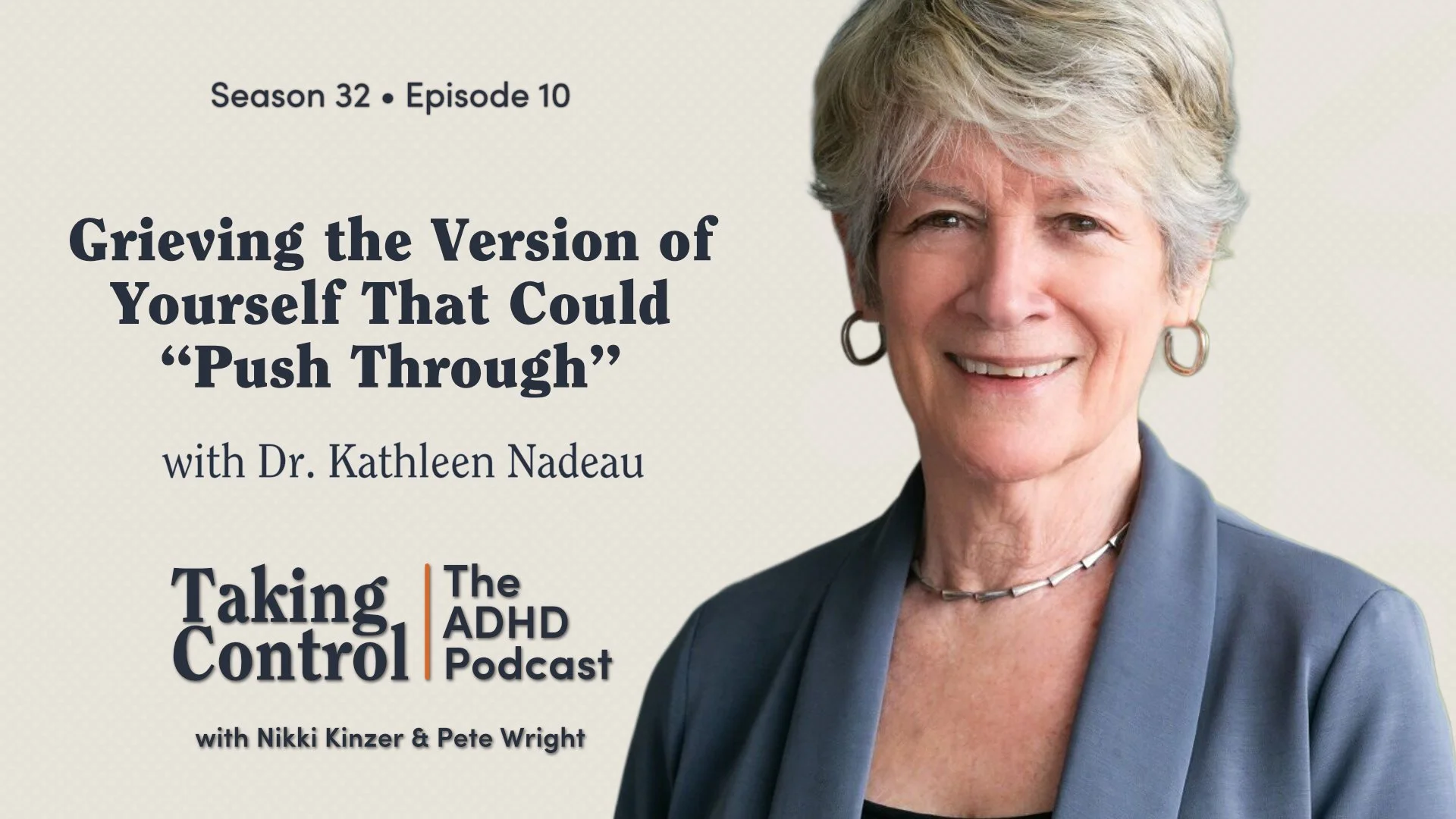
What happens to your sense of self when the coping strategies you've relied on your whole life start to give out? For a lot of us, "pushing through" wasn't just a strategy, it was the story we told ourselves about why we kept making it. And when that story stops being true, what we're left with can look a lot like grief.
Dr. Kathleen Nadeau has spent decades sitting with people in that moment. She's interviewed 150 older adults with ADHD about what the losses actually feel like — the unmet retirement fantasies, the disorientation of late diagnosis, the particular sting of watching younger generations get the support that was never offered to them. She knows what keeps people stuck. And she has a lot to say about what's possible on the other side.
This is the second episode of our ADHD and Aging series, and it goes somewhere we didn't fully anticipate. Kathleen pushes back on the idea that aging with ADHD is mostly a story of subtraction. She makes the case, grounded in decades of research, that our brains are more malleable than we've been told, and that the real question is never "how do I push through this" but "where do I need to plant myself."
Links & Notes
-
Pete Wright:
Hello, everybody, and welcome to Taking Control: The ADHD Podcast on TruStory FM. I'm Pete Wright, and I'm here with Nikki Kinzer.
Nikki Kinzer:
Hello, everyone. Hello, Pete Wright.
Pete Wright:
Oh, Nikki, get ready.
Nikki Kinzer:
I know.
Pete Wright:
Get ready.
Nikki Kinzer:
Going to be a good one.
Pete Wright:
I know. I'm so excited about this conversation. It's the second episode in this series we're doing this year again on ADHD and aging, physiology, brain, and memory. And last week we opened up the conversation with memory. And I think this week's conversation is going to dig us into something deeper, and I'm very excited about it.
Before we get into today's show, I want to tell you about our Patreon community — because if you're a regular listener, this might just be your next move. Members of our Patreon get early, ad-free access to every episode, access to member-only channels in our Discord community, and a seat at the live stream recording of the show where you can ask questions directly to our guests in the chat as we record. Plus, we're always throwing in special events along the way.
Honestly, the thing I hear people talk about most isn't really any of that — it's the community itself. It's a group of real people, all living with ADHD, who show up for each other in a way that's pretty hard to find anywhere else. If you've ever wanted to be more than just a listener, this is where it happens. Visit patreon.com/theadhdpodcast to learn more and join the community.
And if you're not ready for that yet, that's fine too. Find us at takecontroladhd.com, connect with us on the socials, join us in our public Discord community, or sign up for the weekly email. We'd love to have you wherever you land.
This week, as I said, it's a continuation of the conversation we started last week. And we're going to dig into the emotional territory that doesn't always get named: what happens to your sense of self when the coping strategies you've relied on your whole life start to give out?
To help us navigate that, we're welcoming back one of our true ADHD pioneers. Dr. Kathleen Nadeau is a clinical psychologist who spent decades at the forefront of ADHD research and advocacy. She's published many books on ADHD, was inducted into the CHADD Hall of Fame for her groundbreaking work on women and girls with ADHD, and lectures internationally on a solution-focused, integrative approach to life with ADHD. Kathleen has founded a nonprofit, ILAT — the Institute for Lifespan ADHD Training — and we cannot wait to hear more about that. And of course, she's the author of Still Distracted After All These Years, which is the book we come back to many times on this show.
Kathleen, welcome back to The ADHD Podcast.
Kathleen Nadeau:
Oh, it's my pleasure. It's always fun to talk with you.
Pete Wright:
I think where we stand right now, as we talk about ADHD and aging — after this conversation about memory and what happens in our brains as we age, and what happens to our ADHD as we age — introduces this conversation for me that is so much about identity. What happens when we start to have to investigate a changing sense of self?
We used to feel competent in managing our ADHD, our scaffold that helps us support it. We told ourselves this story that we were capable of pushing through anything because we'd gotten good at our accommodations — maybe. And I'm interested in your experience with folks who have to address that changing identity narrative as they age. Where do you start in that conversation?
Kathleen Nadeau:
I start with reality, and that is that it's nothing unique to those of us with ADHD. We go through a long, slow series of losses as we age.
I remember an English teacher trying to teach kids how to write poetry, and the prompt — which I thought was wonderful — was "I used to blank, but now I blank." That was to get kids to be more self-aware and to think about their growth and what they are learning to do that they weren't able to do a while back. But I think the same thing applies to us as we age.
I will be eighty years old on my next birthday. And there's lots of "I used to." I used to ride a bicycle forty miles. Now I don't. I used to sail a sailboat great long distances and have adventures. Now I don't. And what I've always talked to clients and friends about — all my friends around me are aging too — is that we need to engage in addition to counteract the inevitable subtraction.
Our hearing is less good, our sense of balance is less good, our eyesight is less good. And of course everyone jokes about having senior moments. In many ways our brains don't function the same way they did. And that's not unique to ADHD at all. But then you add this extra layer of challenge when you've got ADHD.
And what I try to explain to people is that our bodies are malleable and changeable throughout our entire lives. To give you an example, I came across an amazing article — this had to have been fifteen years ago — and the title was "Reversal of Cognitive Decline." And I thought, reversal? I've never heard about reversal of cognitive decline. And it was written by a physician named Dale Bredesen, who later went on to write a book — which I thought had a somewhat over-the-top title — called The End of Alzheimer's. I have a feeling his publisher came up with that title.
Pete Wright:
Yeah.
Nikki Kinzer:
Mm-hmm.
Kathleen Nadeau:
But Bredesen's message is so important to all of us, because really he is talking about the impact — positive or negative — that we have on our brains and our brain functioning every day. That includes restorative sleep. How do we get restorative, regular sleep?
A lot of people don't realize it, but thirty or forty years ago, you'd read articles about how we don't understand why we sleep. It actually seems like a dangerous thing to do — you go to sleep and you're not aware, you could be eaten by a tiger. But now we do know why we sleep. We sleep because there is something called the glymphatic system in the brain that literally takes the debris out of our brain — but only when we're in deep sleep, not the other phases of sleep. And the accumulation of proteins that are associated with Alzheimer's happens because those brains didn't get adequately cleared out every night.
People think of Alzheimer's as being very genetically based, and there certainly are genes that you'd rather not have that make it more likely. But I was just reading an article where Alzheimer's is now being referred to as type 3 diabetes — to emphasize that how we live every single day of our lives impacts our brain functioning.
And Dale Bredesen is saying a lot of this can be reversed if you change your sleep patterns, if you improve your nutrition, if you get daily exercise, if you are socially connected. We really know now that it's extremely important for well-being and brain health to interact. I mean, what we're doing right now is good for your brain and it's good for my brain, and I hope it's good for the brains of people who are listening. But we're getting the biggest benefit because we're actually talking to each other and seeing each other.
Stress management is also part of it. And so we have tremendous power — that most of us are not exercising regularly — to change our brain chemistry.
Do you know that you can change your brain chemistry through twenty minutes of vigorous exercise, so that your brain is producing something called BDNF — brain-derived neurotrophic factor? And BDNF does something remarkable to our brains. We know that there are tiny filaments in our brain called dendrites that connect neurons to one another. When we learn something, it's because we have new dendritic connections. And the more we practice, the stronger those connections are.
And so BDNF is — some people call it the Miracle-Gro of the brain. We are ready to learn after about twenty minutes of exercise. If you've got to study for a test, if you've got to write a paper, go run as hard as you can for twenty minutes, catch your breath, and get going.
Pete Wright:
Twenty minutes. I've started waking up naturally at about five o'clock in the morning, and I don't love it. My alarm is set for six, and I have an hour where I sit there in that gentle panic state thinking, "Oh my God, this is bad sleep. I'm losing an hour of sleep. What about my brain? It's not effectively cleaning itself while I'm sitting here panicking about not being asleep."
Nikki Kinzer:
And I always have the question: do I just get up now, or do I try to go back to sleep? But then it's going to be even harder to get up at six. There's all these things going on in my mind.
Pete Wright:
Absolutely right. And all of that is really great grounding for this conversation about the things we control and the things we don't. Because there are things we don't, and that shows up, I imagine, in some form of grief.
Grief that we can't pull the all-nighters that we used to be able to pull. The fact that even though I'm a man in my mid-50s, I definitely see myself as nineteen years old almost all the time — right until I look in the mirror. I can't charm my way through any sort of declines I've had, even in the last thirty years. It actually is a lot more work.
And I'm trying to wrestle with the grief, the loss, the relief — I'm not sure how to describe the release of that feeling that I no longer have to operate under a pretense, or pretend that I can handle everything that maybe I used to be able to handle. And that is cognitive dissonance for me, because I want to be the guy who can still handle everything I used to handle. And now there are different things. And that is an emotional brick wall.
Kathleen Nadeau:
You're talking about necessary losses.
Pete Wright:
There's even a word for it?
Kathleen Nadeau:
Loss is inevitable. And I think what people don't keep in mind when they're regretting how fast they used to be able to run, or how much weight they used to be able to lift, is that — at least for myself, and I think for many people — that brute force of youth is not often accompanied by excellent judgment and planning.
Pete Wright:
Okay. And that makes me wonder — in your research, what do people say they miss most as they age through these necessary losses: the capacity they used to have itself, or the identity that came with it?
Kathleen Nadeau:
Well, I don't think what you're referring to is in any way specific to ADHD. And in some ways I think it may be gender-based.
Because women weren't taught to value themselves more highly if they were taller, stronger, could beat somebody up if they were insulted. That's not how we felt good about ourselves. And unfortunately, a lot of women were taught to feel good about themselves if and only if they were visually attractive and attracted men.
I've certainly read about the phenomenon that women experience right around age 50, where they notice that men no longer check them out when they're walking down the street. They begin to feel invisible, because their dopamine bursts came from the admiring glances of men around them, and all of a sudden that's gone. And I think that's the female version of what you're talking about — of virility and strength.
And I find it hilarious: my husband and I have been together for fifty years, and he now refuses, even in the doctor's office, to allow them to measure his height. Because he doesn't want it to be official that he was —
Pete Wright:
Oh my God.
Kathleen Nadeau:
— shorter than he used to be. Because guys are supposed to be tall.
Nikki Kinzer:
Of course, for me it's the weight. I don't want you to know how much I weigh.
Pete Wright:
Yeah.
Kathleen Nadeau:
Exactly. Well, for him it's his height.
Nikki Kinzer:
Oh, yeah.
Kathleen Nadeau:
So you're really talking about an intersection of a time in life that impacts everyone — ADHD or not — with having the kind of brain that we call ADHD. And I think that's an incredible misnomer. I don't like the "deficit" and I don't like the "disorder."
One of the things I really want your listeners to begin thinking about is: I think of ADHD as a type of brain. There are just all different flavors of brain.
I remember — nobody probably remembers this — Hans Lukas Teuber, who was a professor at MIT and is sort of the father of neuropsychology, way back in the day. I was in graduate school in the sixties, and he came to lecture at the medical school. I sat there with rapt attention — here's this famous man come to talk to us. And he started with a very simple phrase I've never forgotten: "Our brains are as different as our faces." That we each have this unique signature imprint, whether it's how we look or how our brains function.
And as we're talking about getting older — the way I look, my face certainly isn't the face I had when I was eighteen. Everything about us grows and changes. Not always for worse, though — in many ways for better, because we learn from our experience.
So I don't see a strong intersection between what you're saying — the regret of aging, "I used to, but now I" — and anything particular to ADHD. But what I do see is the regret of late diagnosis: what could I have been had I known? Had the people around me known? Had they understood what I needed?
Pete Wright:
Okay.
Kathleen Nadeau:
And so I am bringing a message of hope, and that is that neuroplasticity — we now know that our brains continue to produce neurons throughout our entire lives. When I was in grad school, I was taught you're born with every brain cell you'll ever have and it's downhill from here. That's absolutely not true. We didn't know what we were talking about.
Pete Wright:
Wow. The gift of history is knowing what we now know differently. And you're getting to my next question, which is this idea of late diagnosis. I hadn't really considered it in that form — grieving what we didn't know before we were diagnosed. What does it mean to grieve a self you didn't even know you were performing? You didn't even know the context of who you could have been. That is a shock.
Kathleen Nadeau:
Well, I think it's a very common perception, because so many parents with undiagnosed ADHD have had children with diagnosed ADHD. And they see that child getting coaching, getting tutoring, getting accommodations, getting reassurance, learning to understand themselves — being able to graduate from high school, go to college, develop a career. And they didn't have that. They didn't have that at all.
I had a younger brother who was the quintessential Dennis the Menace ADHD-er. And on top of that, he was dyslexic. And when he was growing up, nobody knew what to do about either condition. He was just considered a behavior problem. He just said, "I hate school," without understanding: well, of course you hate school. You're being put in a position of being asked to do things that are very, very hard for you.
Coming back to this theme — because I really think it's important — as we think about aging, the intersection between where we put ourselves and what we're able to do. If we're putting ourselves in a context where we can thrive, and if we understand what that context is, we can make enormous changes at almost any age.
I sat in on the dissertation defense one week ago of an ADHD colleague of mine. I remember having a conversation with her about ten years ago. She's 64 years old, and she just finished her dissertation. When she was in her mid-50s, I talked to her and said, "You are so incredibly bright. Why don't you go out and earn the credentials that will allow you to do what you really want to do?" And she shared with me that her father got his PhD when he was in his sixties.
Pete Wright:
Wow.
Kathleen Nadeau:
And I'll bet her father had ADHD as well. So she just defended her dissertation. And guess what her dissertation was on? People with ADHD struggling to write their dissertation.
Nikki Kinzer:
Oh, I love it.
Kathleen Nadeau:
Which I think was perfect. And she interviewed people with ADHD who had gone through that process and succeeded, and were now teachers with a PhD and ADHD — and people who were still struggling to go through the process. Really trying to understand their lived experience, and what got the people through who made it.
And I've told her, "Your next research project — and I'd love to join you in it — is let's talk to the people that didn't make it through."
Pete Wright:
Yeah.
Kathleen Nadeau:
There's a large number of people called ABDs — All But Dissertation. They did all that work, all the coursework, they passed their qualifying exams, and they could not complete the dissertation. And getting back to your question about loss and regret — those people feel loss and regret.
Pete Wright:
Yes.
Kathleen Nadeau:
But I had a client who was an ABD. He was at Harvard, studying economics, and he could not finish his dissertation. After about two years of fruitless struggle, he left. He was a very bright guy and was able to get good jobs in economics despite not finishing his doctorate. And he met the woman who was to become his wife. And she said to him, "You mean to tell me you were at Harvard, you'd finished all your coursework, you'd passed your qualifying exam, and you left? We are going back to Cambridge right now."
Nikki Kinzer:
Yeah.
Pete Wright:
Oh, I love her.
Kathleen Nadeau:
And they did. And she coached him through his dissertation. And by God, he has a PhD.
Pete Wright:
Wow.
Nikki Kinzer:
Yeah.
Kathleen Nadeau:
Because of that fortunate intersection — he just got lucky. He met somebody who thought, "You can't throw that away, and I can help you do it."
Pete Wright:
You're just such an optimist around all of this. If I'm getting anything from this conversation, it's reframing my own language around this perspective of optimism, capability, and capacity — and the fact that challenges are not necessarily related to the fact that I can't do a thing, but to the fact that I need to do a thing differently. I need to learn to reframe.
And I guess that's the central thesis of my brain right now: how do I help myself reframe decades of "figuring it out" — in heavy air quotes — when this new story is that I don't have to see my past or future necessarily as a struggle at all, but just as a search for fresh scaffolding as I age?
Kathleen Nadeau:
Well, I would leave out the "as I age." And I would say — and I think this pertains to having this kind of brain at any age — I need to figure out what I need, and if at all possible, put myself there.
Nikki Kinzer:
When I think about aging — and this has nothing to do with your brain or ADHD necessarily — I think about: what am I grateful for? What brings me joy? The alternative to not aging is not where I want to be. I'm happy to be alive, happy to be here and see what I get to see. And where does that kind of mindset come from? I have to think your mindset and how you view life has to make a difference, with that optimism.
Kathleen Nadeau:
It makes a huge difference. And we're talking about two different things. And when they both intersect, then you've really hit gold.
You're talking about changing mindset and attitudes. I've forgotten who it was — it might have been Henry Ford who said, "Whether you think you can or whether you think you can't, you're probably right."
Nikki Kinzer:
Mm-hmm.
Pete Wright:
Yeah.
Nikki Kinzer:
Yeah.
Kathleen Nadeau:
And so that's the attitude and mindset. But I'm also saying something different, in that this fellow didn't go back to Cambridge with a different mindset so much as with a different environment — he basically had a very dedicated, determined, effective coach working with him nonstop to finish that project.
And when I talked to him about what had gotten in the way before, it was very clear that he had the bad luck of having a thesis advisor who could not have cared less whether he finished his dissertation or not. Didn't give him any guidance or support. Just, "I'm too busy to bother with you."
So when you say I'm optimistic — one of the reasons I'm optimistic is I've spent decades watching people really, really struggle in one environment, and just explosively succeed in another one. And so I really think of it as: plant yourself in the right garden, rather than trying to attitudinally or behaviorally just fit into where you happen to find yourself. All of these things need to happen and come together.
Pete Wright:
Part of the challenge I'm having with this conversation is that I came in with some assumptions — that ADHD exacerbates aging and vice versa. And what you are telling me around every corner is, "Pete, you're not understanding it right. That's not really accurate." So I have to ask you plainly: in your experience, what is the role of ADHD on aging, and vice versa?
Kathleen Nadeau:
There can be a very negative convergence. There's age-related cognitive decline that most everybody experiences, and if you've already got ADHD and then that starts, there can be a convergence and a greater risk for dementia. But that is ADHD in which — and when I told you about the reversal of cognitive decline — you can reverse it with good sleep, exercise, good nutrition, stress management, social connections. All of those things improve the picture.
But if you're doing the opposite, which a lot of people with ADHD are — they're drinking too much alcohol, they've got irregular sleep patterns, they're eating junk because it's too much trouble to cook — they are contributing to their decline.
I remember talking to someone who was diagnosed with very early Alzheimer's. I said, "Do you know the book The End of Alzheimer's?" And she said, "Oh yes, I do." And I said, "There's some really valuable stuff in there." And she said to me, "There's no way I'm going to change everything about the way I've lived all my life. It just sounds exhausting to even hear about it, much less go do it — that I'm suddenly going to start eating right and exercising and getting out into the community and stimulating my brain." And she didn't. And it was very sad.
And I think one of the things that happens to some people with ADHD is — I'm sure you've heard about how many tens of thousands of negative responses many children with ADHD receive during their growing-up years. And if you internalize all that and believe it, then there is likely to be a negative intersection. Not only, "I've had this brain all my life, which is so inconvenient," but now, "I'm getting old on top of it."
And so that's the intersection of poor health habits that are going to cause cognitive decline — ADHD or not. If we don't take care of our brains, they will decline. And if you're already in a self-defeating mindset because of living with ADHD and not learning how to constructively live with it, then of course there's going to be a negative intersection.
And that's what we're seeing — a greater chance of dementia for those with ADHD, because of lifestyle factors. I'm sure you heard about that groundbreaking article that came out within the past year, done in the UK, where men with ADHD on average have an eight-year shorter lifespan and women have a nine-year shorter lifespan, on average — and that's all to do with lifestyle, and impulsivity in our earlier years.
Pete Wright:
What I'm hearing — and what I'm realizing about myself — is that my assumptions understate the value of lifestyle on decline. There comes with an assumption that it's just reality: I've lived with ADHD all my life, of course it's going to decline at a specific predetermined curve. And what you're saying — what I'm hearing — is that that's not true. That is an assumption worth challenging. And it's worth challenging with tools I can employ today. I can start working on my sleep and wake up better tomorrow, not just in twenty years.
Kathleen Nadeau:
Absolutely. Our brains are amazingly malleable, in real time.
I've spent so many years of my life observing that there are certain cultures that are hard to live in if you have ADHD. Those cultures highly, highly value the very things we're not good at.
So when I was a little kid, I loved school, I loved to read. And I would get so frustrated because I would get marked off — I'm in third grade, I answered everything correctly, but I forgot to put my name and the date at the top of the paper. And I'm thinking, what does that have to do with anything? I learned it. I did it all right. Marked off for that. That was my ADHD.
And that happens to a lot of people with ADHD. If you stay in an environment where being very precise and organized is the core value, that's particularly hard.
I went to Switzerland a number of years ago to lecture at some private schools on ADHD. And they were concerned because all the parents were shipping their kids back to the US, because the schools in the US knew how to help kids with ADHD. So I go into the Swiss Cultural Museum the day before my lectures, trying to get past the brain fog from my jet lag. And I walk in and there's the coat of arms of Switzerland, and above it are the stated values of Switzerland. I said, "This is brilliant. I'm going to remember this." And I made an acronym so I would remember it: PEAPOD. Precision, punctuality, order, and discipline — the stated values of the country of Switzerland, where they make watches.
Pete Wright:
Oh my God.
Kathleen Nadeau:
Can you imagine what it's like to have ADHD in Switzerland?
Pete Wright:
Wow. Oh my God, that's incredible.
Kathleen Nadeau:
One of the things I wrote about in my book is that I was surprised — and then it made sense — to hear that the divorce rate is much higher among people with ADHD. And there are all kinds of reasons for it. We can be very annoying people. We can be overreactive, lose our tempers, get frustrated easily. And sometimes we're messy.
I have a nightly ritual of finding my phone. And I actually have an Apple Watch that helps me find my phone, which is great.
Pete Wright:
Yeah. A lifesaver.
Kathleen Nadeau:
Absolutely. But what really surprised me in interviewing — I interviewed seventy-five men and seventy-five women, all over the age of 60, all formally diagnosed with ADHD, doing research for my book — is that quite a few of them reported, yes, they'd been divorced for all the predictable reasons. But now they were in a very good, very happy marriage that they had entered into in midlife. And universally, those marriages were to people who — the universal word is — they're just patient. They're not impatient, they're not critical.
Pete Wright:
We're going to get to the point where we're wrapping up here, but a personal question. You said you're going to be eighty this year.
Kathleen Nadeau:
Yeah.
Pete Wright:
Incredible. Happy birthday.
Kathleen Nadeau:
It's not incredible at all. I was born years ago and it happens.
Nikki Kinzer:
It's a fact.
Pete Wright:
You're right. Congratulations on chronology, I guess. But what I'm really interested in is — have you always maintained this sense of intellectual and cognitive optimism about your relationship with your own ADHD and aging in partnership with it? Because you're very grounded today. Was there ever a time you weren't?
Nikki Kinzer:
I think what Pete is saying is: I want to be like you.
Pete Wright:
I do. You're kind of my hero right now, and I'd like to know what you did.
Nikki Kinzer:
How do I get to be like you?
Kathleen Nadeau:
I'll tell you what I did, and no, I haven't always been like this. I have spent literally forty years or more thinking about this thing we call ADHD. And I have lived in a — my brother had ADHD, my sister has ADHD, my daughter, my granddaughters, my grandfather. And they're all utterly different people from one another. And so that was my laboratory — this crazy, narrow, derogatory stereotype of what it means to have this kind of a brain.
And just think about it: I've spent all these years working with people who were encountering some kind of difficulty related to their ADHD. So I've had a lot of time to think about it and problem solve with all these folks. And I've learned a lot from the people I've worked with.
I would run adult support groups and get tips I'd never thought of about how to manage this or that. I didn't even know that my Apple Watch could find my phone. That was a suggestion of my daughter.
Pete Wright:
That's so brilliant.
Nikki Kinzer:
That's right.
Pete Wright:
Well, you are an aspirational figure, and you've given me a lot to think about. I was going to ask what distinguishes the people who are able to move through this with curiosity and joy from the ones who get stuck in the grieving process — and you just manifested the former. And I think that is a lesson for me.
Kathleen Nadeau:
Well, let's go back to what I was saying about our brains being as different as our faces. I was blessed by not inheriting the tendency toward depression. My brother was. And there are a lot of people — and it's very biological — I just dodged that bullet. And I think it's a real double whammy when you struggle with depression and ADHD, or intense anxiety and ADHD. I'm in no way meaning to say it's a piece of cake to sail through life.
But I do think it has enormously benefited me to work with so many people with ADHD all these years. And I want to say something I think is important: we are a tribe. People with ADHD are a tribe. And we like each other. When you go to an ADHD convention, there's just this buzz and excitement and giggling and screaming and hugging. Women came up to me and said, "We met each other last year and we formed a group online, and whenever there's something we just can't stand to do, we'll get online and encourage each other — go clean out the closet, work on taxes, whatever." We are a tribe.
And you'd never see that — can you imagine a convention of people with anxiety or depression or bipolar going, "I found my tribe!"?
Nikki Kinzer:
No. So true, though. That community piece is so important. Absolutely.
Pete Wright:
Yeah.
Nikki Kinzer:
And what you're saying too about how we learn from each other — I'm always learning something from my clients and the community, because it's a group effort.
Kathleen Nadeau:
Absolutely.
Pete Wright:
And not to discount the genetic predisposition to conditions — especially depression — the bullets that you dodged. The thing I can remember as a sort of daily mantra is just: I am provoked by a mood of curiosity and openness. And that's when I'm at my very best. And coincidentally, that is when I am most effective in partnership with my ADHD.
Kathleen Nadeau:
And I would say that what you are doing right now — online — you have planted yourself in the right garden. You like what you're doing. You're good at what you're doing. And I think it's probably a lot more fun than if I said, "Go be a bookkeeper."
Nikki Kinzer:
Right, yes.
Pete Wright:
That would — I would probably have a ball. My clients would be living their worst life.
Nikki Kinzer:
That's so funny.
Pete Wright:
Okay. We need to hear about ILAT — the Institute for Lifespan ADHD Training. This is the newest thing you're doing. What are you doing?
Kathleen Nadeau:
It is going to be an online institute. It's going to have in-depth training tracks — age-related tracks for kids, parents of kids, for teenagers, for emerging adults. I love that. We used to call it failure to launch. Now they're just emerging adults.
Pete Wright:
Oh, beautiful.
Nikki Kinzer:
We have some of those in our home, yes.
Kathleen Nadeau:
We're also going to have specialized tracks to focus on women's issues, on the intersection between being intellectually gifted and having ADHD — and those poor folks, for so long, were never diagnosed. "You couldn't possibly have ADHD. Look how well you've done."
So I am going to try to engage the best and brightest minds in the field to join with me and have meaningful conversations, just like the ones we've had today, which has been wonderful. Because clinicians think they know — everybody thinks they know about ADHD. And what they know is a very narrow, outdated definition that doesn't do anybody any favors.
Pete Wright:
Is there a website yet?
Kathleen Nadeau:
There is not a website yet. But we've already chosen our educational platform. We're going to be offering courses for continuing education credits. We're going to be international in nature — I've already got people in Europe, in Latin America saying they're very interested in collaborating. It's a nonprofit organization whose mission is: this world needs highly trained ADHD specialists.
Nikki Kinzer:
Wow.
Pete Wright:
I love it.
Nikki Kinzer:
Keep us updated.
Pete Wright:
What a beautiful mission you have found yourself on right now.
Nikki Kinzer:
Yeah.
Kathleen Nadeau:
Well, I'm excited. It's something I've been wanting to do for a long time.
Pete Wright:
If not now, when? Perfect. Thank you so much for being here with us. We sure appreciate you and your wisdom and your time today. It's been a real honor to have you back.
Kathleen Nadeau:
Well, my pleasure.
Pete Wright:
All right. And we appreciate all of you for downloading and listening to this show. Thank you for your time and your attention. Don't forget, if you have something to contribute to the conversation, we're heading over to the Show Talk channel in our Discord server, and you can join us right there by becoming a supporting member at the deluxe level or better at patreon.com/theadhdpodcast. On behalf of Nikki Kinzer and Dr. Kathleen Nadeau, I'm Pete Wright, and we'll see you right back here next week on Taking Control: The ADHD Podcast.