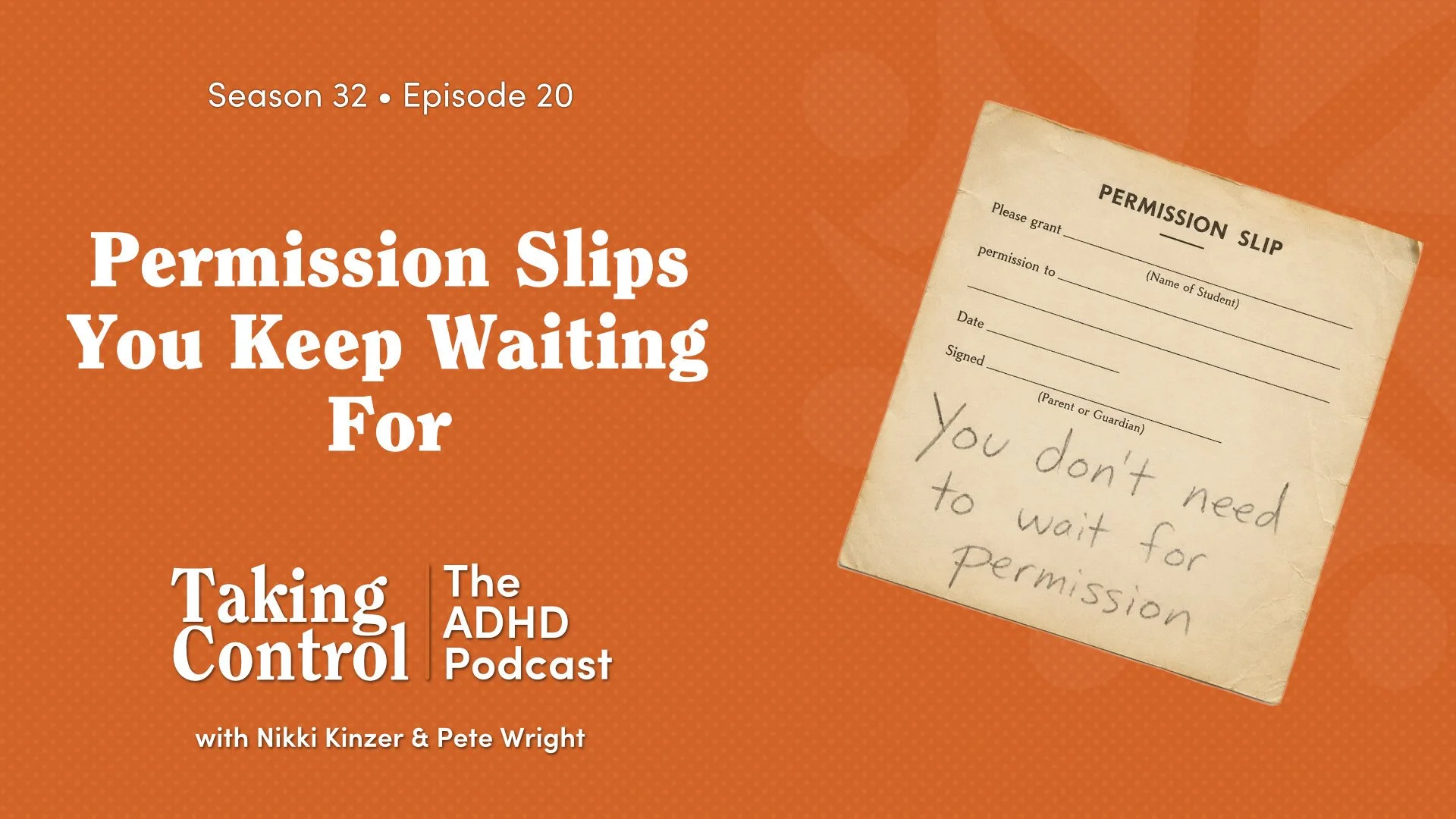
There's a kind of waiting most ADHDers know well — waiting for someone, somewhere, to say it's okay. Okay to rest. Okay to stop masking. Okay to take the accommodation. Okay to want what you want without justifying it.
In this conversation, we get into the permission slips we keep waiting for, often from authority figures who may not even exist anymore. We talk about why ADHDers wait — the research-backed link between years of childhood correction and adult reliance on external validation — and what that has to do with decision paralysis, rejection sensitivity, masking, and the exhaustion of performing a version of yourself that you didn't sign up for.
Plus the swan, self-determination theory, and a small concrete first step you can try this week.
Links & Notes
-
Pete Wright:
Hello, everybody, and welcome to Taking Control: The ADHD Podcast on TruStory FM. I'm Pete Wright, and I'm here with Nikki Kinzer.
Nikki Kinzer:
Hello, everyone. Hello, Pete Wright.
Pete Wright:
Oh, hi. Look at you there on the podcast.
Nikki Kinzer:
And you on the podcast.
Pete Wright:
We are on the podcast, and today we are talking about permission slips. It's a real scholastic kind of thing.
Nikki Kinzer:
I love it. It is.
Pete Wright:
What do you think of when you think of a permission slip?
Nikki Kinzer:
I think of school, and I think about going on a field trip and how you have to come home with your permission slip and you have to have your parents sign off that it's okay for you to leave the school to go onto a bus to wherever you're going for the day, and you have to make sure you pack a lunch.
Pete Wright:
And then you're out in the world alone with maybe a teacher and a bus driver, and you're just living your best life.
Nikki Kinzer:
Yep. Yes.
Pete Wright:
There's so much opportunity that comes from the right permission slip. And we are going to talk about that very blessed opportunity today.
Before we get into the topic at hand, you need to hear about our Patreon community. You know about it because I've told you about it before, but just in case: if you're a regular listener, this is the next move. Members of our Patreon community get early ad-free access to every episode. They get access to the special extended editions, where you get to hear me talk about cinematographers at length. And you get to join us for the live stream while we're recording, and you can chat with others as the recording is going on, and it's really fun. Plus, we add all kinds of extra events throughout the year from time to time, and we'd love you to join us for those too. But honestly, the best part about the Patreon is the community of people that are in here themselves. This is a group of real people all living with ADHD who show up for each other in a way that is pretty hard to find elsewhere. So if you've ever wanted to be more than just a listener, this is where it happens. Visit patreon.com/theadhdpodcast to learn more and join us. And if you're not ready for that, that's fine too. Find us at takecontroladhd.com. Connect with us on the socials, join the Discord, or sign up for the weekly email. We would love to have you wherever you land.
All right, Nikki, it's permission slips all the way down today.
Nikki Kinzer:
I love it. All right.
Pete Wright:
So we start with the pattern. What are we talking about? What is the permission slip orientation?
Nikki Kinzer:
The way that it comes up in coaching a lot is that term — I need to give myself permission to. I just need permission to do something. And it's usually to do something that they feel guilty about, feel guilty leaving behind. So I like these examples that you put out here on the show notes that I'm looking at, because they're really good, Pete Wright.
Pete Wright:
Oh, good. Thank you.
Nikki Kinzer:
You did a really good job.
Pete Wright:
Thank you, Wink.
Nikki Kinzer:
But yes, that is what it is. It's like, okay, well, I can't rest until I've done enough stuff and checked off everything on my list. I can't give myself permission to take a break because I haven't done everything. I'm waiting for someone to say it's okay to be done with the day, but that someone never comes. I'm never given that permission, when really it should be coming from you. But that doesn't matter.
And it's interesting in coaching, because sometimes we'll be talking about something, and I'll ask a couple of questions, and it will come up on their own where they'll say, well, I guess I just really needed permission to let that go. And they're not getting permission from me. I mean, they're getting permission from themselves because they've gone through the process of talking it through and processing it and seeing that what they're believing isn't necessarily true.
Pete Wright:
Right. I want to distinguish one point, which I think is important as a framework: we're not talking about permission to do the things you want to do but can't because your ADHD is getting in the way. That's executive dysfunction. We're not talking about that. This is all about the things that you may have already decided to do, but you're waiting for it to be blessed externally.
Nikki Kinzer:
Yes, I think that's a good idea.
Pete Wright:
And that gets into the waiting-to-rest-until-you've-earned-it-somehow stuff, waiting for someone, like you said, to say it's okay to quit, waiting for a real diagnosis, waiting for someone else — the professional with letters after their name — to call you and your experience with ADHD real, waiting somehow for permission for an accommodation that would actually help you because you need some sort of external validation to do it. And we're all waiting for these things.
Nikki Kinzer:
Mm-hmm.
Pete Wright:
I think the rest one, the self-care one, is a huge one.
Nikki Kinzer:
Well, it goes from what we were talking about last week of the rest and recovery and all of those little breaks that we need to take. It's like we need some kind of permission to do that.
Pete Wright:
It actually came back to me with a comment in our ADHD Happy Hour, one of the Patreon benefits, that someone was looking for an accommodation at work for — what was it? Todoist? I think that was it. And they wouldn't get it because if they got it for one person, they'd have to get it for everybody. But this is a service that would help that individual, and they feel strongly about it. And there is a permission structure, especially at work, that makes that kind of stuff challenging. So what are you waiting for, especially for a service like Todoist that is a reasonable expense as an accommodation? If work won't cover it, then what permission are you waiting for to take action on it?
And no judgment, because everybody does this. I do it too. We've talked about masking a number of times on the show — permission to stop masking with a specific person, or a family member, or something.
Nikki Kinzer:
Yes.
Pete Wright:
In many respects, permission exists as a way to avoid speaking our truth to power — social power, cultural power, professional power. We have somebody that we perceive as an authority, and we are making ourselves smaller in service of a relationship that does not deserve that attention.
Nikki Kinzer:
Mm-hmm.
Pete Wright:
So there are some big ones like those.
Nikki Kinzer:
Absolutely.
Pete Wright:
Truth to power is kind of a haughty term, but there are also little tiny ones, like — I have to think about this all the time — permission not to respond to that text message right now. Permission not to respond to that Discord message right now. Permission not to let myself be interrupted by a flag that comes up and triggers every single people-pleasing nerve I have in my brain. Every one of them.
Nikki Kinzer:
Yes.
Pete Wright:
Permission to medicate, or permission not to medicate.
Nikki Kinzer:
To not. Yes. That's a good one. Because there's so much pressure around that — of that being treatment.
Pete Wright:
Yes, in both directions.
Nikki Kinzer:
Of treatment of ADHD. That conversation's going to come up, and people are going to have opinions one way or the other.
Pete Wright:
Permission to take your ADHD diagnosis seriously, even though you, quote, "function fine."
Nikki Kinzer:
That's tricky, and it's so annoying. Because it's this invisible disorder. Because you may be masking. And so everything looks so good and put together and organized. From the outside, yeah, you're functioning fine. You're going to do fine. But inside, you're crumbling and isolated. That's a very lonely feeling, if everybody's saying, oh, you're going to be fine. You're fine. You're doing great. What do you mean? Really not validating anything.
Pete Wright:
Melissa reminded me over the weekend about why the swan is such a perfect mascot for our ADHD server.
Nikki Kinzer:
Yes, she did.
Pete Wright:
And it happened to be exactly what I needed to hear. The swan is beautiful on the surface, and it's going crazy underneath.
Nikki Kinzer:
Underneath.
Pete Wright:
That's what functioning fine is like. It's the swan. It's beautiful and great and totally taking care of its own business, and also it's a disaster below the surface. And that's what fine can be. That is a neutral state for a lot of us, that we appear one way, but we very much exist in another.
Nikki Kinzer:
Yes. So with that, Pete Story, I love one of these other key points here: permission to stop performing the version of yourself that's exhausting you. Pete Wright had to give me a little pep talk the other day of, you know, Nikki, who's in charge of this? Who's driving this bus? I don't remember exactly what you said, but it basically made me leave the conversation of, oh, right. Maybe I'm doing this to myself, and I need some permission to let some of this stuff go and not take it all on myself.
Pete Wright:
Well, why does that kind of guidance come so easily to me? Because it's that experience of: I am behind on a million things. And I look at those million things, and 999,000 of them I have done to myself. I've added to my own list. Who is in control of that list? I'm in control of that list. I get to make those choices myself. And if I want to go easier on myself, I have the agency and authority to do it. That's a huge thing to wrap your head around.
Nikki Kinzer:
It really is. And I just want to point out, for someone who does not have ADHD and was struggling with that, and someone who has ADHD who struggles with that — I just want people that are listening to understand: it is happening to everyone. It's more so — I think it's heightened when you have ADHD, and it's definitely intense in all of the emotions and feelings that go along with it. But I just want people to know that you're not alone in the ADHD community and the non-ADHD community. Because I needed my dear friend to basically take me off that edge and ledge and say breathe for a moment.
Pete Wright:
Yeah.
Nikki Kinzer:
Breathe.
One thing that I think is really interesting — this isn't a conversation around whether you have ADHD or don't have ADHD, but it is an interesting distinction. You were saying, I feel behind. When I was coming to you, it wasn't that I was feeling behind. I was feeling overwhelmed with what was ahead. And I don't know if that means anything, but it's just something I noticed when you were talking.
Pete Wright:
I think what matters is how it makes you feel, but it may not make a functional difference. The emotional state of feeling behind and feeling like, ultimately, with everything that's ahead of me, I know I'm going to be behind, are the same emotional state.
Nikki Kinzer:
Mm. True. Right. That's true.
Pete Wright:
I'm overwhelmed with what's to come because I don't have confidence in myself to be able to do it all, is kind of the same as: I had a bunch of stuff on my list and I've confirmed that I didn't have enough juice in the tank to do it all.
Nikki Kinzer:
And my own anxiety is creeping up because I'm thinking worst-case scenario.
Pete Wright:
Yeah.
Nikki Kinzer:
Interesting. All right. Little side note there. Let's go back on to giving ourselves permission.
Pete Wright:
There was just one more that I think is an important one that I run into, which is permission to want what you want without justifying it, to yourself or anybody else.
Nikki Kinzer:
Yeah. So true.
Pete Wright:
It's okay to want what you want — to want experiences, to want products and services, to want relationships. You don't owe anyone a rationale behind it. It's just yours.
Nikki Kinzer:
It's so interesting because we just celebrated Mother's Day, and there was a time where all I wanted on Mother's Day was to not be a mom. I'm going to say that out loud. I just wanted a day where I could be by myself and not have to be a mom, not be wanted for anything. That's when kids are smaller — they need you. And then this Mother's Day, before our pre-show, I was talking about how I spent this lovely weekend with my daughter. And it was wonderful. As they get older, that's what you want, is to spend time with them.
Pete Wright:
Yeah.
Nikki Kinzer:
So it is, I think, that permission. Because me even saying that out loud, of me not wanting to be a mom, makes me feel really bad. I feel guilty saying that. So I appreciate that permission to want what you want without having to justify it.
Pete Wright:
This was my big birthday lesson years ago — that I have things that I want to do on my birthday, and I'm not going to try to convince other people that they need to be a part of my party, which is weird and requires you to take essentially a day off of work. I just go to the theater and do it. I watch movie after movie, and it's what makes me happy.
Nikki Kinzer:
To watch movies. I love that.
Pete Wright:
It's the one thing I want. And then I want to come home and have a nice dinner with my family. That's it.
Nikki Kinzer:
Mm-hmm.
Pete Wright:
And I don't have to justify that to anybody. All right.
So as you might be assuming, I did just a little bit of research, and I found this article. It led to self-determination theory.
Nikki Kinzer:
You did.
Pete Wright:
Self-determination theory says we have three core needs: autonomy, competence, and relatedness. And ADHD frustrates all three of these elements from childhood. Adamou-Champ did some research, and team — I'll just say et al. — did some research on self-determination theory and ADHD: "Seeking Connection, Autonomy, and Emotional Feedback — A Self-Determination Theory for Self-Regulation and Attention Deficit Hyperactivity Disorder."
Okay, what does all that mean? Years of correction from authority figures creates an unconscious reliance on external validation. Pull it apart: years of other people in perceived authority — teachers, principals, social workers, special ed teachers, parents, therapists — telling us that we're doing something wrong, outside of the norm. Even if they're not saying it's wrong, if it's outside of the norm when you're a kid, it's perceived as wrong. This creates a reliance on external validation as an adult. This is not a weakness per se. It's a survival adaptation that worked when we were eight years old. And it does not work at 48 years old. It does not work.
Nikki Kinzer:
So true.
Pete Wright:
We're adults, and there is no authority figure that is expecting to give us correction at the same rate and style that we were getting it when we were eight years old. That's not happening anymore. So we have to tear apart the reliance on external validation, which becomes the first biggest muscle that you have to build in order to give yourself permission slips to do the stuff that you need to do to live your life. Thoughts.
Nikki Kinzer:
It's so interesting, and it really makes sense. Because not only the correction, but the validation of doing a good job too. You're not getting any feedback.
Pete Wright:
Right. You're in complete limbo.
Nikki Kinzer:
So what do you do with that? And then of course you're going to think worst-case scenario. So I'm going to think I'm doing the worst job that I could be doing, when you don't know, because you're not getting any kind of feedback. That's so interesting.
Pete Wright:
Which leads to the next point, which I think is related, and this is on decision paralysis. According to the same research, 82% of ADHD adults struggle with decision-making. Waiting for permission stalls the brain and offloads responsibility. If someone else decides, you are not responsible for the outcome. And that is the exact opposite of having your cake and eating it too. As an adult now, if you're looking to increase agency and autonomy in your life, you cannot also seek to offload responsibility for the decisions that define your agency and autonomy.
Nikki Kinzer:
Yeah.
Pete Wright:
You have to develop the second muscle, which is: I'm taking responsibility for my decisions. One, I'm no longer waiting for somebody else to tell me what to do and when to do it. Two, I'm taking responsibility for the decisions that I make on my own.
And finally, the rejection sensitivity layer: waiting preempts rejection. If they say no, at least you didn't act first and cause an RSD storm. The potential for rejection is real. We all know we live with it. It is not your fault, but it is yours. And that's the reality. So this defines why the ADHD brain waits for stuff, waits for permission externally. And also the trade-offs that come with taking responsibility for your own actions and your own decisions and not waiting anymore. Because life goes on. To quote the famous philosopher, life moves pretty fast.
Nikki Kinzer:
Wow. I have to take a moment to process all that. It really connects a lot of dots, because when we talk about decision-making and we know it's difficult for ADHDers — I would say more than 82% of ADHD adults. I would say it's higher than that. But it's an interesting connection when you start talking about why the decision-making is so difficult and waiting for permission. And I think that for a lot of folks, it's because they're afraid of making the wrong decision. Well, where does that come from? Where is that fear coming from? And then we start talking about the RSD, and we start talking about those past internal conversations — it all sort of goes in this perfect little circle. Interesting. I like your research.
Pete Wright:
It's pretty good, right? That's a pretty good article. I was pretty happy with that one.
I think the next piece is the gender layer. Most of this is non-gendered. But there is the important sort of twist that says: women in particular get socialized to defer and caretake and not take up space, and those stereotypes are stereotypes for a reason, because they're very real. And that permission-waiting habit is reinforced twice — once by ADHD, and second by gender norms that are legitimate.
Nikki Kinzer:
Right. Absolutely.
Pete Wright:
And the other side of it — not to say at all that it's in any way easier for men, because men have it too, in their own language.
Nikki Kinzer:
Absolutely.
Pete Wright:
Having permission to feel a certain way, having permission to ask for help, to not be the provider, to stop toughing it out, because those are the norms that men tend to be taught. And all of those flavors are deeply gendered. But the result, the waiting part, is not.
Nikki Kinzer:
Right.
Pete Wright:
We're just doing it for different reasons.
Nikki Kinzer:
Yes.
Pete Wright:
So who are we waiting for?
Nikki Kinzer:
That's a great question. It's so interesting when people — and I see it in all facets, not just like coaching clients, but even just in personal relationships, when I talk to people in my family and friends — there's this thing that we're either comparing ourselves to, or "well, you know, them." And it's like, well, who is the them? Who exactly are you afraid of? I love this question. Like, who is it that we're waiting for?
Pete Wright:
What's your experience with main character syndrome? Are you familiar with this?
Nikki Kinzer:
No, I'm not sure.
Pete Wright:
Main character syndrome describes the context in which you are the main character of your movie, and you have a sense that everything in life revolves around you in some way, shape, or form. You're waiting for the plumber to show up, and for some reason, the plumber is late. The story that you tell yourself about why the plumber is late, if you live with main character syndrome, is usually something related to: they looked on my Facebook page and saw a snide comment that I made once about how plumbers are silly willies, and they've decided to stall and not come to my house right away. Do you see what I mean?
Nikki Kinzer:
And they're going to charge me twice the cost and then pocket it.
Pete Wright:
Yeah, as punitively as possible.
Nikki Kinzer:
Yeah, totally. I get that.
Pete Wright:
Main character syndrome — every single whisper or rumor, everything somehow revolves around you. This is kind of a variant of main character syndrome. Because the person you're waiting on often doesn't know you're waiting, probably doesn't care that you're waiting, and may have been dead for a decade.
Nikki Kinzer:
Or can I just say doesn't exist? The person just doesn't exist.
Pete Wright:
Right. Maybe the person you're waiting on is a 14-year-old version of you.
Nikki Kinzer:
Yes.
Pete Wright:
From 1984, who has no understanding of the life you're living today and your current needs.
Nikki Kinzer:
Yes.
Pete Wright:
Back to the Champ research, they call this the impairment of internalization. The rule that you're looking for never becomes yours. So you keep checking with an external rule-setter that may not exist.
Nikki Kinzer:
Yeah.
Pete Wright:
Impairment of internalization. That's an important term to understand, even if you put it in different language. Because that is something that, when you're looking for those permission slips and you're finding the hints that you might be waiting for any function, it's likely an impairment of internalization. You're not able to take ownership of whatever the context is around your life and take action.
Nikki Kinzer:
Right.
Pete Wright:
So how then do you write your own permission slip?
Nikki Kinzer:
Oh, I love this. Please tell us.
Pete Wright:
Well, I don't.
Nikki Kinzer:
How do you do it?
Pete Wright:
I mean, who knows? What I do know is this: just saying you have to give yourself permission doesn't work.
Nikki Kinzer:
Yes. That's the "just do it" — that doesn't work.
Pete Wright:
"Just do it. Just muscle up and do it." That's not how your brain — exactly.
Nikki Kinzer:
Bullet journal. Go get a planner, and that's going to change your life.
Pete Wright:
Right. That's not how it worked, because your brain didn't learn this this way, and it's certainly not how it unlearns it. So, again, if we look to the research: these small, concrete acts of autonomy — acting without the slip in very low-stakes ways, so that you're able to notice that the world doesn't end when you take action on it. Don't start with the biggest thing in your universe right now. Start with a little tiny one.
So you may consider certain prompts. You may have a piece of paper, and you write down: here's one permission that I feel like I've been waiting for. Write it down. Say it out loud and hear it. I've been waiting for an accommodation at work. They've refused to give it to me. What would happen if I did it myself? What would happen if I came up with a solution to my own problem? And then you write down who you're waiting on. Check whether they even know. Check whether they even exist.
Nikki Kinzer:
Exactly. Is this person real? Who is the them? Who is it?
Pete Wright:
Maybe you break down that one act into smaller versions of the act.
Nikki Kinzer:
Love that.
Pete Wright:
Maybe it's: I'm not going to quit my job. That's not the act. But maybe I'm going to take a 30-minute walk in the middle of the workday to clear my head and figure out what's going on. I'm not going to subscribe to a brand new major service that nobody approves of at work, but I am going to get a completely separate journal — or timekeeper — that allows me to keep track of my time in a way that's outside of the work systems. Does the world end? Did you notice? Does the world end? Is anybody mad at you? Anything changed in their relationship with you?
This implies you cannot think your way out of needing permission. You have to act your way out. Because losing permission was action-oriented. Someone else acted on you to take your permission away and teach you that you weren't allowed to give yourself permission to do anything. So you have to let your brain collect evidence. You have to collect evidence in your skin that you can change without asking for permission, in many, many ways. Don't break the law.
Nikki Kinzer:
Oh, I love that. Right.
Pete Wright:
We should say that. But take those small actions and see what happens to your life.
Nikki Kinzer:
Small actions. I love that.
Pete Wright:
What do you think?
Nikki Kinzer:
I think it's great. And I think that it takes away some of the all-or-nothing that can happen so easily with ADHD — that if I don't take a 30-minute walk, it didn't work. But if I can take a five-minute walk, actually, it can still work. So I think it's really changing our mindset of the tiny actions. It's that whole quote — and it was from Martin Luther King — you know, one step at a time takes you up to the staircase. You don't just leap. You take little steps. And I think that's great.
Pete Wright:
So that's where we are.
Nikki Kinzer:
I love it. Yay. And we're going to do a download for this, you know.
Pete Wright:
Tell me about it. Do you know what it is yet?
Nikki Kinzer:
Well, I don't know. I have no idea. So this is in real time, folks.
Pete Wright:
It's a permission slip.
Nikki Kinzer:
It's going to be some kind of permission slip.
Pete Wright:
We're going to call it the ADHD Permission Slip.
Nikki Kinzer:
Yes, that's what it's going to be. I don't know yet, because I still have to think it through. But when I saw this outline and saw what we were talking about, I thought this is going to be a great download for people to practice this idea. And it will have the prompts: name one permission you've been waiting for, identify who you're waiting on, pick a smaller version. We're going to have all of that stuff on there so that you can practice this. And we'll have it ready for you to download soon, when this is live.
Pete Wright:
When this is out, check your show notes. It's there. It's on the website on the podcast page. You can find it right there. Just follow the links in your show notes and you'll get it.
So thank you, everybody, for hanging out with us. We appreciate you downloading and listening to the show. Thank you for your time and your attention. Don't forget, if you have something to contribute to the conversation, we're heading over to the Show Talk channel in our Discord server, and you can join us right there by becoming a supporting member at the deluxe level or better — patreon.com/theadhdpodcast. On behalf of Nikki Kinzer, I'm Pete Wright, and we'll see you right back here next week on Taking Control: The ADHD Podcast.