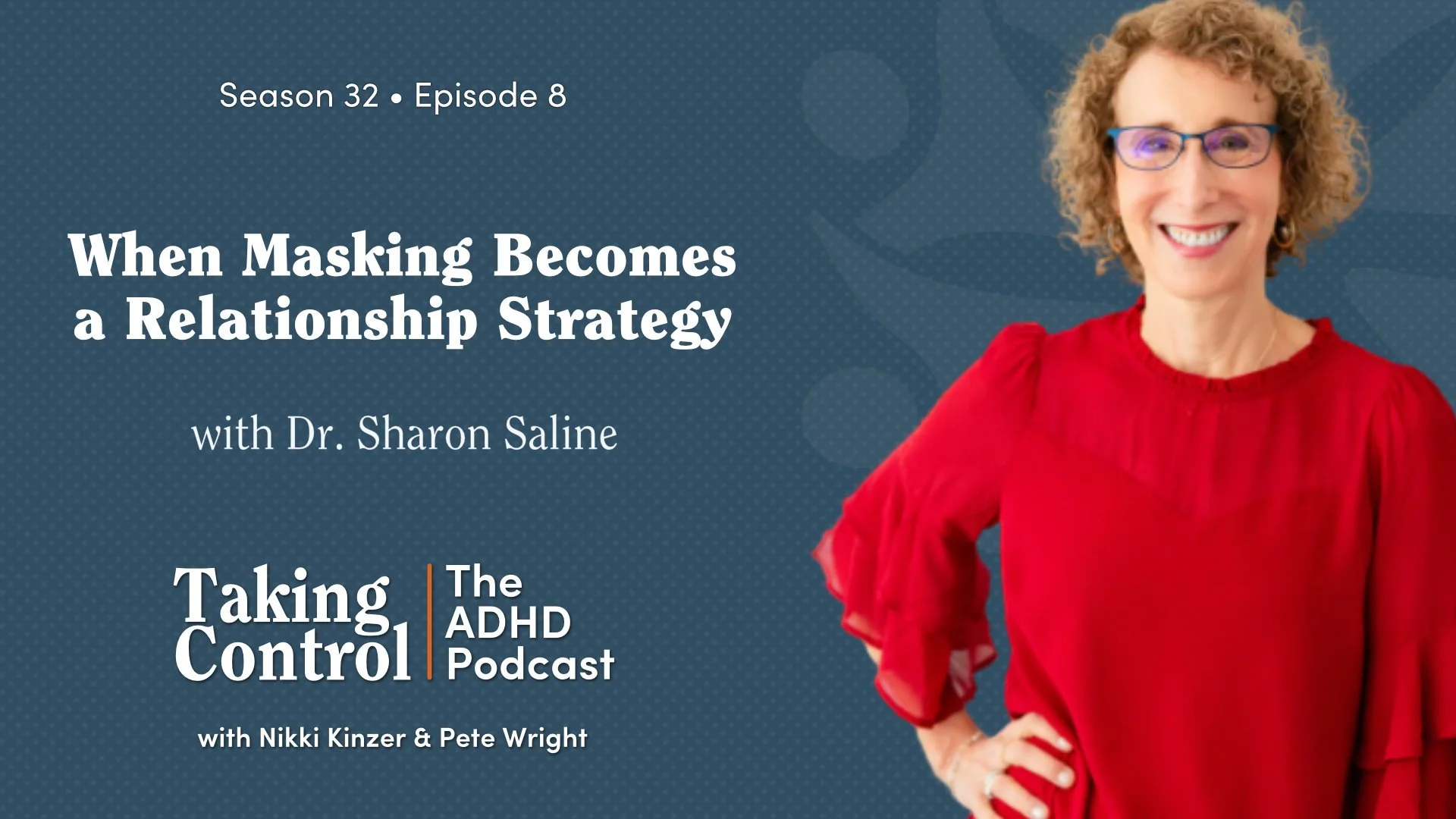
If you've ever spent an entire day performing a version of yourself that felt nothing like the real you — holding it together at work, seeming calm when you're not, passing as organized — you already know something about masking. But knowing it and understanding it are two different things. Dr. Sharon Saline returns to help Pete and Nikki unpack what masking actually is: hiding traits, suppressing impulses, and overcompensating to appear more polished than you feel. It's a coping mechanism that can be useful, but for adults with ADHD, chronic masking carries real costs — increased anxiety, emotional exhaustion, a growing disconnect between who you show the world and who you actually are.
One of the most important distinctions in this conversation is the difference between masking and presentation. We all show up differently in different contexts — there's a version of you at work, with close friends, with your partner. That's not masking; that's healthy. Masking is specifically about hiding, about a core sense of deficiency that says if people see the real me, they'll reject me. Sharon traces this directly to the social anxiety spectrum — and to the RSD, perfectionism, and imposter syndrome that so many with ADHD know intimately.
So what does it look like in practice? Saying yes when you mean no. Staying quiet when you have something to say. Overpreparing to look like you know everything so no one discovers you feel like you know nothing. And at work, pretending you have it all under control when you're drowning — rather than simply asking for what you need. Sharon draws a crucial line between protective masking (I will never feel safe here) and productive masking (I don't feel comfortable yet) — and that distinction is where the path forward starts to open up.
Lowering the mask isn't about tearing it off all at once. It's about identifying the patterns — the people and places where you've felt safe before — and using those as your guide. It's about noticing the physical sensation of safety when it shows up, and recognizing that you deserve spaces in your life where you don't have to perform in order to belong. Sharon also reminds us that for AuDHD people especially, masking has often been an essential survival tool, and that owning your challenges with honesty — and even humor — is ultimately far less exhausting than the alternative.
Links & Notes
-
Pete Wright: Hello, everybody, and welcome to Taking Control: The ADHD Podcast on TruStory FM. I'm Pete Wright, and I'm here with Nikki Kinzer.
Nikki Kinzer: Hello, everyone. Hello, Pete Wright.
Pete Wright: It is good to pod with you today. We are talking to another Hall of Famer — Dr. Sharon Saline is back with us. We're going to be talking about masking. We're going to be talking about when masking becomes a relationship strategy. This is a big one, and it's a great follow-up to our conversation last week — it's part of a series, so if you haven't listened to that one, go back and do that.
Before we get started, head over to takecontroladhd.com to get to know us a little better. Listen to the show on the website. You can subscribe to us across the socials at Take Control ADHD, and jump into our free Discord community at takecontroladhd.com/discord. Most importantly, if this show has ever benefited you or your life with ADHD, I hope you'll give us support over at Patreon — patreon.com/theadhdpodcast. You can join us for a few bucks a month and get access to all kinds of behind-the-scenes content, access to the show live streams, the ability to ask the guest questions as we record — and you can sleep soundly knowing you're supporting creators that you love. For those who've already subscribed: thank you for being a member, we're so grateful for you. And to everyone else: the water's warm. Take control — patreon.com/theadhdpodcast.
If you have ever spent an entire day performing a version of yourself that felt nothing like the real you — holding it together at work, seeming calm in conversations, passing as organized or on top of things — you already know something about masking. And if you have ADHD, there's a good chance you've been doing it for so long it doesn't even feel like a choice anymore. It just feels like the day.
Today we're talking about what happens when masking stops being a coping strategy and starts becoming a relationship strategy — and what that costs us. Dr. Sharon Saline is back, and we're going to jump into the psychology behind the mask: why we build it, what it's protecting, and what it takes to finally let someone see what's underneath. Sharon, welcome back.
Sharon Saline: Thank you so much. I love being here. This is one of my favorite places to come and hang out and talk about all things ADHD. Thanks for having me.
Nikki Kinzer: Wonderful.
Pete Wright: Love that so much. All right, Nikki — you've put together a robust outline for us. Where would you like to start with Dr. Sharon?
Nikki Kinzer: I think we start with the definition of what masking is, because I think a lot of people know what it is — but then a lot of people are doing it and don't know that that's what they're doing, and maybe don't know that that's what it's called. So let's start with the definition. What does masking mean?
Sharon Saline: I think masking means hiding traits, suppressing impulses, or overcompensating in order to appear more organized, focused, calm, or socially polished than you may naturally feel. Masking is a coping mechanism, and sometimes it can help people navigate school, work, or social situations — it can be a useful tool. Other times it can be really draining and increase anxiety, shame, and burnout. Chronic masking in neurodivergent adults is associated with increased anxiety, heightened emotional exhaustion, greater risk of burnout, and of course lower self-esteem. The thing about masking is that you've created a persona you're hiding behind because there's some concern — sometimes a valid concern — that who you actually are will be rejected, be uninteresting to people, or be turned away from. You put up the idea that you've got it all together, that you can handle it — or you become the class clown, or the party giver, or whatever the persona is. That persona may have components which are true to you, but they may also be exaggerated. And it's living with that exaggeration that can be exhausting.
Nikki Kinzer: Yeah. So one of the things we've been kind of hitting on is not just romantic relationships but also the workplace, family, friendships — all of the different kinds of relationships. Does masking show up differently depending on who you're with?
Sharon Saline: In certain situations, masking can be useful. I don't want to go into a meeting with someone I don't know, or show up at a TV station for an interview, and be the same person I am when I'm with my three-year-old grandson. But I don't consider that masking — I consider that presentation. I'm presenting myself in a professional capacity versus presenting myself as Bubby. Bubby puts on a cape and runs around the house pretending to be Super Bubby with the kids, who are trying to save somebody who stole donuts. That was our last—
Nikki Kinzer: I love that. I hope you got that thief, because—
Sharon Saline: "Someone has stolen donuts. We have to go!" Super Bubby, followed by three little children. Superman.
Nikki Kinzer: Oh, I love it.
Pete Wright: There's a really interesting thing going on in what you're describing, because — two points. First of all, I like calling it presentation. One of the things I was struggling with is that I mask intentionally every day. There's Podcast Pete, there's Pete hanging out in the kitchen with my wife, there's different Petes. I don't want to use the word masking around those, because that's not the intention.
Sharon Saline: Right, because when we're thinking about masking, we're talking about hiding. You're like — excuse the analogy — a delicious apple pie. One section might have nuts, one section might just have apples, one section might have some peaches thrown in. Whatever it is, you're this pie. Masking is a strategy. And the question is: when is this strategy going to serve you and when isn't it?
In social situations — which is where we mostly see masking — we see things like practicing conversations ahead of time in your head, thinking through how you imagine they'll go. By the way, they generally don't go that way, so don't spend too much time on that. What's better is to have a general strategy. So instead of scripting every exchange — "When this person says this, I'll say that" — because the chances of them saying the exact thing you're expecting are small — what you can have is a backup response. If someone says something and you don't know how to respond, your response could be: "That's a really good point. I'm not sure how to answer that. Can I think about it and get back to you?" That actually involves no masking, because you're saying "I need some space" — versus masking, which would be acting like you fully understand what they're saying and know exactly how to respond. Masking is so fundamentally related to social anxiety — the concern about being in situations where you're embarrassed, humiliated, or rejected. You're compensating for a core sense of deficiency that you believe you have in order to navigate those situations.
Nikki Kinzer: We were talking a while ago about the word "high-maintenance" — what that looks like. And I feel like from what you're describing, trying to appear low-maintenance is a form of masking. If you're going to be the easy one, the one who says yes, the one who goes along — "I want to please you" — that would be a form of masking. Because you're taking on more than you really can, and you know it, but you're doing it anyway.
Sharon Saline: Right. And the thing that's so interesting about that is there's also an adjacent term we use: camouflaging, which is when you kind of blend in with what other people are doing and don't voice your own opinion. With masking, you might suppress impulsive comments, mirror what other people are saying or doing — which is also a form of camouflage — or hide overwhelm or sensory discomfort. These can ease social anxiety in the short term, but in the long term they're not actually going to get you where you want to go. Because ideally, you want to be who you are, tempered by the situation. When I go to record a segment for a TV station, I'm going to be different than I am as Super Bubby. And that's not masking — that's me being a different part of myself, the professional part of myself. So I think we have to be careful, because masking is really about hiding. For example, you might overprepare to avoid mistakes so you look like you know everything, because you don't want people to think you know nothing. Or you might say yes when you really mean no, and go along with things. Or you might stay quiet when you really have something to say, but you're afraid of embarrassment or criticism. You're hiding that part of yourself.
When we talk about masking, we're talking about this idea of hiding. And yet sometimes it's needed — for safety, until you've developed the tools and skills you need in a situation that's novel or awkward or uncomfortable.
Pete Wright: It sounds very much like a continuum. On one end is presentation — an active choice to present the identity I want to be seen as in a given situation. On the other is masking — protecting myself by essentially pretending to be someone that inside I'm not, just to get through the next event or phase.
Sharon Saline: Yes. For example, say someone hasn't treated you great professionally, but you're at a conference and you have to see them. You're going to have to mask the fact that you don't care for this person at all and don't want to talk to them. You say, "Hello, how are you? Nice to see you," and move on. In that situation, masking is an asset — a tool — so that you don't walk up to them and say, "You really hurt my feelings and were a crappy colleague." I would say don't do that. Not the time or place, and perhaps never. So it is interesting to think about.
When we think about masking in relationships specifically, there are two types I want to talk about: masking in romantic or intimate partnerships and dating, and masking with friends. Ideally, you are your authentic self with your partner, with your children in an appropriate way, and with your friends. If you really can't be who you are with your friends — are they your friends? That's an interesting question.
Pete Wright: It's sort of an inverse of Dunbar's number — with your five closest people in the center, you're your most authentic. And as you get further out into the concentric circles toward acquaintances, the degree of masking or presentation goes up.
Sharon Saline: Correct. And it should. If I run into someone at a café I haven't seen in a number of years and they ask about one of my kids, I don't really want to go into the whole saga about how they're doing. I'll just say, "Oh, they're living here, they're fine." When in my head, it's absolutely not that simple. But I'm not going to go into that because it's not appropriate. And then if I overshare, afterwards I'm going to feel the "ick" — as my 21-year-old tells me: it's not the yuck, it's the ick.
Nikki Kinzer: It's the ick, right.
Pete Wright: Yeah, we've moved on from yuck to the ick.
Nikki Kinzer: Well, with dating, it's risky, right? When you first meet someone and you're really into them, there's a part of you that wants to impress them — you want them to see you as someone they want to spend time with. There's a little of that naturally. But when you're masking things, it's almost like false advertising. You can get yourself in trouble, because you can't be that person all the time.
Sharon Saline: Right. The issue isn't "I'm never going to mask." It's not all-or-nothing. It's choosing — having consciousness about the choice — because we all deserve places in our lives where we don't have to perform in order to belong.
I'll tell this story if you don't mind. I had a birthday party a few years ago for a few of us who turned a particular age that I don't really want to say, but it begins with a six. I was a little overexcited, and one of my best friends leaned over and said, "A little too much. It's a little too much." And at first I was a little hurt — hello, RSD. But then I was like: okay, she's giving me feedback. She loves me enough to give me feedback. I don't want to ruin the party. I can dial it back. And I did. And I told her afterward it was hard to hear, but I appreciated it. That's the thing that's really tricky about this — you have to be willing to be authentic and risk that someone might give you feedback that could be an ouch, but has real value in it for you.
Pete Wright: You bring up two situations. Because of where I live on the spectrum of ADHD, I have a very difficult time attuning my personality to the room. I can't read the room very well. So I need someone to push back on me. And being uncertain about that — particularly because of the relationship between ADHD and social anxiety — can be paralyzing.
But the other end of that spectrum is not being able to mask at all. I lived with a guy for a couple of years who was an absolute sweetheart, and he could not mask. He was the same guy in every situation — out to dinner, in a meeting with clients, hanging out watching TV. As his roommate, also with ADHD, I found him joyous and also deeply exhausting. And I wonder how many people relate to that — people who, because of the "read the room" piece, actually can't attenuate their ADHD.
Sharon Saline: That's a really interesting question. How did he feel he was doing in his life? Was he satisfied? Did he notice challenges? Because if you're not noticing the challenges, or you notice them and you don't care, then you're fine.
Pete Wright: He was very much not satisfied — jumping from career to career. I almost want to make you guess, but I'll tell you: he's an actor. And that was it. He was able to channel all of that energy into characters, and that turned out to be his outlet. He's in Hollywood now, making movies. But there were a lot of very difficult years where he didn't know how to manifest his identity because he could not change who he was in social situations. Interestingly, as soon as it became professional, there was like a valve he was able to turn — he could become someone else completely.
Sharon Saline: And I bet that helped him socially now, because he knows where to put it. He just didn't know where to put it before.
Pete Wright: For sure. But he's certainly not the only person I've met who's had trouble figuring out how to present versus how to mask because of how their ADHD works. And that's the space I'm living in right now. How do you learn to work with the psychology of protective masking or social masking — and turn masking into presentation — so it's not quite so energetically sapping?
Sharon Saline: I think some of it is: what's the function of the masking? How did it develop? And is it serving you? Because sometimes masking developed in childhood as a strategy to hide the things you were getting negative feedback for. In many situations, masking is a compensatory behavior rather than having a more unified sense of self. A unified sense of self says: "I am who I am, and there are different levels at which I share that — and that has nothing to do with masking." Masking has an almost pretending aspect to it: "I'm not showing you my full, true self because I don't feel safe. I don't trust you. I've been hurt in the past." That's different from "I've got different parts of me, and when I'm with my friends this part comes out, when I'm at work this other part comes out." That's actually pretty healthy — that's how most people function.
Nikki Kinzer: We all play different roles. So what are some of the consequences of staying in that chronic masking place — continuously hiding who you are? What ends up happening?
Sharon Saline: The core sense of deficiency I talked about is part of the definition of social anxiety — the social anxiety spectrum. Under the umbrella of social anxiety, we find rejection-sensitive dysphoria (RSD), perfectionism, and imposter syndrome. They all share a core sense of deficiency.
Over time, what happens with masking is there's a greater and greater disconnect between what I'm showing to the world and who I feel I actually am underneath. And that disconnect is psychologically troubling, because it's hard to keep track of the mask. You feel disconnected. It can even lead to a kind of dissociative experience — where I'm not connected to the person out there. "That's somebody else. It's not me."
Pete Wright: So if we're masking — and I'm struggling with how to transform it from protective to productive — we have to do some of it, it's part of being human and engaging in groups. And yet if we're doing it purely from a protective stance, it becomes exhausting to live like that. So to make it serve us, we need to understand some of the underlying elements of our own psychology — to be able to say, "This isn't serving me in this way anymore. What do I need to do to make it serve me?"
Sharon Saline: Right. So the question has to be: Why am I afraid? Why am I afraid of being genuine? What are the circumstances in which I feel like I can actually be more authentic? And what are the obstacles getting in the way of lowering the mask so I can be more of myself in a given situation?
Protective masking is: I feel unsafe, I feel vulnerable, I'm worried, I'm scared, something bad is going to happen to me. Productive masking is a choice you make in a situation because you don't feel comfortable yet — but it's provisional. The difference for me is that productive masking is a conscious choice because you don't feel comfortable yet, versus protective masking, which says: "I will not feel comfortable. I do not feel comfortable. There is no safety available to me here."
Pete Wright: That makes total sense. It's the idea of: I know I can be a lot at this party, and I'm going to present a certain part of myself just long enough to figure out who these people are — and at that point I'll be able to let go of the fear of letting people down, or letting people see a part of me they may not be ready for.
Nikki Kinzer: Oh, we're ready.
Sharon Saline: Yeah. Well, we're ready.
Nikki Kinzer: Bring it on.
Pete Wright: I mean, you say it — and it's actually really interesting. I spend a lot of hours on video and on a microphone every day. And there is never really a sense where I feel completely safe doing this, because there is risk. Risk of putting my foot in my mouth, saying something stupid, saying something I'll be remembered for.
Nikki Kinzer: You could be canceled in a split second.
Pete Wright: God forbid, I really hope not.
Nikki Kinzer: But no, there's a real fear around that, for sure.
Pete Wright: It's a legitimate risk.
Sharon Saline: There is a real fear. And particularly for AuDHD people, masking serves a purpose. It can take people with AuDHD longer to develop a sense of safety in a given situation, and masking helps them adapt. So the question is: does it ever stop? And that's what I'd want to explore with someone — yes, masking can be adaptive. It can help you adjust. When do you lower the mask?
Nikki Kinzer: Let's talk about that, because I think that's a great next step. We've formed a picture of what masking is, the different types, when it serves you and when it doesn't. So when do we lower the mask? What are your suggestions?
Sharon Saline: It's a good question, and I think it's individual. I can't tell you when it's okay for you to lower your mask. What I'd want to look at is the patterns — the situations, people, and dynamics where you notice it feels okay to reveal a little bit more of yourself. Identifying those patterns, those places, those situations—
Nikki Kinzer: And people, right? Because if you can identify who you mask the most with, that tells you a lot.
Pete Wright: And the people you don't mask with. Who among your group do you feel you can trust — who you feel safe with and protected by, who you can be your authentic self with — because that is the marker. When you go into any new situation, you know when to lower the mask when you start to feel that again.
Sharon Saline: Exactly. So what is that feeling? What are the physical sensations? What are your perceptions, your senses telling you? What is your gut saying? Those are the things that I think are most important.
Nikki Kinzer: And it also makes you ask: Do I have the right people around me? Am I in the right job? Do I have the right colleagues? Because if you feel that unsafe, it may be time to look for something that suits you better.
Sharon Saline: Right. But I think it's also important to realize that in relationships — work or social — there are some people who are good to talk about certain things with, and there are others you don't want to address certain topics with, because you've tried it and it didn't go well, or you just don't feel safe there. And that's okay. In those situations, you don't address those topics. Is that a form of masking? I'm not sure — in a way you're protecting yourself by avoiding certain things, but in another way it's a completely healthy coping mechanism. It's just reading the room and making sensible social choices. And if you're not sure what the sensible social choice is, then masking makes sense.
Nikki Kinzer: What I was thinking more about is the person who's bringing work home and pretending like they're getting it done during the day — or not feeling comfortable asking for accommodations. And I don't even mean formal accommodations; just saying, "I need more time on this," or "I need more clarity." Not even highlighting ADHD — just that basic ask. That's what I was thinking of: hiding the ADHD at work.
Sharon Saline: Yes. And that kind of masking is very problematic. You're acting as if you've got it all under control when you really need more assistance. That masking is very unhelpful. You're hiding, and ultimately the product of your hiding is that things could go down the tubes — instead of just asking for help and being okay with that. And I think that means you'd have to really accept who you are and accept having ADHD, instead of feeling ashamed about it.
Pete Wright: And I think the real danger is when masking has become such a habit that you don't remember a time when you weren't doing it. It's just a constant, exhausted muscle that is always tense. And that's one of the reasons I know this is a sticky conversation — because it's so fluid. But the most important thing for my money to get out of this conversation is to just talk about it with myself — to think about: when am I doing it? Now that I have a word that describes this circumstance, when does it appear for me? When can I apply this word to my own behavior? That awareness will help me navigate releasing that muscle a little bit and letting myself be a little more free.
Sharon Saline: Yeah. Where I see masking at work is over-functioning and saying yes when you mean no, or taking on more than you can handle, to compensate for executive functioning challenges you don't want other people to see. The path out of that is to own that you have these challenges — that you're struggling — and either find an assistant, check in with your boss about your progress more regularly, or be upfront about needing more time. But all of this circles back to that core sense of deficiency. If I thought I was okay — if I didn't feel like a loser with a capital L because I have this challenge, like being always late — it would be much easier to just be neutral about it. And it's the difficulty with neutrality in certain areas that leads people to mask.
Pete Wright: Last tricky question. You just described a circumstance that does apply to me. You're masking because you want to be seen as low-maintenance. And it frustrates you, and you're full of self-loathing because you're late every day. But masking does not necessarily mean you're going to be on time. Because the behavior and the experience of ADHD is in conflict with masking. Masking is not a medication.
Sharon Saline: Right. And as someone who also struggles with time management — I was actually sitting here 13 minutes early waiting for you guys, and when I'm early and someone isn't, I freak out: "What did I do wrong? Is something wrong? Am I in the wrong place?" The core sense of deficiency — it shows up. But the thing is, with time and other executive functioning challenges, it is so much easier in the long run to just own them and have a sense of humor about it. To laugh with yourself: "Here I go, struggling to be on time again." It's hard to hate yourself when you're laughing.
I worked with a man when I was getting my master's degree — we would lead groups together. He was always late. Always 15 minutes late to anything. I was generally on time, give or take a few minutes. I struggled with not knowing if he was coming. I was an intern, so I had zero power, zero influence. But I finally said to him: "It's really hard for me. You're often late, and I never know if you're coming. I come early to set up for the groups." And he said, "I'm not late until I get there."
Nikki Kinzer: What is that supposed to mean?
Pete Wright: I just spoke to the riddle of the Sphinx.
Sharon Saline: Right? But I'm here with you. If he had just owned it, it would have been different. To me it was his narcissism — but also a kind of denial. And so I think there are times when people mask as a way to hide a certain kind of culpability, guilt, or shame about a part of themselves they'd really rather not face.
Pete Wright: You just gave us a spin-off on narcissistic deflection that is going to be a whole separate episode, because oh my God.
Sharon Saline: Oh, I could—
Nikki Kinzer: That's it. Great example.
Sharon Saline: "I'm not late until I get there." Yeah, but the rest of us are here.
Nikki Kinzer: Right, like everybody else around here — yeah. Oh boy. Okay. Great stuff, Sharon.
Pete Wright: Hey, Sharon, you're the best.
Nikki Kinzer: Thank you so much. This was wonderful.
Pete Wright: Thank you.
Sharon Saline: Thank you. And I again want to just emphasize that for AuDHD people, masking can be a very important protective and useful tool — to help them make transitions into uncomfortable spaces and learn how to adapt to them.
Nikki Kinzer: You know, we've talked about The Accountant before — with Ben Affleck. I love it because he does that, right? When he's trying to relate to the woman in the film — just the way he's like, "Hi, how are you?" — you can see the way he's trying to be in that social moment.
Pete Wright: Practicing, yeah.
Sharon Saline: And having a few phrases is a great thing. Practicing a few things makes sense. To be able to say, "Oh, that's a really interesting point — let me think about it and get back to you." Or, "I'm not sure where you're coming from — can you explain a little bit?" Just having one or two things in your pocket to take the heat off yourself and allow more space, so you can catch up.
Pete Wright: Sharon, what are you up to? What do you want to share with the world?
Sharon Saline: Well, I redid my website, so it looks really fabulous. And I now have a resource library on my website and a store with mini courses and masterclasses that people can sign up for and do on their own. It's at drsharonsaline.com. And I'm writing a new book called Breaking Free from the ADHD Anxiety Cycle: 10 Steps to Transform Worry, Build Confidence, and Get Things Done.
Nikki Kinzer: Love it.
Pete Wright: Outstanding.
Sharon Saline: It's a bit of a mouthful — I'm still practicing saying the subtitle.
Nikki Kinzer: Yeah, we have to do the same thing. I still have to look up the subtitle of our own book.
Pete Wright: I've got the main title and that's about where I stop. The fine print is on the website. I'm actually scrolling the website right now, and it's lovely. I love the blues. You're wearing blue glasses in every promotional shot, and they're just delightful.
Sharon Saline: Yes! I'm wearing my computer glasses right now, but here they are — ta-da!
Pete Wright: Very classy. Sharon Saline: class act and expert.
Nikki Kinzer: When the book launches, you let us know and we'll have you right back on the show to talk about it.
Sharon Saline: Oh, for sure. And actually — when I've finished the manuscript, I'd love to come on because I did a survey, and I have about 1,470 responses about living with ADHD and anxiety. I would really love to come on and talk about those results.
Nikki Kinzer: We would love it.
Pete Wright: Name the date.
Nikki Kinzer: Absolutely.
Sharon Saline: It's really fascinating. It's not as diverse a pool as I would like — the majority of people are white — but there is some diversity in there, and there's age diversity, some gender diversity. It's really, really interesting.
Pete Wright: We have a couple of questions. Do you have a few more minutes?
Sharon Saline: Yes.
Pete Wright: Alyssa asks: "I'm confused by masking. Inherent to the way we use it seems to be intention and pretending to be someone you aren't — I think we covered that. So what is it called when people see one side of us and the other side is so incongruent?"
Sharon Saline: That's a great question. Are we still on the air?
Pete Wright: We are. She's listening.
Sharon Saline: Thank you, Alyssa. So — we have parts of ourselves that sometimes even surprise us. When you think about Internal Family Systems, it's all about the parts: "I have this part and I have this part." Sometimes there's a part of ourselves that we don't like or don't understand. If there's a part of yourself that seems very different from who you are — that you're uncomfortable with and don't like — that's a great question to bring into therapy. "I notice there's this part of myself that I really struggle with. I try to hide it from people. I don't like it. I'm not proud of it. I want to understand it more, figure out how I can integrate it, or maybe shrink it so it's not running the show." We all have parts of ourselves that make us go "huh." Learning how to accept those parts — and when I say accept, I don't mean resigning to them. It's more like a tolerance: "This is here, and this is here, and I like these parts better than that one, but I want to work on that one so I don't feel so much of the ick when it comes up."
Pete Wright: Jacques has a comment: "At the beginning of a relationship there's also an aspect of higher performance due to interest, passion, novelty, or urgency. Sometimes we automatically put our best self forward just because it's easier to do — not just out of masking." I think that's an astute point.
Sharon Saline: Absolutely. And that's natural and healthy. We put our best self forward because we're trying to connect with and meet another person. And over time there's an unfolding in relationships — you're in the connection phase, things are going really well, and then you have your first argument. In that first argument, the other person sees the part of yourself you didn't want them to see. And you see that part of them that they didn't want you to see. And the question is: how do you process that and move on? Can you accept it? Can you learn to live with it? Are they willing to make some changes? People in relationships argue — that's part and parcel for the course. I've never met anyone in a relationship who said "we've never argued." In fact, in The 99-Year-Old Man, the great two-episode show on HBO about Mel Brooks — Anne Bancroft talks about it. She says: "We can fight like hell, but we never go to bed angry." I was like, okay.
Pete Wright: One more question. "Looking beyond the when and going to the how — how do you lower the mask when masking has become an unconscious, inherent part of your interactions with people? Said another way: how do you lower the mask when it feels like the mask has become part of who you are, even if it's not actually who you are?" I feel like we kind of started addressing that in the show.
Sharon Saline: Great question. That's something I work on with clients in therapy — how do they lower the mask with me, in a safe place, in a safe container, and see what happens? I was working with someone yesterday who was having some big feelings and crying. She doesn't walk around like that all day — but with me, in that space, she could. That's a place where you can practice lowering the mask and see what happens. There might also be one person in your life — a really good friend who has shown you some of their own warts — where if you showed them a wart or two, they'd be able to receive it. Like the friend I mentioned at the party. I've seen all kinds of sides of her, and she's seen all kinds of sides of me. So she can say, "A little too much," and I can hear it without feeling like something is horribly wrong with me.
Pete Wright: So many great comments today, everybody. Thank you for hanging out and being such an active part of the chat. We're going to go ahead and wrap it up. Thanks again, Sharon.
Sharon Saline: Thank you.
Nikki Kinzer: Thank you, Sharon.
Sharon Saline: Have a great day, everyone.
Pete Wright: We appreciate everybody downloading and listening to the show. Thanks for your time and your attention. Don't forget — if you have something to contribute to the conversation, head over to the Show Talk channel in our Discord server. You can join us by becoming a supporting member at the Deluxe level at patreon.com/theadhdpodcast. On behalf of Nikki Kinzer and Dr. Sharon Saline, I'm Pete Wright — and we'll see you right back here next week on Taking Control: The ADHD Podcast.