The Relational Toll of ADHD Over Time with Dr. Dodge Rea
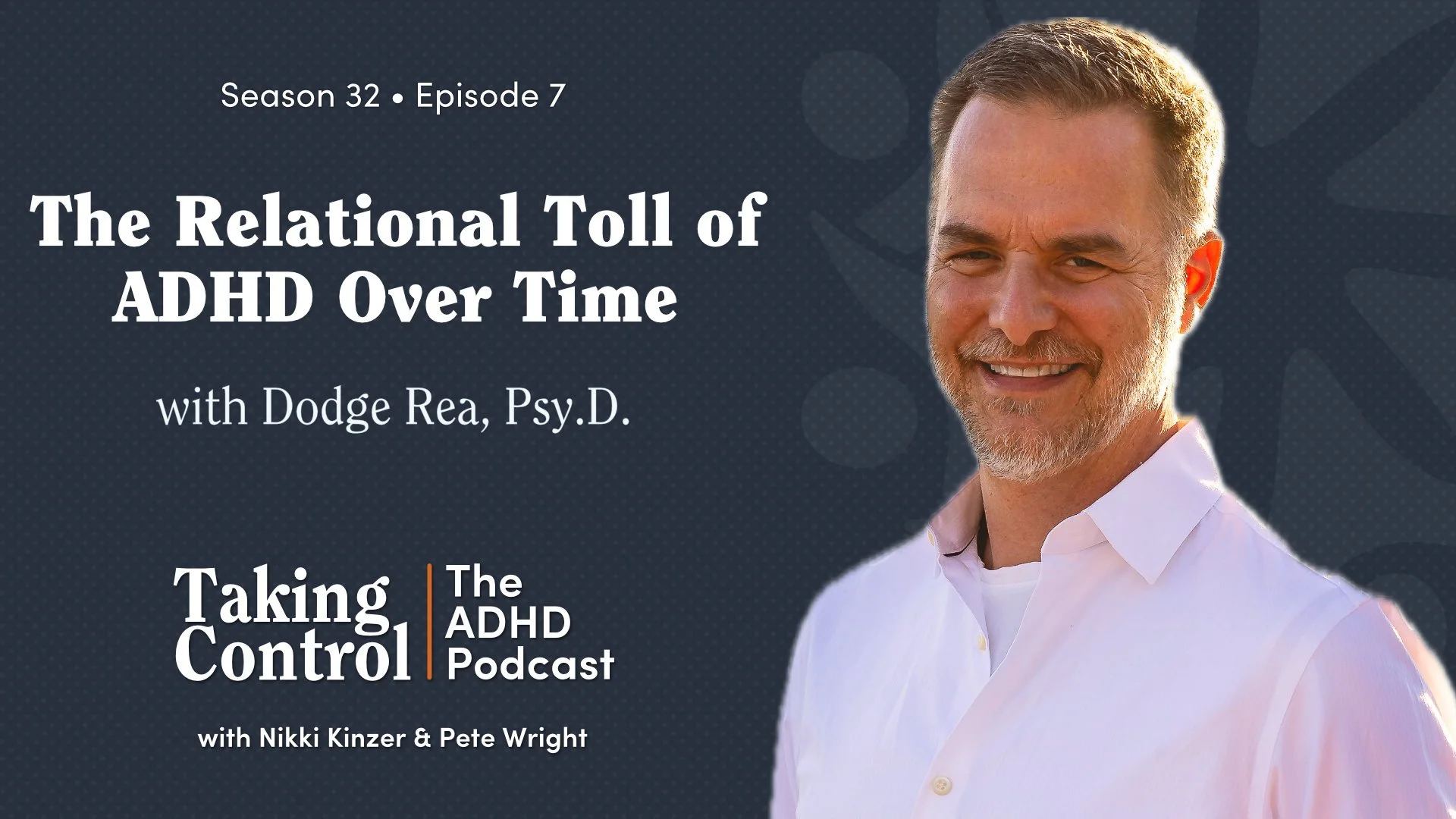
It's not the blow-ups that do the most damage in a relationship — it's the quieter stuff. The look you misread, the deadline you missed again, the apology you've given so many times it stopped meaning anything. For those of us with ADHD, these small misconnections harden faster because we arrive already carrying a lifetime of being told we're too much or not enough. Dr. Dodge Rea is back to help us name what's really happening beneath the surface when relationships start to calcify.
Dodge walks us through the concept of misattunement — the challenge of being both intact and in touch at the same time — and why ADHD brains and neurotypical brains can miss each other without anyone being at fault. He shares a powerful reframe: "It's not your fault and it's not your fate, but it is yours." Both partners have ownership work to do, and it starts with putting down the shame long enough to actually talk about what's hard. From the kitchen stepladder analogy to his expanded Ferrari metaphor, Dodge offers language that makes the invisible patterns in ADHD relationships finally feel speakable.
Pete and Nikki bring their own experiences to the table — Pete on the fear of being "generalized forgetful" and Nikki on the compassion required from the non-ADHD partner. Together they explore why shame makes everything about your value, how all-or-nothing thinking accelerates the spiral, and what it looks like to meet your experience with authenticity instead of defensiveness.
Links & Notes
-
Pete Wright
Hello everybody and welcome to Taking Control: The ADHD Podcast on TruStory FM. I'm Pete Wright and I'm here with Nikki Kinzer.
Nikki Kinzer
Hello, everyone. Hello, Pete Wright.
Pete Wright
Nikki, just real quick, and I know I just want to put you on the spot, and I can't wait to hear how you dance around this question.
Nikki Kinzer
Oh.
Pete Wright
How was your brief vacation to Oklahoma?
Dr. Dodge Rea
That sounds loaded.
Pete Wright
I can say it that way because I am a native of Oklahoma.
Nikki Kinzer
Okay, good, yeah.
Pete Wright
So yeah.
Nikki Kinzer
So I had a lovely time visiting family and getting my hands on a seven-month-old new baby. You know, a little seven-month-old baby, like—
Pete Wright
Mm-hmm.
Nikki Kinzer
Perfect baby because he sits up and he kind of plays but he can't really do anything and he's so cute.
Pete Wright
Perfectly.
Nikki Kinzer
They can't run away, but they laugh at you. And anyway, he was just perfect. So I loved that. I loved that. Am I an Oklahoma fan?
Pete Wright
Is that all you're gonna say?
Nikki Kinzer
Not necessarily. I think I'm very spoiled in living in the Pacific Northwest. I love mountains and I love greenery. And I love trees and green trees. And even in the winter they're still green.
Pete Wright
Yeah.
Nikki Kinzer
And Oklahoma is very flat.
Pete Wright
Keep going, keep going.
Dr. Dodge Rea
Other green things.
Pete Wright
Bring it, bring the truth.
Nikki Kinzer
It's very flat and very brown.
Pete Wright
Yeah. Yes it is.
Nikki Kinzer
That's what I have to say about that.
Pete Wright
That's where we're gonna end.
Nikki Kinzer
Yeah.
Pete Wright
Well, I'm glad you got to visit one of the great flyover states of the United States of America.
Nikki Kinzer
Yes.
Pete Wright
And I'm from right where you were. And that is a good feeling. You get to see my stomping grounds. And to all our Oklahomans, good to have you here. Welcome.
Nikki Kinzer
Yeah, that's great.
Pete Wright
Yeah, alright. You wanna do — I mean, we could do the rest of the show like this. You wanna do that?
Nikki Kinzer
Well, we need to do the show now.
Pete Wright
We're gonna bring a little bit of Okie out of Pete.
Nikki Kinzer
Oh dear.
Dr. Dodge Rea
I know, I know.
Pete Wright
Before we get into the show proper, takecontroladhd.com. That's your home base. Listen to the show, subscribe to the weekly newsletter, and find us on social at Take Control ADHD pretty much everywhere you want to go. If you want to go deeper, join us in the ADHD Discord community. takecontroladhd.com/discord gets you right in. And if this show has ever helped you see your relationship with ADHD in a new way, we would love your support on Patreon. A few dollars a month helps us keep growing. patreon.com/theADHDpodcast. Are you just loving this new Pete? I'm feeling my roots.
Nikki Kinzer
You're doing good.
Pete Wright
It's all about the roots.
Nikki Kinzer
You're doing good.
Pete Wright
Today we are talking about what happens to a relationship when the small things pile up. It's not the fights, it's not the blow-ups, it's the quieter stuff. This is the moment your partner needs something you didn't catch. The look you misread, the apology you gave for the hundredth time that stopped meaning anything to either of you. Over years, that stuff doesn't just fade. And for those of us with ADHD, it hardens faster because we arrived in these relationships already carrying a lifetime of being told we're too much or we're not enough. Doctor Dodge Rea is back with us today. If you have heard him on the show before, you know he has a gift for naming things we feel but can't quite put into words. Today we're exploring the relational toll of ADHD over time — the shame, the survival strategies, what it looks like when we finally start to see the patterns clearly. Dr. Dodge, welcome back.
Dr. Dodge Rea
Well, thank you, Pete. Great to be here.
Nikki Kinzer
Welcome, welcome.
Dr. Dodge Rea
Thank you, Nikki.
Pete Wright
Now I know that we told you about this topic that we wanted to talk about and you've been sweating it. I happen to know this firsthand that you were sweating. What am I gonna talk about on this show?
Dr. Dodge Rea
Like, you picked the hugest topic of them all.
Pete Wright
Yeah.
Dr. Dodge Rea
And it's the one that ends up being the most urgent.
Pete Wright
Yes.
Nikki Kinzer
Right, yeah.
Dr. Dodge Rea
I mean, as much as anybody with one of these beautiful brains is thinking, how do I get more done, really it's how am I going to get my relationship to work that feels most urgent when it's not working.
Pete Wright
Yeah. And so I would like to start with a definition of terms because this one keeps coming up again and again and again, and that term is misattunement. This whole idea that two people — my understanding is that when two people keep missing each other emotionally in a relationship structure and it's not from lack of caring but just lack of being able to read the different needs and desires. Is that a fair assessment of what attunement is?
Dr. Dodge Rea
Yeah, I think that's a fair way to say it. I think there's some cool context to put around it. There's a guy named Winnicott long ago who was an analyst and wrote in really cool ways about how people work. But Dave Richo, R-I-C-H-O, who's been a guest on my podcast with you, has brought back some of his ideas in really neat ways.
Pete Wright
Yeah.
Dr. Dodge Rea
And one of the things I think about all the time and talk a lot about with clients, especially in groups, is this idea that the fundamental challenge of relationship is to be both intact and in touch at the same time. We tend to be better at one of these than the other, whoever we are, and we tend to pendulate between them. So some of the time I'm really aware of what you need and I've totally lost myself. And some of the time I'm hurting or upset or pissed off and I've totally lost track of you. And the misattunement happens typically when we've gotten to that second half of that swing. But it starts often with being not very well attuned with what we needed in the first place. And then when we stop getting what we need on either side of this, we then come back to ourselves, right? And so this misattunement is easy in any relationship, but it's especially easy if you have brains that are really built quite differently.
Pete Wright
Can we talk a little bit more about what we need personally? Because I feel like misattunement's gonna lead me down a road of talking about what happens when we misattribute misattunement issues with conflict. And I don't quite want to go there yet, but I think there's going to be a high point in our conversation where we talk about that. But I want to start with what we need as individuals with brains that are as unique as the ones that we all have. What is it that we're missing, that we need in these relationships that would help us read the room better?
Dr. Dodge Rea
That's a great question. I think there's this thing that I often find myself saying to new people that I work with, you know, it may be on the phone when I talk to them for the first time or in our first session. It's not a plan, it's not a shtick. It's this thing that every time I'm sitting with a person and I just really want them to know this because so often people come in really not knowing this. I often find myself saying, well, we don't know each other very well, but one thing I'm really clear about is you're not dumb and you're not crazy. Life taught you this. Whatever they're walking in with, life handed you this thing. And it's not your fault. But it is yours.
Pete Wright
It's not your fault, but it is yours.
Dr. Dodge Rea
Yeah, it's not your fault and it's not your fate, but it is yours, right?
Pete Wright
Could be the mantra. Yeah.
Dr. Dodge Rea
And you could say that to either person. Let's say we're mostly talking about relationships where one person's neurodiverse and somebody else is more neuronormative. Is that what we're setting up?
Pete Wright
Yeah, cool.
Dr. Dodge Rea
So you could say that about any element of this. And, you know, as I've been thinking about it — as soon as you invited me to do this, I was like, I know absolutely nothing about that. I have no experience with these things. And then the next seven conversations I have in my office turn out to be entirely about this. Like, somebody coming in with a work colleague and another person coming in with a partner and it could be either side of this dynamic, right? And what I kept noticing was, man, the hard part here is owning your side of the street. And so coming back to your question of what do we really need, I think some of it is we need a chance to really own that we are in this relationship on purpose and that the other person is too. That we are in fact very different and both sides of these are beautiful. And a lot of what I think happens over the million little micro failures that happen in any relationship, but especially in one where they can't even understand where the mistake comes from because their brain is built differently, is there's this kind of calcification that then turns into shame and blame, and then turns into higher and higher defensiveness. And then it kind of burns all the grace out of the relationship. That part where you can just be like, I know what you meant there. I saw you trying. I love you. Let's work on how we find a system for this. Or, I see why you're saying that and I get why you're pissed. I really would be too. I don't blame you at all. And we're gonna figure this out. And so what do we need? I think we need understanding. We need understanding of our own process. We need an understanding of the other person's process. We need to accept these are different brains and we're here on purpose. And then we got to figure out how are we going to make meaning of the places where we're not happy with what just happened.
Pete Wright
Sometimes in my relationships, particularly new relationships, I'm meeting new people and I'm dealing with all of the confusion that comes with social cues and making sure that I'm tracking all of them and feeling like I'm on top of it. And I feel like one of the things that I do, and I've heard others living with ADHD deal with as people pleasers, is give up so much of ourselves. We've talked about the cost of being quote "low maintenance" in a recent episode. And so I give up ownership of identity, of who I am, of saying that this relationship, however old it is, is shared, and taking my part of it is a heavy lift sometimes for me because I've trained myself to let go in order to just make it so people don't notice that I might be struggling in some way or another. Just let go, shut up, and try not to have any of my challenges turn into red flags.
Dr. Dodge Rea
And that sets up that masking sort of thing, which sets up several troubles, right? Some of it is this shame that builds with going, okay, I've just given up all of this stuff and somebody's still annoyed. And then the defensiveness that can then be like, ow, okay, what else can I do? But then the weirdest part is it also sets up it being difficult sometimes to accept love or approval or gratitude because you're not quite sure that they are evaluating anything that was authentic, you know? So you're like, well yeah, but if you knew the real me — like, oh, your apartment's so beautiful. You're just like, yeah, well, everything's shoved in a closet.
Pete Wright
Yeah, well, I don't live here. This is my staging apartment, right?
Dr. Dodge Rea
Yeah, I don't — right. I rented this office for this meeting. But it's got that kind of effect wherever you go sometimes where there's enough masking going on. But it also means that both sides can do that out of care for each other. One gentleman I was working with was talking about just a business partnership he's in where he was feeling some frustration that regularly he says, hey, I need this information from you. Can you do it by Friday? Sure, man, I got you. And then he'll remind him multiple times and then Friday comes and goes and he doesn't get what he needed. And he finally just sat him down to say, God, we gotta talk about this. And one of the things the guy was saying was, so I think what you're telling me is when you say you want it on Friday, you actually want it on Friday. He was saying, well, yeah, that's why I use that word, Friday, right?
Nikki Kinzer
Yeah.
Pete Wright
Yeah.
Dr. Dodge Rea
Like, yes, that is exactly it.
Pete Wright
It's one of seven very important words that we use around days and dates.
Dr. Dodge Rea
The guy didn't realize. And part of what goes with this is this guy loves his business partner. He's like, he's absolutely brilliant. There's nobody else I'd want to work with. I love working with this guy, but I can't quite count on him to do the thing when we're gonna do it. And so I feel often like I'm just sort of trying to be a good sport all the time. And so when I asked him, do you have any idea why he was confused about Friday being a big deal to you? He was like, I mean, I'm super clear. I remind him a million times, right? I'm like, yeah, but have you ever told him what happens when he doesn't get it to you on Friday? Long pause. No. What happens? Well, it kind of ruins the entire flow of what I was going to do next because I need the weekend to do this thing. And if he gets it to me Friday, then I can do the thing. Does he know that? Long pause. No. I was like, okay.
Pete Wright
Yeah.
Dr. Dodge Rea
So you're working as hard to mask as he is. You're not wanting to be seen.
Pete Wright
That's so interesting, especially because how many times have we talked about the fact that ADHD brains often demand context? This is exactly what you're talking about.
Dr. Dodge Rea
Context and consequence, right? Like there's no urgency for this guy because in three years he's never heard, oh, this really, really bugs you. Like, it affects you. It screws everything up for you if I don't do it when I say I'm gonna do it. And having just had that much of a conversation, they've come to no system. They don't know what they're gonna do differently. This guy is more engaged. He is like, all these other things that weren't working quite right in the relationship have suddenly gotten better too. They just talked about it.
Nikki Kinzer
Because there's more understanding. There's more understanding of where each person's coming from.
Dr. Dodge Rea
I don't think it's even an understanding thing. I think there's more connection. There's a limbic thing of like, hey man, I gotta say, this is really hard for me. Can you help me understand what's going on? And the other guy's like, dude, I have got young kids and my life is in chaos. What do you mean? Right? And he's like, yeah, but back to the work part, what are we going to do about it? They didn't come to an understanding exactly, but suddenly I think the guy on the other side realized, oh, I matter to him and my timing matters to him.
Pete Wright
Yeah.
Dr. Dodge Rea
My process matters to him. Oh, that feels good. It feels terrible that I've been bugging him and I didn't know it, but it also feels good that when I do do it when I say I'm gonna do it, it feels really good to that guy.
Nikki Kinzer
Right.
Dr. Dodge Rea
And I care about this guy. They clearly care a lot about each other. They're both brilliant at what they do, but they hadn't really been talking about, hey, there's a thing. We got to figure it out. And so it's not just an ownership of one guy saying, hmm, I think I might legitimately be neurodivergent, man. I wonder if I should get that checked out and maybe get some help with it. That would be really helpful. I really think that would help them a lot. But also the other guy saying, I'm not sure what exactly is happening on your end. I'm not a psychiatrist. But also, I can tell you when you don't get things to me on Friday, it's really hard for me. Can I tell you why?
Nikki Kinzer
Mm-hmm.
Dr. Dodge Rea
Don't have to lead with blame, but you do have to tell them.
Pete Wright
Yeah. Well, probably because we're already coming into an engagement with shame. Right. We're pre-loaded with shame and probably shame and ostriching from not getting it done on Friday, not being able to have the wherewithal to get it done on Friday. And that gets back to — I think your description of the healthier conversation undercuts what I wanted to talk about with conflict. What you just described had a potential for a stronger conflict in this business, right? When we talk about the relational toll of ADHD, that's it. And what it ends up being is not a fight, it's not necessarily a conflict, it's a misconnection. And applying that sort of limbic level of understanding actually leads you to unveil that everybody in the system has the same ends in mind. They have the same goal and they just might not understand their part of it and what they owe each other as colleagues, even if not friends.
Dr. Dodge Rea
Yes, I think if the end goal is feeling good and functioning well together, then I think everybody shares that for sure. And the shame pops up so fast, right? And so some of what has to happen on the ADHD side is owning the shame and knowing, wait a minute, if I could put down this whole idea that I'm a terrible person because some things are hard for me, and recognize, wait, everyone has things that are hard for them. And it's okay that it's annoying sometimes. It's annoying for me when my brain isn't doing what I want it to do. That's okay too. We can just talk about this and be like, hey, I get that that's really frustrating for you because I said I was gonna do a thing. And I actually really tried and here's what happened instead. Can we start to have a conversation where we don't go straight into blame and it's more of like, here are symptoms that weren't managed in a way that worked this time? Or if it's way earlier in the conversation, often it's somebody having symptoms and they have absolutely no idea that their brain's built differently. They don't have any idea that they're affecting somebody in a way that isn't working. And so then they're having a really hard time talking about it. But either way, there's ownership things, yeah.
Pete Wright
One of the things you taught us a while ago is a framework around shame that I'd like to hear again and more about, which is that shame isn't necessarily evidence of brokenness. Shame is not evidence of brokenness. It's loyalty to old lessons that no longer serve us. Does that ring a bell as something you would have said?
Dr. Dodge Rea
Yeah, that does sound like something I would have said. I appreciate you bringing that back to me.
Nikki Kinzer
That sounds really good, in fact.
Pete Wright
This is one of my favorite things about having repeat guests on the show is doing those kinds of little drops.
Dr. Dodge Rea
Yeah, I need to say that again. It was loyalty to old — what was that?
Pete Wright
Old loyalty to old — what is it, he says.
Nikki Kinzer
Yeah.
Pete Wright
This delights me. Dodge is an old friend.
Dr. Dodge Rea
I know, I know.
Pete Wright
This makes me very happy. Shame isn't evidence of brokenness. It's loyalty to old lessons that no longer serve.
Dr. Dodge Rea
Yeah.
Pete Wright
It's one of those things that we've talked so much about recently, that shame is an engine beneath behavior that leads us to overapologize and take a lot of responsibility for failure because we're accustomed to doing it. Because we've spent our whole lives being the brunt of failure. And that's where it runs headlong into this framework of letting go of shame because it's not evidence that we're broken. It's evidence that we are still loyal to old lessons that probably didn't do us any good in the first place.
Dr. Dodge Rea
Yeah.
Nikki Kinzer
Well, and it's still believing the story too that something's wrong with you. Like, something must be wrong with me. And it's holding on to that because I have ADHD, I am broken. I don't belong. I'm less than. And you're repeating that over and over again.
Dr. Dodge Rea
There's another piece of it though that's also really important, which is this — this is a tricky topic in the ADHD world. You guys have wrestled with this before, but it's this topic of like, ADHD legitimately in very limited contexts can feel like a disability, and in other contexts can feel like a superpower. And it feels like, well, which one is it? And it's like, well, it can be both. And relationships span quite a lot of breadth. You're going to see them both, right? So both parties, if they're gonna start owning stuff, have to not just be owning, yep, there may be some ADHD happening in this relationship and yes, it's affecting some of the things we agree about or do, the things that do and don't happen. But then you also have to own the other side of it.
Pete Wright
Yeah.
Dr. Dodge Rea
So one couple I was talking with recently, she was saying he knows that it's there. And I'm mad at him because he's not owning it enough to do something about it. Okay, great. That's one topic. And now guess what? He's doing something about it. But part of how I was pushing her separately also was to look at what is it you love so much about this guy? And the list of things, I promise you, were like all the best parts of ADHD.
Pete Wright
Yeah.
Dr. Dodge Rea
So sensitive. His kindness is extraordinary. Like, this guy will give the coat off his back to a homeless man. There is a piece of that — that's not only ADHD, but there is a kind of way he can feel somebody else's stuff as vividly as he can feel his own. His creativity is astounding. He's an incredibly gifted artist, and she loves that about him. She loved this guy before she ever met the guy because she knew about his art and loved that about him too. And so on and so on. I mean, the list is beautiful. And so I was trying to say, okay, so you got to remember when he says, yeah, I'm going to do that every week, I promise, and doesn't do it, there's also this other thing that is happening so naturally for him.
Nikki Kinzer
Well, it's—
Dr. Dodge Rea
You guys have started taking it for granted that that's just who he is. Yeah, it is. That's also part of that incredible brain. And when the moments when you're feeling pissed that his brain doesn't just make it easy to do that thing exactly on Friday when he said he was going to do it, please remember, that's also the thing that you fell in love with. I want him to know that too. Because otherwise he starts going into, well, if I completely suck for not doing it on Friday, what hope is there here? So now I have to berate her or something over it, or Friday doesn't matter, or I have to start hating myself so much or wondering if we're ever gonna make it. It's like, wait, slow down a second. Let's put this back in context. So much of what she loves about you comes from this incredibly beautiful brain. It is a sensitive brain that does some things very easily and some things with difficulty.
Pete Wright
This is exactly — I mean, you've just described exactly both the thing that I battle myself and my greatest fear in my closest relationships, that I practice constantly saying like a mantra. Just because I did this thing or forgot that thing does not mean I am a bad person, right? It's just an isolated, situational shame versus generalized shame. I'm a terrible person because I do this all the time. I am constantly forgetful because I never remember this one thing. And what you just connected for me is that the people I'm in relationships with, I deeply want them not to have to think about that too, that Pete is situationally forgetful versus Pete's not someone I want to work with because he's constantly forgetting, or Pete's not someone I want to live with because he never does the dishes. I low-key carry that in the back of my mind and it drives so much shame-motivated behavior, even when it's not real, even when I'm pretty sure my wife isn't thinking that about me all the time. I'm pretty sure my friends don't think about that all the time. It's just part of the equation that I live with, trying to live up to a guy who is not able to be categorized as generalized anything.
Dr. Dodge Rea
Yeah. And the other part of it — that when we get into that sort of spiral we can forget, for whatever reason, but this topic is an easy one because it recurs — is how powerful it is to come back to the person and say, oh man, that thing is so annoying. Yeah, it is annoying. It is annoying. You should be annoyed.
Pete Wright
Yeah.
Dr. Dodge Rea
I get why you're annoyed. I'm annoyed. I'm annoyed that I have to struggle with this all the time. And so sometimes I'll put it in really simplistic terms for a minute, be like, I live with a person. I am married to a person who's five foot two. There are a lot of things in our kitchen she can't reach. She can reach them. She just needs help. She either needs a stepladder or she needs me to come along and be like, yeah, yeah, I got ya. Right? She can do it, but it's a pain for her. And so there are a lot of moments where she's like, honey, do you mind getting the thing, right? And so either I'm gonna function a little bit more on the things that are hard for her, because believe me, there are a lot of things in kitchens that are much harder for me than finding a step stool. So she does a lot of functioning in the kitchen that I do not do, because she's a chef. It's like, she doesn't think to herself, I should feel bad for being five foot two.
Pete Wright
Right. Is she generalized five foot two or situationally five foot two?
Dr. Dodge Rea
Right.
Pete Wright
That conversation never has to enter because it's ridiculous, right?
Dr. Dodge Rea
Because it's ridiculous. And how nice would it be if you could just be like, yeah, this is just one of those places where it's harder for my brain.
Pete Wright
Yeah.
Dr. Dodge Rea
So owning it means some of the time saying, just so you know, there are gonna be a ton of things I do easily and happily all the time. There are gonna be a few of them where I work way harder than it seems like I should, just to do that simple thing. It still matters because it matters to you. So it matters to me. I'm gonna do that work. If I fall down, just please understand that wasn't about you or how I feel about you or this project. That's just the harder part. Here's what I'm doing about it. And a lot of the times the thing you're doing about it is gonna help. And then some of the time it isn't gonna help enough. And being able to go back and be like, that's that thing.
Nikki Kinzer
What a great analogy. I'm gonna hold on to that because I think that's such an important lesson. She's not gonna apologize for being five foot two. That's just who she is. And she needs that help or she needs to figure out how to do it when you're not there. You're not able to get Dr. Dodge to do it, but I still need to get what I need to get.
Pete Wright
Yeah.
Nikki Kinzer
What else is in my toolbox to help me get there?
Dr. Dodge Rea
Right.
Pete Wright
Right.
Dr. Dodge Rea
And so I think for the folks where meds or supplements have been really helpful, it's like, I just strap on my stilts before I go out into a world where everything's on the top shelf, because it's just kind of one of those annoying worlds built for tall people. But I'm also going to remember, this is just a functional thing. It's not because something's broken about me. The way I'm built also means I end up coming up with a whole lot of the best ideas that drive the world.
Nikki Kinzer
Right.
Dr. Dodge Rea
In this world of muggles, I am often the guy showing up with the magic insight or the intuition or the creative vision. So I have a huge role to play here, but in the little world of I have to reach something on the top shelf, I'm either gonna need to get some help or I'm gonna have to ask for it. What's not going to work very well is me pretending that wasn't needed or that it wasn't mine to reach. That isn't really fair.
Pete Wright
Yeah.
Dr. Dodge Rea
Like, look, I got ADD, so sorry. That doesn't really work very well.
Nikki Kinzer
Right. That's not gonna work in a relationship that's supposed to be a partnership, right? Because then you start getting into what Melissa Orlov talks about, that parent-child relationship, and you don't want to go down that route because that's not very fair.
Dr. Dodge Rea
That doesn't feel good. And it doesn't work very well to be on the other side of it and saying, well, I mean, he's a creative. What are you gonna do? Like, you know, I can't expect him to pick the kid up from school right at the time school ends every time. It's like, yeah, actually you might have to say, dude, you gotta do what you gotta do because that's not okay for a kid to be sitting outside an empty school waiting for 45 minutes. If it's at that level of disruption for somebody, they're gonna have to figure out what they're gonna do about it.
Nikki Kinzer
All right.
Dr. Dodge Rea
So again, not your fault, not your fate, but it is yours — on both sides.
Nikki Kinzer
Yeah.
Pete Wright
Yeah. There are real tasks in the world that have to get done, and it's yours, so it's your job to figure out how to do it. There is a reality.
Nikki Kinzer
And I think there's also a compassion factor that the person that doesn't have ADHD needs to have as well. You know, this is hard. And so you don't want to necessarily just assume or try to force them to be something they're not. So I think about my own situation and I can't assume that my husband's gonna know what project I would like him to finish out of the unfinished projects in our house, right? Without having some kind of conversation with me about it. So I can't just get mad at him for saying, okay, you didn't finish painting the bathroom. Like, this is annoying. And then, you know, you need to finish this bathroom or you need to organize the garage, when he walks out in the garage and he's so overwhelmed. There's gotta be some understanding of ADHD when you're not the ADHD person, right? You've got to understand that you asking him to do this is not enough.
Dr. Dodge Rea
Yeah.
Nikki Kinzer
We have to help, and not as a parent-child but as a partner. Let's tackle this together. Let's see what we need to do. I would really like you to focus on this and get this done. What can I do to help? That level of understanding has to be there too because they don't think the same way that you do. And it's not as easy.
Pete Wright
It makes me think about — your relationship with your husband is rooted in a very deep and long love for each other, right? And that partnership has a lot of emotional credit in the bank. So the line for calcification of frustration between the two — it's very long. It takes a long time for you to get frustrated with his unawareness. But I think about other relationships — not that I realized what that came out to sound like. I love you, Brad. You're not unaware of anything. You're very astute, very talented. Bone structure is amazing. Very handsome, snappy dresser.
Nikki Kinzer
Very handsome, yes.
Pete Wright
The works. Seriously, you're a catch. Okay. But those other behaviors, right? The people-pleasing and fawning, the emotional withdrawal and going quiet, the preemptive self-deprecation — "I'm the worst, but" — the hyper independence that comes the other way, like I'm just gonna do everything myself because then everybody will be happy with me and nobody'll ever have to ask. That lasts about three minutes. We've already mentioned the parent-child dynamic. It feels like depending on the class of relationship, the race to calcification and frustration between you two could be shorter, very short, when I don't have a bank account built up of credit with new people. And I'm working with or in new relationships, new friendships, whatever, new brunch buddies. I don't know what relationships are.
So I feel like calcify is our key word here, right? That all of the things that we do in a relationship stop being choices and become our underlying operating system. Figuring out how to make sure that we are open and honest with every relationship, that we are well attuned with the relationships that are important to us, that we know the relationships that are important to us, that we remember them. And that we don't find ourselves over-functioning or under-functioning either way. And that seems like everything I've described seems very, very real. It is also mine. It is not my fault. And when I say it all out loud, it seems impossible. Like, why do I have friends in the first place? They're too hard. Why do I work with people in the first place? It's too hard. Right? There is a little bit of a sense of desperation that I feel welling up when I think about it, and I immediately think about a text that I haven't returned from a friend, that I owe a text and it's so easy for that to creep back in, do you know?
Nikki Kinzer
So Coach Nikki's gonna come on here real quick because what I'm noticing — and Dr. Dodge, you can agree or disagree, I'm okay with either way.
Dr. Dodge Rea
Mm-hmm.
Nikki Kinzer
You go.
Dr. Dodge Rea
Please.
Nikki Kinzer
But I'm hearing a lot of all or nothing from Pete in those statements. Like, it's either going to be I'm a great friend and partner all around, or I should never have any relationship. There isn't anything in between. And I think that's part of the awareness that needs to happen, where — when I'm speaking this, where am I coming from? And you don't notice it necessarily until it's repeated back to you of how that comes across because you know you're a good partner.
Pete Wright
Yeah.
Nikki Kinzer
You've been married for a long time. If you weren't a good partner, you wouldn't be married for as long as you have been.
Pete Wright
Oh, she has another family.
Nikki Kinzer
Well, yeah, that's probably true. But I also think that what you're saying is that you've got to have the right people around you. Like, not everybody is meant to be friends with Pete Wright. Not everybody is meant to work with Pete, or Nikki, or Dr. Dodge, or to be our partners, right? We have to choose and be with the right people. And I remember when I started learning about ADHD, there was a documentary on PBS and I remember it was so profound because he's like, you've got to find the right partner and you gotta be in the right job because those are the things that are going to help you succeed with your ADHD.
Pete Wright
Uh-huh.
Nikki Kinzer
So anyway, that's my piece. I'm going to take the hat off now and I'm going to give it back to our therapist, Dr. Dodge.
Dr. Dodge Rea
Yeah. Well, it's the all-or-nothing thing that sets up the shame so fast. Like, if I can't do this perfectly, if I'm gonna keep making mistakes somewhere, well, I'm completely useless to this person I care about and therefore useless in the world.
Pete Wright
Yeah.
Dr. Dodge Rea
I mean, how many other people think I'm useless just like she obviously thinks I am? And then before you know it, you've spiraled into I'm nothing. And the only way out of this is to fight like hell on that one silly point instead of conceding, yeah, that's gotta be annoying. That's okay. I really get that is annoying. No worries. Yeah, I completely get you. Absolute apology. That's on me. I'm gonna have to figure out why that happened. Or, oh, I know exactly why that happened. Here's what happened. I just didn't use my system. Like, you gotta just talk it through from there and it is not about your value.
Pete Wright
Shame makes it about your value, right? That's the lizard brain. It makes it about your value. That's what turns it into generalized shame.
Dr. Dodge Rea
That's exactly right. Like, fundamentally our limbic system desperately wants to know two things. Am I significant and do I belong? Like, do I matter? Really, is the thing. And for mammals, that is fundamentally essential, right? Because lizards can fight for themselves almost as soon as they've hatched from an egg. And for mammals, we take a very long time where we need to belong somewhere or we're gonna die. And so shame ends up being really this desperate fear that I don't really belong to the group that keeps me safe and fulfilled.
Pete Wright
Yeah.
Dr. Dodge Rea
So that is a chunk of work. That's one of the pieces the neurodivergent side gets to own — like, huh, that is an old thing there. And I don't have to live with that at a nine or a ten my whole life. I can just work on that.
Pete Wright
Just as we get toward wrapping up here, I'm curious what the work looks like. What are we expecting of ourselves to be able to rewire these old patterns around shame in the context of healthy relationship?
Dr. Dodge Rea
I think a big part of the antidote to shame is authenticity. It's sort of meeting our experience first where it is. In this case, if you're talking about the g.r.a.c.e. sequence, it's really like, okay, for a minute, what is going on right now? I'm spinning a whole lot of thoughts.
Nikki Kinzer
Mm-hmm.
Dr. Dodge Rea
Driven by feelings, but what does that feel like in my body? And can I find that for just a minute and actually bring some care to it, some love to that part of me? It's astoundingly powerful. It shifts your brain in all kinds of really neat ways. It turns on your vagus nerve that really calms your whole system down. But at some level, shame is most fundamentally fear. And we gotta figure out that fear piece.
Pete Wright
Yeah.
Dr. Dodge Rea
I'm thinking a little bit about Gabor Maté. Do you guys know this Canadian physician?
Pete Wright
Yep.
Dr. Dodge Rea
One of the things he talks about is this idea that as we're growing up, we have these two primary needs. The first is for attachment because our survival depends on it, that's what helps us survive. And the second is for authenticity. That's what helps us thrive. And the problem is that very often in the world our experience is I have to sacrifice my authenticity in order to maintain the attachment. Like, I have to be whoever my parents need me to be or I'm not going to get fed and clothed and accepted. Even if that's not true, it feels like that, right?
Pete Wright
Yeah, it's transactional. Right.
Dr. Dodge Rea
It just feels like I can't be somebody who has anger. I can't be somebody who speaks my mind. I can't be gay. I can't be somebody who has a really differently built brain. Because over and over again, the attachment to teachers and to peers and to classrooms and to institutions feels like it's threatened, right? And so then we go into that masking thing and there's the shame. It's like, I'm not acceptable as me, as opposed to, no, I am absolutely acceptable as me. But like everybody else, I got some work to do. And for everybody that work is hard. It's just more visible, right?
Pete Wright
Yeah.
Dr. Dodge Rea
Like, one gent I know and adore is a guy who's got Tourette syndrome. And he's like, the thing for me is all of my difference is absolutely visible and audible to everybody everywhere I go. But I used to think I'm the only one who's got hard things and I'm the only one who's vulnerable. And it's just not true. I'm just the only one in the room most of the time who's doing it out loud.
Pete Wright
Yeah.
Dr. Dodge Rea
And that turned into an amazing gift for him. But it's a little bit like that for ADHD, where it's just a little more obvious because there are little deadlines and little tasks and little somethings that don't work as well. I promise everybody else in the room has got something about them where they're like, oh man, if you could see that, you'd never like me. You'd never accept me this way. If they haven't been working on that, they too carry their own little slice of shame. It just doesn't come up at every little deadline quite this way.
Nikki Kinzer
Yeah.
Pete Wright
Well, Dodge, this is lovely and hard and complicated for all of us, but you said a few things in here that are gonna stick with me, and that last one is it's hard for everybody. That's gonna be an important little mantra because we're on a spectrum. Even those trending toward neuronormative have really hard things that they deal with too. They're just different things. They look different. And it's not their fault, but it is theirs. That's really lovely.
Dr. Dodge Rea
Some of them very simple everyday things like just owning, hey, I have a need. Can I tell you what it is? Would you be willing to commit to this thing knowing — I know this is a hard thing I'm asking of you. That is a hard thing to do as the normative person, is to say, I need you to be there on time for this one. This is a big deal.
Pete Wright
Yeah. Yeah.
Nikki Kinzer
Yeah.
Pete Wright
Beautiful. Are you up to anything? Do you have anything to plug? Do you want to just send people to the website, sign up for a mailing list? What would you like to do?
Dr. Dodge Rea
Yeah, not plugging much right now. It's been a year where I'm just dealing with a whole lot of grief and just slowing way down on workshops and teachings and all of those things to just kind of stay close to myself for a little while.
Pete Wright
Yeah.
Dr. Dodge Rea
But as that emerges again, I'm sure a little later in the year I'll be back at it with the g.r.a.c.e. sequence.
Pete Wright
Good. Can't wait to hear more. Thank you so, so much for hanging out, buddy. It's always great to have you around.
Dr. Dodge Rea
Love you guys. It's always a pleasure to be with you.
Pete Wright
Love you too, man. And thank you all for downloading and listening to this show. Thank you for your time and your attention. Don't forget, if you have something to contribute to the conversation, we're heading over to the Show Talk channel in the Discord server, and you can join us right there by becoming a supporting member at the deluxe level or better. patreon.com/theADHDpodcast. On behalf of Nikki Kinzer and Doctor Dodge, I'm Pete Wright, and we'll see you right back here next week on Taking Control: The ADHD Podcast.
Subscribe to Taking Control: The ADHD Podcast