"Friendship Skills for Neurodivergent Adults" with Caroline Maguire
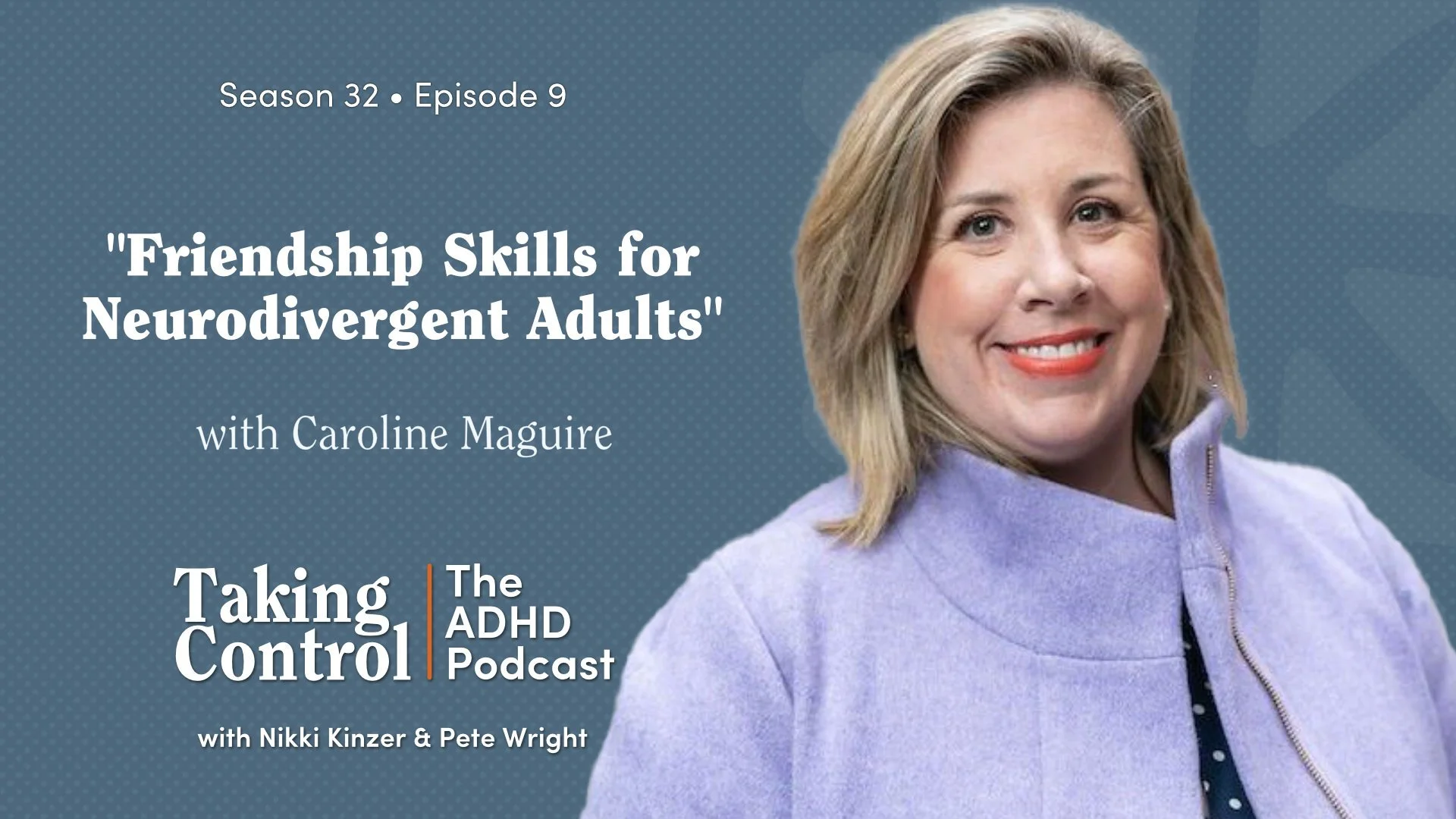
If you've ever given everything to a friendship and been left wondering what went wrong, Caroline Maguire has a gentle but clarifying answer: you probably gave too much, too soon, to someone who hadn't yet earned it. That's not a character flaw — it's the ADHD brain doing what it does when it finally finds someone who sees it. The dopamine hit of new connection can tip straight into hyperfocus, and suddenly you're all-in on a relationship that hasn't had time to prove itself. Caroline calls it the impulsive friendship cycle, and she has spent years helping neurodivergent adults find their way out of it.
Caroline is a social emotional learning expert, ADHD coach, and author of the award-winning Why Will No One Play With Me. Her new book, Friendship Skills for Neurodivergent Adults, arrives April 14th — and it's not another book that asks you to fix yourself to fit a friendship model built for someone else's social battery. Instead, she starts with a reframe that carries the whole conversation: our friendship struggles are not a personal failing. They're a neurological mismatch between the way we were taught to connect and the way our brains actually work.
In this conversation, we dig into the masking vs. adapting distinction that has already sparked significant conversation in our Discord community — including what makes the difference between reading a room and suppressing yourself entirely. Caroline walks us through the ice cream scoop method for building trust slowly, what "emerging friend" means and why it matters, how to troubleshoot a friendship before you decide it's over, and the unmasking story she never expected to tell — including the moment Ned Hallowell called her out on a mask she didn't know she was wearing.
This episode is part of our ongoing relationships series, and it may be the most practical and personally honest conversation we've had in it yet. The book is available for pre-order now, with bonus resources, at any major bookseller.
Links & Notes
-
Pete Wright:
Hello everybody, and welcome to Taking Control: The ADHD Podcast on TruStory FM. I'm Pete Wright and I'm here with Nikki Kinzer.
Nikki Kinzer:
Hello everyone. Hello, Pete Wright.
Pete Wright:
Hi. We had a little bit of an energetic pre-show.
Nikki Kinzer:
Hi. Yeah.
Pete Wright:
I'm trying to dial it back a little bit. I don't want to come in at a 13 when people are expecting a seven or eight. I'm just trying to chill out a little bit because I'm liable to get worked up again.
Nikki Kinzer:
Got it.
Pete Wright:
We have a fantastic guest and we're talking about friendships. And you know how I feel about friendships.
Nikki Kinzer:
Mm-hmm.
Pete Wright:
Friendships are the best, and they are warm pudding and hookah. And so I'm very excited about this. It's Caroline Maguire. But we have to do our little boilerplate intro first so people know where to find us. I can already feel it boiling up.
Before we talk to Caroline, make sure you head over to takecontroladhd.com to get to know us a little bit better. You can listen to the show right there on the website or subscribe to the mailing list — we would love to send you an email each time a new episode is released. Find us on all the socials at Take Control ADHD and jump into our Discord server at takecontroladhd.com/discord. That's where all of the coolest ADHD people are hanging out and chatting.
Now, if you're looking for a little bit more — just a smidge, just a sniff more — and particularly if this show has ever touched you and the way you live with your ADHD in a new or different way, we invite you to support the show on Patreon. Patreon is our listener-supported podcasting partner. With a few dollars a month, you can help guarantee we continue to grow this show, add new features, and invest more heavily in our community. Patreon.com/theadhdpodcast to learn more.
Caroline Maguire has spent her career in the mechanics of human connection. She's a social emotional learning expert, an ADHD coach, a TEDx speaker, and the award-winning author of Why Will No One Play With Me, a book that reshaped how we think about social skills for kids with ADHD. And now she's turned her lens on us — the adults — and her new book, Friendship Skills for Neurodivergent Adults, is the guide so many of us have been waiting for. In fact, it was a year ago as we record this that Caroline was here on this show teasing the concepts that she has written in this book. The book comes out next month. Caroline, welcome back to Taking Control: The ADHD Podcast.
Caroline Maguire:
Thank you so much. I'm so happy to be here. You were someone I thought of a lot when I was writing this book, Pete. So I don't know what that says. But we've had so many discussions about friendship and rewriting the friendship map. And so I'm so happy to be here. I'm so happy to have this conversation.
Pete Wright:
Well, let's — yeah.
Nikki Kinzer:
Well, we're thrilled to have you.
Pete Wright:
God, for sure. Let's dig in. If people are coming to you from Why Will No One Play With Me, where you're helping children address the needs of children and their social emotional skills — what inspired you to turn that lens toward adults with Friendship Skills for Neurodivergent Adults?
Caroline Maguire:
So there were a couple of things. When I was promoting Why Will No One Play With Me, so many adults kept coming up to me and saying, this is all good, but I don't know how to make friends. How can I help my kid?
And then I helped Jessica McCabe with her book. I co-wrote a chapter, "How to People," with her. And we spent every Friday working on her book. And it was so much fun. And I just started developing tons of stuff. And then I just started turning my lens on it and really focused the past three years on clients who are adults so that I could hone this.
And everyone kept saying we need this, we need this. And so I finally decided — we do need this, and I'm gonna go for it.
So it really was about the community. And so many things that have happened since the pandemic. I feel like since the pandemic, the diagnostic rates have exploded and we have all kind of coalesced around a few ideas. And one of those ideas is: we want more. We want friends. We want to unmask. We want to be ourselves.
And so it really is the community that inspired me.
Pete Wright:
I have a feeling that community is pretty natural to us — particularly a year ago when you started talking about these concepts. It seems so incredibly obvious, because as soon as you're talking about kids with neurodivergent developing skill sets, you're talking about their parents who are discovering their own stickiness with this very topic. So I imagine it was a bit of a hand-to-glove kind of natural experience for you. But I would love to know: what was your experience writing about these friendship dynamics that surprised you in the process?
Caroline Maguire:
I think what surprised me was I'm different than I was when I wrote Why Will No One Play With Me in 2017. And I think in all the best ways. And I think I really realized that the problem — I had this sort of salient moment where I realized the problem with everything out there, to paint with a broad brush, because I buy all friendship books, right? And I read them, is that they all basically tell us to change. And to change everything about ourselves. And they don't take into account the fact that we do friendship differently.
And I think that was one of the biggest things — I very early on said: I'm gonna tell the reader that you don't have to change everything about yourself, and that you get to make choices. Like, if it's too much for your social battery, maybe you don't want a hundred friends. You want two or three friends.
I feel like Caroline 2017 would have been afraid to kind of go like, I'm gonna flip this all on its head. Whereas I feel like now I kind of realize that — because some of the publishers who didn't buy the book, and shame on them, were basically like, well, can't you people read the books about friendship that are already out there? And I was like, that's rude.
And then I was like, well no, because they don't take our neurology into account. And it was such a salient moment for me. I'm reading the email back and I'm like — it just struck me like a lightning bolt. No, we can't, right? Like, if we could have done that, we would have done that. Don't you think I wanted to conquer this problem in the fourth grade?
And then the second thing, Pete, was I feel like so many people still to this day feel like all of our friendship struggles are a personal failing. And I really started to be like, I have to help people see that it isn't, and we have to stop indicting ourselves and shaming ourselves. And it made me really passionate about this. Gosh darn it, it is not a personal failing.
Nikki Kinzer:
But you're right. So many people take it as that. Like, if somebody didn't respond to me, or if I haven't heard from someone for a while, there's this immediate — I've done something wrong. They don't like me. I was too much. Whatever it might be that's going through your head.
Pete Wright:
This is where the "shoulds" come out for me. Because I think we mentioned it on a recent episode too — I've been noodling a lot about Dunbar's number. This is the number that Robin Dunbar came up with that says you should have 150 kind of acquaintances all the way down to five very, very close friends. And that's about all we can handle as human beings. And if you imagine a target, each concentric circle out gives you a little bit more in terms of the number of friends, but they're not as close to you.
And I'm curious your perspective, after having written the book, on how debunkable Dunbar's number ends up being. Because for me, I have to give so much more forgiveness to myself for feeling very strongly about the friendships that I do have, even when they are out of sight, out of mind.
Caroline Maguire:
I think things like Dunbar's number — I do think we have more acquaintances than we have close friends, and I have a tool called the Flavors of Friendship, where I talk about: here's all the levels of friendship. Here's what to expect at those different levels. Here's how you build trust with people. Don't give trust away. Trust is track record. I talk about all that. But I think all those numbers, all those different things — they're also based on typical people.
So I almost feel like we all have to come up with our own number. And we have to know the research and know, hey, you do have more acquaintances than you do close friends. But maybe, Pete, you can only handle three close friends. You only want to socialize this much.
Know what's going on. Know that it's hard if you don't respond to people — they don't know what's going on. You have to communicate about that and say, hey, I haven't responded to you just because it's hard for me. But I don't know that we can match to those numbers, right? Because those numbers are based on a social battery that I don't possess. That kind of debunks it right away.
Nikki Kinzer:
Do you think — we had a guest not too long ago who talked about being an introvert and having ADHD, and I'm definitely an introvert. So it's interesting. Do you feel like if that is also added to the mix, you're even going to have fewer friends? Because it does take a lot of energy to be in a social situation for longer than an hour.
Did you do any of that when you were studying this or thinking about it?
Caroline Maguire:
Yes. And I've been saying this lately — I kind of think the way we were taught to friend as kids, and sort of the popular assumptions about friendship that make people feel bad and make people feel shame, were based on an extroverted model.
And one of the reasons burnout happens, or people are like, I don't want friends because my social battery gets run down — and we really struggle with this as a community — is partly because people are trying to match those extroverted standards.
You're an introvert, which means you need different things from friendship than, say, I do. You have a different social battery. And a lot of this is about: does it fulfill your friendship cup? Do you feel fulfilled?
And we have to check ourselves, because sometimes we're cynical and we're scared of friendship and we're telling ourselves we're okay when really we're not.
But I do think that introversion piece — I very much talk about this in the book, because I think that goes back to the "Pete shoulds." I'm sure, Nikki, I'm just gonna take a guess that when you were a kid, people were like, buck up and function like an extrovert, and you're not.
Nikki Kinzer:
Mm-hmm. Right. Yeah, yeah.
Pete Wright:
Yeah.
Nikki Kinzer:
Well, I get that even from my husband, who's an extrovert. Because we'll go somewhere and he'll want to be there longer, or I won't want to go at all. And I think after you turn 50, you just start to not care. And so now I'm just like, nope, you go and I'm hanging out at home and everything's fine — doesn't mean anything is wrong with our relationship. You know, I can pick and choose and not feel that "should" anymore.
Caroline Maguire:
Yeah, it's fine.
Nikki Kinzer:
Because small talk is the worst thing for me. I would rather have a one-on-one deep conversation than do the small talk at a party.
Caroline Maguire:
Yeah, and I know that from so many neurodivergent people too, Nikki. I literally — the way I talk about small talk in the book is: listen. Small talk is necessary for meeting people. I know you all hate it, though. I'm basically like, don't come for me because I'm gonna tell you how to do small talk. Here's where you might need it. I'm providing this information to you, but please don't hate me because I know we hate it.
And I don't really like small talk either. I see it more as an experiment — I'm practicing my skills — than I do as an enjoyable thing.
And that's part of it too: other people make you feel bad because your social battery gets run down. But are you satisfied? That's part of this journey that I think I'm flipping on its head. I'm sort of saying: stop trying to meet that model that we were told as kids. Start trying to figure out what you really need.
And then — here's the data: if you never show up, people do forget about you. People do get upset. So I'm very into: know what's going on socially and navigating the social world, and then also make choices and sometimes explain to people.
I've been telling the story a lot — I met somebody who I knew from my baby groups, and I kind of reacquainted with her last summer. We were having coffee every month, and I like her so much. And basically in November — we were going to a conference — I had to be like, so I will see you in May, because I'm finishing editing a book. I'm going to this conference and then I have a book coming out. And I won't have a morning to give up to go to coffee. But I want you to know that when I fall off the radar, I really like our coffees and I'd really like to get to know you more.
And I think that's part of it. I call it a "communisflation" — hey, I am a person who forgets to text back.
Nikki Kinzer:
Mm-hmm.
Pete Wright:
Yeah. And what I'm hearing is: if you take control of the path forward in a relationship, you don't have to stress so much about rebuilding a broken relationship later.
Caroline Maguire:
Yes. Yeah, I love how you articulated that. That's so true. And P.S. — I don't want Nikki to try to meet typical extroverted standards that aren't her social cup. And then she's talking to me in six months about how she did everything.
And by the way, that loops into masking. Doing everything everybody expects of you, even when it doesn't work for you — to me that is part of the sort of masking umbrella where you're not just pretending you're someone else. You're also behaving in a way that meets everyone else's standards, but doesn't help you to survive.
Nikki Kinzer:
So we had this conversation with Dr. Sharon Saline about masking, and our community afterwards had a lot to talk about with it. And one of the things that I noticed in your book — that is beautifully written — I hope that group listens to this, because I think you need to get this book ASAP so you can get the differences between what adapting is and what masking is.
Can you just share a little bit about what the difference is?
Caroline Maguire:
Yeah. I think one of the two little criteria that I came up with is: if you're suppressing your preferences and needs, that's masking. So I pretend I like chocolate ice cream because you like chocolate ice cream, or because I don't want to say this doesn't work for me.
Food allergies are a thing now, right? So people say all the time, I can't go to that restaurant. But we as neurodivergent people often mask. We often say, oh, I'm going to pretend I'm not allergic to garlic. So I'm going to go to a Chinese food restaurant where everything has garlic and I can't even eat. That to me is masking because you're suppressing your preferences and your needs.
Pete Wright:
Well, you're also sending a message that who you are is broken.
Caroline Maguire:
Who you are is broken and you don't matter. Right? You don't matter.
Nikki Kinzer:
Right.
Caroline Maguire:
And some of this is suppressing those neurodivergent traits. This book is neurodivergent friendship. So our AuDHD friends and our autistic friends are part of this. And if you have sensory needs —
And I say — come to the Taylor Swift concert. Now, Taylor Swift people, do not come for me.
Nikki Kinzer:
Yeah.
Caroline Maguire:
Okay, this is an example. I didn't go to the Taylor Swift concert because I don't do well with loud noises.
Nikki Kinzer:
Mm-hmm.
Caroline Maguire:
But if you pretend you do and you just live in misery all night — I'm sorry, Taylor Swift fans, again, don't come for me. I understand you had a great time. My daughter, my husband had a great time. It's just not my scene.
That to me is masking. I think adapting is more reading the situation around you. Thinking about not suppressing your needs in favor of others, but — when do I hold back because someone else is having a bad day? I don't tell someone who's just become unemployed that things are going great for me.
Nikki Kinzer:
Right.
Caroline Maguire:
Right?
Nikki Kinzer:
You're reading the room.
Caroline Maguire:
Right. I'm reading the room. And sometimes you read the room and you make a choice and you say — I'm reading the room and you don't want me to say that I have a garlic allergy, but I'm gonna go ahead and say it anyway. But I think adapting becomes this ability to think about your role, how you want to show up, and then you're adapting to the different situations versus I'm suppressing.
I don't know, Nikki, if I'm doing a good enough job with that versus the book.
Nikki Kinzer:
You are. And one of the things that you have is this diagram — pause, Pete, while I look for it. Hold on.
Pete Wright:
Okay.
Nikki Kinzer:
It was up above —
Pete Wright:
Pause everybody. Don't say anything smart.
Nikki Kinzer:
Yeah, yeah.
Pete Wright:
Yeah, yeah, yeah.
Nikki Kinzer:
Everybody pause. Because it was about choice and — PDFs are hard.
Caroline Maguire:
I'll just go to the masking chapter and look.
Nikki Kinzer:
Because you have the differences between —
Caroline Maguire:
So I have — it feels like a choice for adapting.
Nikki Kinzer:
Yes.
Caroline Maguire:
It's usually temporary for adapting.
Nikki Kinzer:
Yes. That's the one.
Pete Wright:
That's the one.
Nikki Kinzer:
It's on page fifty-eight. So let's start over again.
Caroline Maguire:
Okay.
Pete Wright:
Okay.
Nikki Kinzer:
All right.
Pete Wright:
All right.
Nikki Kinzer:
So Caroline, you have in your book a really great diagram about the differences between adapting and masking. And what really touched me — what really resonated with me — is that adapting feels like a choice, where masking feels like you're powerless to make a choice. And I think that's really key, right?
Is that when I'm adapting, I'm making a choice to adapt to the other person, like we're talking about. We're reading the room. I'm gonna lower my energy because this person I can see is having a bad day. Or the opposite, even — because it's contagious, right? Somebody could be having a really good day and come into a conversation really excited and now all of a sudden my energy is up because I'm mirroring them.
But the masking — a great example is the restaurant. I don't feel like I have a choice, going back to what you guys were saying before, because I'm broken and I don't matter and I shouldn't have a say about where we go to eat.
Caroline Maguire:
Exactly.
Pete Wright:
Exactly.
Caroline Maguire:
It should feel like a choice and it should be temporary. So adapting is temporary, right? I'm adapting temporarily.
Nikki Kinzer:
Right.
Caroline Maguire:
Not my entire personality, which is different from who I really am. And I never express my needs and my preferences.
Nikki Kinzer:
Yeah.
Nikki Kinzer:
And it stems from fear.
Caroline Maguire:
And it does.
Caroline Maguire:
And it does stem from fear, because people write me and DM me and they say, oh, this is nice, Caroline, but the fact is I won't have anybody. And so there's this fear we have around — if I say my needs and my preferences, or I leave the party after an hour, right?
Nikki Kinzer:
Mm-hmm.
Caroline Maguire:
I'm really coming in hard on that. Your husband's gonna be like, Caroline, go away. But —
Nikki Kinzer:
He totally gets me. We've been married for twenty-five years. He gets it. He understands.
Caroline Maguire:
But, you know, that feels like it comes from fear. And if you stay seven hours because you feel like you don't have a choice, that to me is masking.
Nikki Kinzer:
Yeah.
Nikki Kinzer:
For sure.
Caroline Maguire:
And by the way — this is my message to everyone. Do you really want to be friends with people who, if you said — you know, this has dire consequences to me —
I had a gentleman who told me a story: if he sits in the sun, as an autistic man, it has such effects on him — the sensory, the whatever. He just doesn't like to sit outside in the sun. It literally gives him a headache. He feels terrible for the rest of the day. If someone doesn't care about that, they're not your friend.
Nikki Kinzer:
Absolutely.
Caroline Maguire:
PSA. Hot take.
Pete Wright:
Yeah. Right.
Nikki Kinzer:
Yep.
Caroline Maguire:
They're not your friend.
Nikki Kinzer:
Move on.
Caroline Maguire:
Move on.
Caroline Maguire:
And so that's part of this.
Nikki Kinzer:
Right, right.
Pete Wright:
Yeah.
Nikki Kinzer:
Accepting —
Pete Wright:
I think part of the reason that this masking/adaptation presentation skill set is so confusing is because many people in our sort of shared set of circumstances have been doing it so long they don't know what it means to do anything different. It feels like normal.
Caroline Maguire:
Absolutely.
Pete Wright:
It feels like masking. What's that? I call it Monday.
Caroline Maguire:
Right. I tell my unmasking story in this book. And I really was — I was going around when I was writing this book at first and saying, masking is so important and it's such a journey, and my clients take years to unmask, and I'm gonna talk about it, but I don't mask.
Caroline Maguire:
And my friends were like, what are you talking about?
Pete Wright:
Oh, you got called out?
Caroline Maguire:
And I kind of did. I got called out.
Caroline Maguire:
Ned called me out.
Nikki Kinzer:
Wow.
Caroline Maguire:
Ned was like, you have a mask. Your mask is "I've got it all together" and you don't ask for help. And I was like, oh wow. When Ned Hallowell tells you you have a mask, it's time to take a good look.
Pete Wright:
Oh my god. Oh my god.
Nikki Kinzer:
You need to listen, yeah.
Pete Wright:
Caroline, that's going on your headstone.
Caroline Maguire:
But Ned is part of how I unraveled that persona.
Pete Wright:
"Ned told me I was masking." Rest in peace.
Caroline Maguire:
Right.
Pete Wright:
Yeah.
Nikki Kinzer:
Yeah.
Caroline Maguire:
Because he said to me — even before, you know, he had called me on that and made the joke — but years ago, when I was having trouble with my book team and I was having some struggles in my professional life, I went to him unmasked, unadulterated, and said, I'm in trouble here.
And I tell the story in the book. I didn't send him curated emails like I normally do. He basically said to me, isn't this better? And I was like, yeah.
Nikki Kinzer:
Yeah.
Caroline Maguire:
So, you know, I think we all wear different masks, and there are safety issues — sometimes you have to wear a mask. And we can mask for short periods of time. But I think it is like Tuesday — like, oh, I didn't even realize this.
And I want to say this to everyone: unraveling this takes a lot of time. I don't want people to feel like they should listen to a podcast and at the end of it be unmasked. That's completely unrealistic. And going back to the shoulds —
Nikki Kinzer:
Right, right.
Caroline Maguire:
You unmask at the pace you unmask.
Nikki Kinzer:
Right.
Caroline Maguire:
And I walk you through how to do that, but I also say: your doing that might begin with just you reading this chapter. And that might be the most you feel you can do at this time.
Nikki Kinzer:
Mm-hmm. What are the other things in the book that you feel are important? I mean, obviously everything in the book is important. And I've only seen it for like five minutes and I love it already.
What are some takeaways for our audience today? Maybe something you could share — a chapter, a method — something that can help. Maybe a more common challenge you've heard from clients.
Caroline Maguire:
I think one of the most — oh, go ahead.
Nikki Kinzer:
Oh, Pete, do you have your hand up?
Pete Wright:
I do. I know you asked an open-ended question, but I actually have a request. I feel like I'm calling a DJ.
Nikki Kinzer:
Oh, good.
Pete Wright:
I have a request. I too have only had the book for about five minutes, but I am looking at the impulsivity chapter. In terms of our relationship series tie-in — this framing, that for neurodivergent people meeting someone who sees you releases a hit of dopamine that we can rush into fast — especially coming off of this masking topic — what does that mean for building new relationships and cultivating and encouraging them?
Caroline Maguire:
I would actually say this is an important thing, Nikki. I'm answering both questions.
Nikki Kinzer:
Yeah. Great.
Caroline Maguire:
The impulsive friendship cycle is something I talk about. And by the way, everyone — I totally own my stuff. I resemble this remark. I was the queen of impulsive friendships. And I think it was the time that I realized I was becoming friends with someone who was racist — and whatever — that I was like, I gotta stop this cycle, because I'm now trapped with people who I would never even talk to.
Nikki Kinzer:
Right.
Caroline Maguire:
So it's this idea that our brain is under-aroused, so we're seeking stimulation. And there's nothing better than falling in love. And friendship is very much like falling in love. When we are meeting people, it's very easy to get very caught up in them and to get a kind of hyperfocus.
And even introverts and inattentives may be thinking, oh, I don't do this — but I gotta call you out and say you do. It looks different. I'm literally running through the fauna toward the friend, and it's big actions and you can see it from a mile away. But I see this with all my clients. I see this with my autistic clients too.
We're so excited. It is exciting. And we don't stop to look at — is this person really a fit for me? And I don't mean fitting in. I mean, are they my people?
Nikki Kinzer:
Right.
Caroline Maguire:
And because we're so used to masking, I think there's a degree where we're like, oh yay, someone likes me. Let me bend myself into a pretzel to be who they want me to be.
Nikki Kinzer:
Mm-hmm.
Caroline Maguire:
And so I do think this is one of the most important things: stop calling everyone who's an acquaintance a friend, because then you expect things from them — you imbue them with the characteristics of friendship when they haven't earned it.
Pete Wright:
And the first time is the most important thing. But "acquaintance" seems so cold. What do you call them?
Caroline Maguire:
What about "emerging friend"?
Pete Wright:
Oh, emerging friend.
Caroline Maguire:
Right? They're like a buddy. They're an emerging friend. You're hoping — it's kind of like your fourth date. You're hoping this will stretch to five dates, six dates, seven dates. You hope someday your husband is saying what my husband says to me: "Why are you so great once you get there? But you complain every minute till we get to an event."
You're Nikki who wants to leave after an hour. You're hoping you get to have that. But I think we rush into friendships and give too little thought. And I'm really asking us to look at that and say: who are your people? I'm walking you through looking at that.
Here's my latest example: if you are trying to date, my clients who are trying to date spend like hours on Hinge profiles, but they spend like two minutes thinking about — who are my people, who do I want to be friends with, what are my values, what do I need out of someone, and what are red flags?
Nikki Kinzer:
Mm-hmm.
Pete Wright:
Yeah.
Nikki Kinzer:
Yeah.
Caroline Maguire:
Like, when they don't care that you have a garlic allergy and they're asking you to eat at a Chinese food restaurant — red flag.
Pete Wright:
Yeah.
Nikki Kinzer:
Yeah.
Pete Wright:
I think all of this strikes me because you're talking to me personally. I think I'm somebody who overextends the word "friend." And maybe being a little bit more precious about it will help to refine or focus the relationships that really are friendship relationships. And that's a hard pill to swallow, I think.
Caroline Maguire:
I'm sorry, Pete.
Pete Wright:
It's okay.
Caroline Maguire:
I don't mean to make you dwell on that pill on your own podcast.
Pete Wright:
I mean, this is what this show is all about: give Pete something hard to think about.
Nikki Kinzer:
Yeah.
Caroline Maguire:
Well, but also let me just say this. I don't think it's just that. I think it's this: don't give to them at the level of a friend yet. We give to people and then we say, oh, people take from me. And part of it is also — if someone says I can't have coffee, and we've imbued them with the qualities of a friend, it pushes that rejection sensitivity button, because now I feel rejected. But you aren't rejected.
If God forbid something's happening in your family and you call a real, true, bosom close friend — of which you've told us you think there's five, I think there's three, in your lifetime — you should expect that. Like, something's happening with my family. I need to talk to you. I need support. But if I expect that from an acquaintance and then they don't give it to me, I feel rejected.
But that's lopsided. They aren't really my friend. So it's more than just what I'm making Pete think about.
Pete Wright:
Yeah.
Caroline Maguire:
It's also so that you don't feel rejected, because you're not really being rejected.
Pete Wright:
Also — you don't need to feel rejected. You're balancing an equation. It's everything comes back to algebra.
Nikki Kinzer:
Mm-hmm.
Pete Wright:
Everybody knows this.
Caroline Maguire:
You mean I can't do algebra, Pete.
Pete Wright:
You just have to balance the equation. Well, you do — you're doing algebra right now. The whole issue — I think you just described it so perfectly. We give and give and then when they don't give back, we say they're taking. But the truth is we just gave too much before we got to see if they were willing to give back. And that's what makes the friendship — when you get to be a giver and a receiver.
Caroline Maguire:
Yes.
Pete Wright:
And I can't believe I'm saying this in my fifties, but that's a new way for me to think about these social relationships. And I can start ticking them off in my head right now. We say this is the common thread for adults: oh, as an adult it's so hard to make friends. Well, for a lot of reasons — not the smallest of which is we're so impulsive about the potential for new friendships that we meet in mom groups, on kids' athletic fields, whatever — that maybe we overstate too early the role of that relationship in our lives.
Caroline Maguire:
I think we do. And I think there are a couple of other things in the book that are important. One — I have an ice cream scoop method, and I don't mean for everything to be about ice cream. That's like a theme. I don't know. Maybe I need ice cream.
Nikki Kinzer:
Do you like ice cream?
Caroline Maguire:
I do like ice cream.
Pete Wright:
Yeah, it's an ice cream day.
Nikki Kinzer:
Okay.
Caroline Maguire:
I have a method for sharing. And basically it goes back to what you're saying, Pete. It's like — I give you a scoop and then I see what you do. And then if you do something positive, I give you another scoop. I don't give you the whole ice cream at once. And that's because trust is track record. And I think we don't think about that enough.
And as a person who rushed into friendships for 40 years, I have to tell you, that is a hundred percent true. I've lived it.
Pete Wright:
It's so good.
Caroline Maguire:
And then the other thing — I feel —
Pete Wright:
The metaphor is so good. My friendships — I am just throwing scoops of ice cream at your face and waiting to see what you do.
Caroline Maguire:
You're like, here's a gallon. Here's a gallon of ice cream.
Pete Wright:
Yeah.
Caroline Maguire:
Now will you give me even a cherry back?
Pete Wright:
Yeah.
Caroline Maguire:
No.
Nikki Kinzer:
Right, yeah.
Pete Wright:
Right.
Caroline Maguire:
This is why I love you guys. We have so much fun. And then the other thing is — I have a troubleshooting section. So many people — I even had texts from clients this week who were like, you know, investing in people and then feeling burned. And I get it. And it's so hard.
But I have a troubleshooting chapter where I'm like, okay — before you say that you've invested for months and they have given you not a single scoop of ice cream and you are just distraught — go through and sort of check: did you actually — was it actually a friendship? Did you actually do stuff to see them? Or were you — and I resemble this — alone on your couch thinking that you're building a relationship.
That's not building. And so I think that's important, because one of the things we also do is: we don't do great with self-reflection. And I'm right there with everybody else — to sort of pause and go: wait, I've given them the entire tub of ice cream. Have they given me anything back?
And when things fall apart — also to sort of say: is it really falling apart, or is this a snafu?
Nikki Kinzer:
Right, right.
Pete Wright:
Yeah. Yeah.
Nikki Kinzer:
Which we go straight to — it's falling apart.
Caroline Maguire:
It's over.
Nikki Kinzer:
And it's the worst case scenario.
Pete Wright:
Yeah. The ice cream is melted.
Nikki Kinzer:
Yeah, right.
Caroline Maguire:
The ice cream is gone, Pete.
Nikki Kinzer:
Yeah, it's all melted and the truck is gone.
Caroline Maguire:
From the planet — the ice cream is gone, you'll never have ice cream again.
Nikki Kinzer:
That's right.
Caroline Maguire:
Right? That's what we do.
Nikki Kinzer:
That's right. But it's how it feels.
Pete Wright:
Yes, yeah.
Nikki Kinzer:
Yeah, for sure.
Caroline Maguire:
That's how it feels. And I'm right there with you. I've been right there with you.
Nikki Kinzer:
Mm-hmm.
Caroline Maguire:
But I want people to sort of — I have exercises to check that — because I think so often: look, friendship is harder for us. I'm not gonna lie about that.
Nikki Kinzer:
Mm-hmm.
Caroline Maguire:
But I also think there are these ways where our mind plays tricks on us, or where our mindset makes us feel way worse. And having that sort of pause, having that self-reflection — sometimes when you reflect, you're like, this friendship is lopsided and that stinks. And then go eat some ice cream, because you'll feel better.
Pete Wright:
Yeah. Right.
Nikki Kinzer:
Right, right.
Pete Wright:
Right. Not metaphorical ice cream.
Caroline Maguire:
No — real ice cream. Real ice cream, yes.
Pete Wright:
Go get some mint chip. Yeah.
Nikki Kinzer:
It's interesting when you say it's lopsided, because I think of some of my friendships in the past, and some of them have definitely been seasonal. Like when you talk about the kids' sports and things like that — they're seasonal friendships, acquaintances, maybe some of them do end up being good friends.
But it is interesting when you talk about the lopsided, because if you look, you'll see the red flags if you're aware. But if you're not paying attention, it can really go past you pretty quickly.
And then you get disappointed. I remember I had another friend whose mother had passed. And I was going up to go to the funeral and be with my friend, to be with her in that moment. And then this other friend said something really strange to me: well, I don't know if I would tell you if my mother passed. And I just thought it was so strange.
Pete Wright:
Wow.
Caroline Maguire:
And kind of mean.
Nikki Kinzer:
I know.
Caroline Maguire:
I'm kind of mad at them now.
Pete Wright:
I know.
Nikki Kinzer:
I'm like — you wouldn't tell me that you were going through something like that?
Nikki Kinzer:
And it really was an eye-opener — this is a lopsided friendship — because I would have immediately gone to her.
Caroline Maguire:
Right.
Pete Wright:
Yeah.
Nikki Kinzer:
She did not see me in that light. And she also didn't see me in the light to celebrate her big birthday.
Caroline Maguire:
Okay, I'm furious with her right now.
Nikki Kinzer:
Which was weird.
Caroline Maguire:
I'm furious with her.
Nikki Kinzer:
Yeah. Yeah.
Caroline Maguire:
I need her phone number and her name, and I'm gonna hunt her down.
Nikki Kinzer:
I know.
Caroline Maguire:
But no — this is the thing too, Nikki.
Nikki Kinzer:
Yeah, so strange.
Caroline Maguire:
I want everyone to hear me so that they don't think I just joke around. That is the hardest moment. And I've been there and I've had those moments.
Nikki Kinzer:
Mm-hmm.
Caroline Maguire:
I've had moments where someone doesn't invite you and you're like, wait, I thought we were friends. We've all had those moments. And I want to say: that is so hard. And that's why some people are cynical about friendship or cynical about this whole topic.
But if you know — I have a whole section on relationship repair and also lopsided friendships. If you read that section and it strikes you, I know that that's a painful day. But I would rather know.
And there's a whole chapter on how do you know if someone is a friend and if they'll be a good friend. And I just want to say — that's why I think Pete's thing about online friendships, that we've talked about in the past, is key.
If I know that I have some people who are there for me and where we have that relationship, even if it's online — and I'd prefer in person — even if I don't get to see them every day — then I'm more empowered to hear that horrible thing that a woman said to you, Nikki — which by the way, I don't think anyone needs to say that out loud. That was kind of mean.
Nikki Kinzer:
I know. It was weird.
Pete Wright:
Yeah. Maybe try a little masking for the other person.
Nikki Kinzer:
It was, yeah.
Caroline Maguire:
Right. They ask a lot of it.
Caroline Maguire:
But then you feel less scared. And you feel less alone. But it is so hard. And it's hard also when you invest and you like someone and they don't reciprocate. But I think we take that as: that's all about me.
And one of the messages I want to get across is: that could be — look at what I did to this poor woman who started having coffee with me. I'm basically like, I'm gonna see you after November through May, because I'm launching a book and I'm getting my daughter into college.
And luckily she was like, cool beans.
Nikki Kinzer:
Right, because that's a good friend.
Pete Wright:
Yeah.
Nikki Kinzer:
Because they want to support you.
Pete Wright:
Yeah.
Nikki Kinzer:
Yeah, good luck. I hope everything goes well. I'll catch you in May. I can't wait to hear about it — because they're not going to take that in a bad way. They're going to appreciate that you're being honest, and you'll reconnect when it's the right time.
Caroline Maguire:
And I think also that's the other thing. I do think it's too bad that not everybody takes the Caroline Maguire course of etiquette and says stuff. I wish typical people would say stuff that isn't cruel and unkind — like this person I'm gonna hunt down for you.
And it's more like: hey, just FYI, my mother's in the hospital and I'm really overwhelmed and this isn't about you. And I know you've asked me to go to hot yoga a million times and I don't mean to not go.
But they don't always. And I advise in the book saying this stuff. And I know some people will say, well, we're tired of always having to explain ourselves as neurodivergent people. I'm not coming from that perspective. I'm coming from a much more logistical, human perspective: if you do sometimes disappear and you don't tell people, then they just assume you're not interested in them.
So I think it's better — in my "Am I Keeping Up with People" chapter — to tell people that it's hard for you to keep up with them. Tell them this is a thing so that they don't write you off.
Nikki Kinzer:
Right, right. Yeah.
Pete Wright:
Yeah.
Nikki Kinzer:
Oh my gosh, this is so good. We could talk to you for so long.
Pete Wright:
And I know you have — oh, for sure. I know you have this book, but this new course, the Caroline Maguire School of Etiquette — when you start enrolling for that, yeah.
Nikki Kinzer:
When is that coming out?
Pete Wright:
It's a very short course. It's just: say stuff.
Caroline Maguire:
And be human. And don't say what that person said to Nikki.
Nikki Kinzer:
Yeah.
Pete Wright:
Yeah. Yeah.
Caroline Maguire:
I have many people that I wish — my husband's always like, you would have to have so much money to do this. You'd have to be like a hundred millionaire to just go around doing like an Avenger. But I do have things where I wish I could go to people and be like, that was rude, and you didn't need to say that.
Nikki Kinzer:
And what's interesting is she probably doesn't even remember saying it, but boy do I ever remember it.
Pete Wright:
Oh, of course.
Caroline Maguire:
Nope.
Pete Wright:
Yeah.
Nikki Kinzer:
Yeah.
Caroline Maguire:
Yeah.
Pete Wright:
It's what the French call "escalator humor."
Nikki Kinzer:
Yeah.
Pete Wright:
Where you come up with this great retort when you're on the escalator, away from the engagement.
Caroline Maguire:
Oh, in my car.
Pete Wright:
Away from the engagement.
Caroline Maguire:
I'm like, oh, I should have said this. And I never say that — that was always my problem being bullied. People would say stuff and I had no response back. I don't have zingers. I'm not good at that.
Nikki Kinzer:
Yeah, yeah.
Pete Wright:
And so this is a practice — it's the Caroline Maguire School of Escalator Vengeance. You'll come up with it eventually.
Caroline Maguire:
We can update it.
Pete Wright:
Caroline, the book — I feel so lucky that we actually have it, even if just for a short time as preview readers. I am very excited to read it in depth. Tell us about it. When can people get it? Where will it be? Where do you want people to go to learn about it, sign up, pre-order?
Caroline Maguire:
I would love people to pre-order it. It's available anywhere your books are sold. It's available April 14th. I'm actually doing a ton that I'll be posting on Instagram, which is @AuthorCarolineM, about pre-sale bonuses.
I have book bonuses. So if you buy the book, you hit a QR code and I have a journal and exercises that couldn't fit in the book because I had to cut 60,000 words from the book — because it was too long, because there's a lot to say. I didn't give you 60,000 words in the book bonus, don't worry about that.
And then I'm doing a bunch of webinars and you get to talk to Caroline and ask Caroline: how do I figure out if my friendships are lopsided? So if you follow me on Instagram, you'll hear about that.
And then go pre-order the book so you can get free stuff, wherever books are sold. It's available April 14th. I'm so excited for April 14th. It's gonna be like a palooza of things.
Nikki Kinzer:
Yeah, that's so great.
Pete Wright:
That's awesome. Oh, so happy for you to be getting this one out to breathe in the open air. It's so wonderful.
Nikki Kinzer:
Mm-hmm.
Caroline Maguire:
I'm lucky. Thank you.
Pete Wright:
Well, we're thrilled to have you and can't wait to do it again. And we appreciate all of you for downloading and listening to the show. Thank you for your time and your attention. Don't forget — if you have something to contribute to the show, we are heading over to the Show Talk channel in our Discord server, and you can join us right there by becoming a supporting member at the deluxe level or better at Patreon.com/theadhdpodcast. On behalf of Caroline Maguire and Nikki Kinzer, I'm Pete Wright, and we'll see you right back here next week on Taking Control: The ADHD Podcast.
Subscribe to Taking Control: The ADHD Podcast