ADHD, Memory, and the Stories We Tell Ourselves with Daniella Karidi, Ph.D.
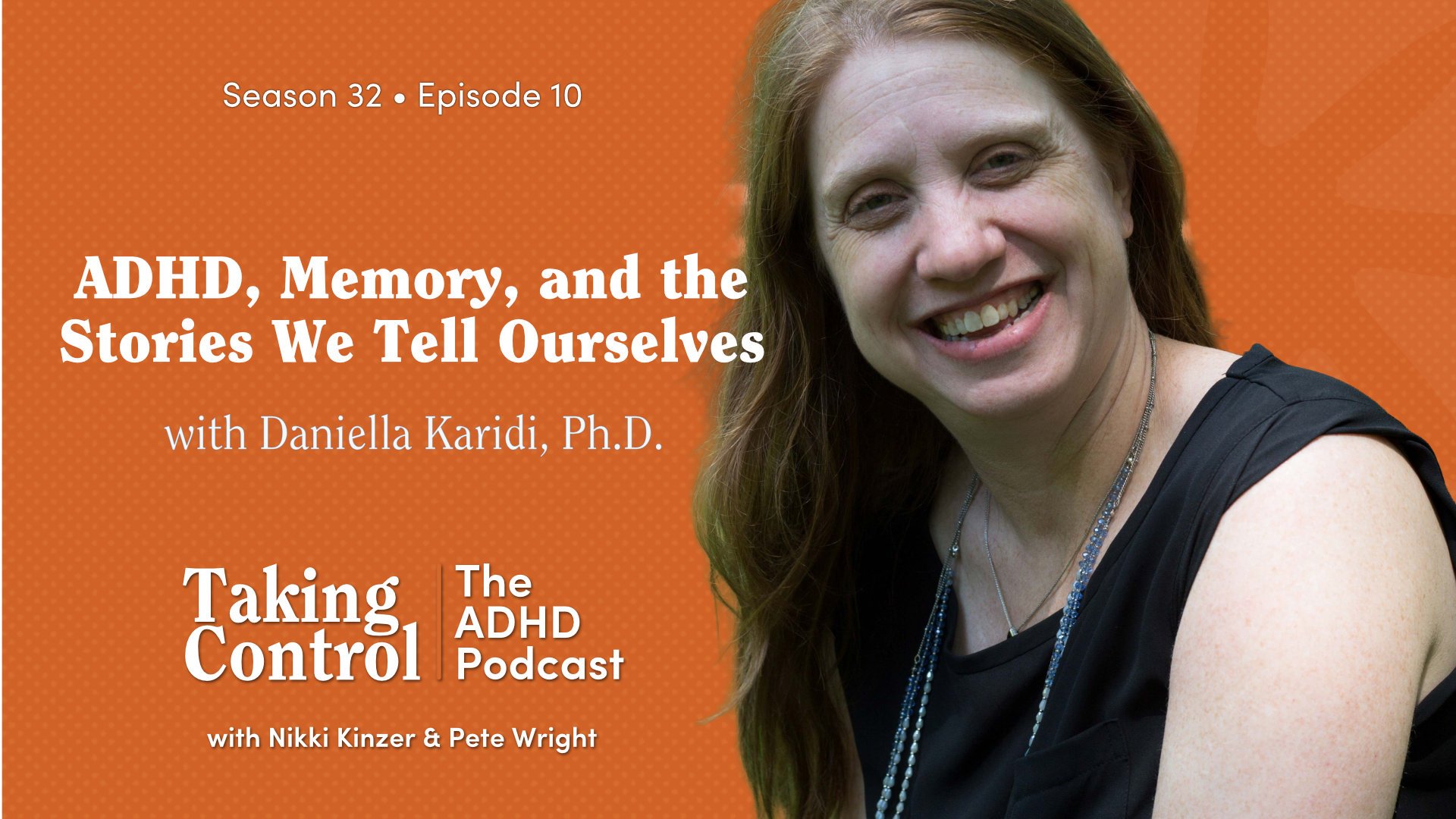
"You forgot because you didn't care enough." Most people with ADHD have been told that — or have told themselves that — more times than they can count.
Dr. Daniella Karidi returns to challenge it. She's a PhD researcher from Northwestern who has spent her career studying memory in ADHD, and her opening argument is one of those ideas that reframes everything that comes after: forgetfulness isn't a failure. It's the default of the system.
This episode also kicks off a new series on ADHD and aging — what happens when the structure we've built around our ADHD starts to change, how to tell normal forgetting from something more serious, and why brain fog in perimenopause and menopause is absolutely not your imagination.
Dr. Daniella Karidi is the founder of ADHD Time and a board member of CHADD Greater Los Angeles. Find her at adhdtime.com and on YouTube at ADHD Time on Air.
Links & Notes
-
Pete Wright:
Hello everybody and welcome to Taking Control: The ADHD Podcast on TruStory FM. I'm Pete Wright and I'm here with Nikki Kinzer.
Nikki Kinzer:
Hello everyone. Hello, Pete Wright.
Pete Wright:
Nikki, do you remember what we're talking about today?
Nikki Kinzer:
I was just going to do the same joke.
Pete Wright:
You can't do the joke. It was my conversational turn.
Nikki Kinzer:
Dang! No, I don't remember, Pete, but I did remember to show up.
Pete Wright:
Cheap podcast humor in the morning. That's what we are. We are thrilled to be here and thrilled to be talking about memory again. We've got our fantastic returning guest and friend of the show, Dr. Daniella Karidi, and we're going to dig into it.
Before we get into today's episode, though — if this show has ever helped you understand your brain just a little bit better, or made you feel a little less alone in all of it, there is a place you can go deeper. It's our Patreon community. This is where real conversation happens. There's more connection, more support. It is a group of people who genuinely get what it means to navigate life with an ADHD brain. There is no pressure to show up perfectly. You just show up however it works for you. Visit patreon.com/theadhdpodcast to learn more and join us.
What do you get? You get to watch this show as it records, live. You get access to our Discord server and all of the member-only channels. There are a lot of people in our Discord server who are living their best life with ADHD, and we'd love to introduce you to them. If you're not quite ready for all of that, you can always find us at takecontroladhd.com, connect with us on socials, join the public Discord community, or sign up for our weekly email. We'd love to have you wherever you land.
Memory is one of the most loaded topics in the ADHD experience because of what we make it mean about us. Today we're opening a new series on ADHD and aging, and we're starting where it gets personal: the stories we tell ourselves about what we can't remember, and how those stories compound over a lifetime.
Joining us is Dr. Daniella Karidi, founder of ADHD Time, board member of CHADD Greater Los Angeles, and a PhD from Northwestern with a research focus on — you guessed it — memory in ADHD. Daniella coaches people through major life transitions, and she's here to help us untangle what's ADHD, what's hormonal, what's just getting older, and how to stop treating forgetting like moral failure. Daniella, welcome back.
Dr. Daniella Karidi:
Thank you. I'm so honored to talk about this topic.
Pete Wright:
It seems like it's an important topic to you. Just to get people caught up — you've been here before, we've talked about memory before — but I'd really love to hear how you landed on this fascination, how you came to devote a career to studying humans and their memories.
Dr. Daniella Karidi:
As is typical for a lot of people, I got hyperfocused on something. What happened was, actually in third grade, I told people I was going to be an academic researcher and help people learn better and read better. I was very motivated as I continued in my career. I got an undergrad in education, special education, and psychology from Tel Aviv University, and then I continued to get a master's in diagnosing learning disabilities.
Being severely dyslexic, I struggled with helping people diagnose their dyslexia. It was kind of the blind leading the hearing-impaired — really challenging. I realized I wanted to become a researcher before going back to diagnosing. So I switched to the other side of the fence and flew to the United States to Northwestern University. My original focus was going to be speed of reading, or speed of listening and audio processing disorders. I love audiobooks at very high speed — 1.7 or 2 times — and I was really curious whether that did something special for neurodivergent brains.
Pete Wright:
Two-point-five right here. Yep.
Dr. Daniella Karidi:
I kept coming late to my lab meetings. I kept forgetting things. And my professor turned to me and said: that speed-of-reading thing is really interesting, but I'm curious about why you keep forgetting to come to our meetings. Is this a you thing or an ADHD thing? I looked at him — this was 2006 — and that's when I got into memory.
I wanted to see that I wasn't alone, that forgetting things that were crazy important to me wasn't because of a personality defect. The more I talked with ADHDers — I interviewed people first, then I developed a scientific tool, then I did the research — I found out that I'm definitely not alone. Having memory challenges is very common to ADHDers. They just don't look like the memory challenges of someone impaired from a car accident or from cancer or from aging. Our memory challenges are significantly different from the populations that have been studied most often.
Pete Wright:
The entire thing is fascinating. Especially as you bring up that memory issues in ADHD just don't look like memories that result from some sort of trauma. I think that probably goes toward explaining why forgetting sometimes feels like a character flaw when you're living with ADHD — because we can't trace it back to any one event.
Dr. Daniella Karidi:
Yes. And I'm going to add two important things that people don't totally understand. One is that forgetfulness is the default of the system. Our systems are not built to retain everything. If we were retaining all the information we're exposed to, we kind of would have exploded. There are actually some people in institutions who suffer from a medical condition of remembering everything. There are things we don't want to remember and things we don't need to remember. We are designed to compress information and keep it in a way that's easier to use for survival.
Can you remember what you ate for dinner on May 12th, 1999? No. But you might remember what you ate at your wedding, or at a special restaurant. Why won't you remember a specific dinner on a random day? Because our brain compresses all those dinners into a schema, into a story of what dinner is. We do that because it's good for our survival.
So forgetfulness is the default of the system. We have to overwrite that default in order to remember — and that requires energy, time, and effort. We think we will just default to remembering. We think someone will tell us something and we'll remember it. But something has to happen actively for us to remember. The challenge with ADHD is that sometimes we do that actively, and sometimes the system doesn't. The inconsistency is where we struggle.
Pete Wright:
Yes. Saying over and over that forgetting is the default — that is a worldview-changing statement. Because we've spent years being told that we're just not doing enough, not trying hard enough, that if we cared about whatever is in front of us we would remember it for sure. By the time we're adults, the shame around forgetfulness is so deeply baked in that hearing "forgetting, biologically and neurologically, is the default" is a grand awakening — for which we should have much more forgiveness for the years we've spent being told otherwise.
Dr. Daniella Karidi:
And this is like when you tell someone to "look harder." Looking is a skill we cannot activate harder — we look or we don't look. There is no "look harder." That is not a muscle we can just flex stronger. When we tell someone to "remember more," what are we exactly telling them?
We need to say the right words. Instead of "look harder," we say "pay attention" or "let's reduce distractibility." Those are words we can actually use when we want someone to look harder. So what should we be saying to ourselves and to others when we want them not to forget?
We should be using different language depending on what we're trying to remember and what we're trying not to forget. And that was my second important point. If there are only two things anyone takes from this conversation, let it be these: forgetfulness is the default of the system, and memory and forgetting are not one construct.
There are different types of memory: short-term, long-term, episodic, biographical — the list is never-ending. We can do the same thing for forgetfulness. There's forgetfulness that happened because we were distracted. Forgetfulness that happened because we were overwhelmed. Forgetfulness because our system was in anxiety mode. It's not one thing.
And if we treat ourselves the same way every time — "oh my God, we're terrible people, we forgot Debbie's birthday" — instead of saying, "of course we forgot Debbie's birthday, we're in the middle of an anxiety spiral, this is what's going on in our brain" — we automatically put the "I am a terrible person" label on ourselves.
Nikki Kinzer:
Mm-hmm. It's our fault.
Dr. Daniella Karidi:
Now, Debbie, if she's a good friend, will be able to understand if we apologize and take ownership. I want to make sure everyone who hears this doesn't think I'm giving them a card to forget Debbie's birthday. We're living in a social environment. Forgetting only counts if other people remember.
Nikki Kinzer:
True. They may forget too, and so we're all in the same boat.
Pete Wright:
I remember the first year both my parents forgot their own anniversary. It was a thing to laugh about. But if my dad forgot and my mom didn't, there was trouble.
Dr. Daniella Karidi:
My dad's favorite saying used to be: the problem is not what I forget, but what my wife remembers.
And this is about the social cost of forgetfulness. If you forget to report important information to your boss, you could get fired. There's a real financial cost if you forget to pay your taxes. If you forget to tell someone you appreciate them — that could be a social cost. We pay for forgetting. But we also pay for remembering sometimes. I have to tell you, I remember someone who insulted me by accident and I can't let go. Remembering also sometimes has a cost.
Pete Wright:
Well, the cost I think about most practically is the RSD of remembering — not being able to let go of that feeling of rejection. I wish forgetting were the default in that scenario.
Dr. Daniella Karidi:
That's a great example of how much we don't control the mechanisms.
We can talk about some strategies to increase remembering and reduce forgetfulness. But we're not going to create a perfect system. I got to attend a conference in Amsterdam focused on prospective memory — how we remember to do things in the future. That's my favorite topic. It's remembering to take your meds at night, remembering to send an email later, remembering to say hello when you see someone at a conference. Remembering the future.
ADHDers struggle more with remembering the future than remembering the past. That's why you might remember the phone number of your childhood pizza place, but forget to do something important today. We're better at remembering the past than remembering the future.
At that conference in Amsterdam, I forgot to bring the dongle I needed to connect my computer to the big screen. I can't tell you how many notes I put down, how many reminders I set. I can't tell you how important this presentation was — a thousand people. I was prepared and dressed and ready, standing in front of the audience, and could not access my slides. I had to wait until someone in the audience found a cable and gave it to me.
My first reaction was: "Oh my God, I am so stupid for forgetting something so important." But my second reaction was: this was such an anxiety-inducing event, I'm shocked I remembered to get dressed this morning. I am proud that I'm wearing shoes that match. I am really proud that I made it to the right place, at the right time, and I'm not late. I have my water. I forgot one element — a critical element. Solve the problem. Let's keep going. Now I have a story about forgetfulness to tell for the rest of my life.
Nikki Kinzer:
Mm-hmm. And you're telling it to an audience about forgetfulness and memory, which is interesting in itself.
Dr. Daniella Karidi:
Did I remember to bring the dongle to the next conference?
Nikki Kinzer:
Yeah?
Dr. Daniella Karidi:
No. I did not remember to bring the dongle to the next conference. But I did check the day before and ran out and bought one. A lesson had been learned — I checked the day before. But I was already in that country, so it was too late. I had to go buy one. I paid the ADHD tax by spending time and money running to get it. This time, not only did I laugh about it and make it funny — that was the last time. I now have a dongle in my travel bag, even though I've never needed it again.
Why am I telling you this story? To show you that even the most expert person in memory can forget — that's one lesson. The other lesson is that even if we have a forgetful event, it doesn't guarantee we will remember next time. We have this illusion that we learn from our mistakes. Sometimes we do and sometimes we don't. Mistakes don't guarantee learning. We need to understand that we have limited capacities, and that event was a big drain on my resources. I had just moved countries. This was my biggest presentation ever. I'm actually amazed I only forgot one thing.
And that's the language shift I wish we could all do: shift from blame and guilt to amazement at what we did achieve. Shift to understanding there are limitations in the system. Shift from the blaming game to the learning game.
Pete Wright:
Which immediately repositions your entire worldview to one of greater forgiveness when you see other people forget for the same reasons.
I want to transition a little bit to our aging conversation, because that's a piece I think we're all obviously dealing with. I want to talk about people who've maybe managed to keep their ADHD under control through routine and structure, and then something changes. What happens when the scaffolding disappears — when we've had careers, school schedules, kids, all these externalities that gave us cognitive lift? At some point, whatever looked like managed ADHD starts to look like something different as we age. Can you position us for this conversation?
Dr. Daniella Karidi:
I'm going to position this and clarify one thing first. Let's assume we're talking about normal aging, not including neurocognitive decline — we're going to leave dementia and Alzheimer's aside for a moment in this conversation.
So we're talking about an ADHDer who was a mom with a full-time job and kids to care for, or a solo entrepreneur, or someone who worked in an office and is now transitioning to retirement or part-time, no longer driving kids because they're all at college. Things have changed and the load has changed. The biggest problem I hear is that the structures people used are no longer adaptive — and ADHDers are not good at shifting strategies.
I find three common issues that come up with my clients. One is a loss of sense of time and day. They tell me the worst part of retirement is that there's never a day off. There's no Saturday-Sunday difference. Friday is the same as Saturday. They lose some of the coping mechanisms they had. Things that used to not be challenging — like going to the park on a Saturday — suddenly become really challenging. Because theoretically they can go to the park any day now. So they don't go at all. Because theoretically they can do it anytime, they don't do it.
Nikki Kinzer:
Which totally makes sense because it's something you can do later.
Dr. Daniella Karidi:
Right. That's one type of challenge. The other type is the opposite: suddenly trying to do everything. Crafting in the morning, then the grandchildren, then the store, then tennis, then bridge. They end up more exhausted and more busy than when they were working, and their ADHD symptoms go haywire because they're overcompensating and overdoing — not giving themselves recovery time, because before they had structure built in.
And then there's a third type: people who haven't planned, communicated, or configured what their retirement looks like with their spouse or partner. They're spending ninety percent of their energy and time negotiating how this time is going to look. Maybe their partner is the one bouncing between activities, but they're the one staying home and doing nothing. The partnership and communication that worked before — when maybe an assistant at work was handling some of that cognitive load — suddenly collapses. Relationships fall apart. Sometimes it's not between spouses; sometimes it's with kids, or a lifelong business partner of twenty years. Because there was no real conversation about what this period of life was going to look like.
Nikki Kinzer:
That's so interesting. And it makes me think that my husband and I need to talk about retirement. Seriously. Because I'm more of an introvert and he's an extrovert. I can see us having some issues.
Dr. Daniella Karidi:
Think about all the years and time you put into planning your career. You invest so much in figuring out the right fit, doing what you love, being passionate and successful. And when we think about retirement, we don't invest that energy. We don't think about how our retirement will be successful and fun and play to our strengths. Instead we kind of just glide into it.
I had a client whose dream was to travel. His wife was on board. No medical conditions. He went on a month-long trip, came back, and said: "Oh my God, I don't like this." He had never actually done a month-long trip in his life. He'd always gone for three days here, five days there — whatever work allowed. He had this illusion that switching hotels and going from place to place would be so exciting. We eventually worked toward finding his golden path. He bought a vacation house in the mountains and started going fishing and hiking in that one area. He didn't need to keep changing locations.
I think I took us on a bit of a side quest because you asked about memory. Do you want to go back?
Pete Wright:
I was about to catch you. I want to come back to what happens when the scaffolding falls away — and it sounds like one of the things we forget is that we don't actually like to travel.
Dr. Daniella Karidi:
When the scaffolding falls away, we need to rebuild it and adjust it to our new surroundings and new life. Like if you didn't have kids and suddenly you have kids — and then when the kids leave the house, you have to change again. That's not easy.
Pete Wright:
There's a proactive piece we forget. If you don't think proactively about retirement as the next big life transition — just like having kids or changing jobs — that's when it feels like the scaffolding completely collapses. But if you are proactive, what does that look like? Transitioning from something with heavy scaffolding to something where you have to bring your own?
Dr. Daniella Karidi:
Not only do you have to bring your own, you have to have a lot of metacognition and self-awareness.
One of the common things I hear from clients is: "My memory was so good and now I can't remember anything." And I'll say: well, you came to this meeting. You're wearing your clothes. You ate. You hopefully brushed your teeth. You remembered something. Let's shift the language first.
The decline is actually not in our memory itself. The decline is in our capacity to store those memories and retrieve them. If I told you right now we're going to sit and practice a list of five words, build a memory palace, put real effort into it, and I'll test you next week — I put importance, a reason, a strategy, and time into it — there's a high likelihood you'll remember those five words. But if I just turn to you and rattle off five things without telling you to pay attention, without a strategy — there's a higher chance you won't remember.
In a typical two-hour work session in front of a computer, you're making about 550 shifts between screen and brain. That's a lot. And now that you're aging, your capacity to shift is slower and reduced.
Nikki Kinzer:
That's crazy.
Pete Wright:
That's disappointing.
Dr. Daniella Karidi:
Now let's say you're trying to sit and plan your vacation in front of that screen for two hours. Maybe you're not shifting 550 times — maybe it's a little less challenging, so only 300 or 200 times. But now your capacity is also reduced and your speed is reduced. So you're loading your working memory more.
What is your working memory? It's short-term — between zero and one minute. If you pass the minute, it's no longer in your working memory; it's already in your long-term. This is where we do manipulations, where we do decision-making. If I show you a blue tie and a green tie and tell you to choose between them, that decision-making is happening in your working memory.
When you shift quickly — looking at a computer screen, trying to make decisions — you're using a lot of working memory. And we know three things about our working memory. One: ADHDers consistently have worse working memory than neurotypicals. Even people who have practiced their working memory for four years in a lab every single day still have worse working memory compared to neurotypicals. Two: our working memory capacity is very short — zero to one minute. If I show you those two ties and you look away and come back, and you're not looking at the ties again, you're already retrieving them from long-term memory — which requires more resources and energy. And your aging brain struggles with limited resources and energy. Three: we need to support our working memory. We need to write things down more. We need to operate as though our working memory is not working. That phrase — "working memory" — is a terrible name. Just like ADHD.
Pete Wright:
Especially as you get older. I've never considered that if I look away from the ties and look back, I'm accessing long-term memory. For me, the load always feels like I have to start over because I've lost the thread. I look away, come back, and it's like brand new.
Dr. Daniella Karidi:
Because you didn't shift it. A few things could have happened. You didn't move it from working memory to long-term — you let go of it, thought it wasn't important, or got distracted. Or you did move it to long-term memory but stored it somewhere you can't find. You put it in the "ugly tie" category instead of the "decision-making" category. It could also be an active decision of not caring, or it could be overwhelm of the system. It could always be both.
Pete Wright:
I like that there is a third place called the ugly tie category. It's like the void you'll never reach again. It's just sitting there collecting dust.
Dr. Daniella Karidi:
We think for some reason that our memories are like books in a library — that if we put them in a spot, we'll be able to go back to that category and retrieve that memory. When you were in school, half the job your teachers were doing was teaching you how to put information inside categories and systems you could retrieve later. We spent a lot of time in school doing that. As adults, we kind of think memories will automatically put themselves into those categories.
Think about the Library of Congress. A book can be put in the Dewey decimal system under different categories, but it also gets an individual code you can scan. There are multiple ways to retrieve it. You might remember the way the book looks, or like me, you might catalog books by color — all my books are sorted by color because that's how I remember them.
We can put information into our brain in many different ways. When we only use one way, we reduce the likelihood of remembering. The Library of Congress could just stick to the Dewey decimal system and be done with it — but they don't. They add a QR code, they scan it. And they are doomsday believers: every book still gets a paper catalog card in a physical filing system, because they're afraid of their whole computer system crashing.
Pete Wright:
As they should be.
Dr. Daniella Karidi:
And anxiety, depression, lack of sleep, taking antibiotics, hormones, aging — all of these are like our computer's doomsday. That's just a small list of things.
Nikki Kinzer:
So I have a question. You've talked a lot about how ADHD impacts memory. What about the other things around aging — for women, menopause, hormones? What are the differences we need to be looking at?
Dr. Daniella Karidi:
Let's take ADHD out of the equation for two seconds and talk about an individual who is naturally aging.
As we age, our systems slow down. They're not giving the brain as much energy because we're supposed to be, at this point, sufficiently learned to survive. Our brain assumes we've learned everything important for survival, and what we'll get now are bits of new information — not huge new things. That's why it's harder to learn a new language, harder to learn a new skill. Not impossible — harder. Requires more practice.
So as we age, our speed of processing is reduced and our energy capacity is reduced. And we're also more affected by emotional states. Let's say something really positive happened yesterday — your grandson was born, you won the lottery, you got a free donut. That can affect our memory too, because we're in this flooded state. We're actually not as good at remembering when we're overflowed with chemicals — and that's true whether those chemicals come from happiness or from something negative.
Pete Wright:
Right.
Nikki Kinzer:
Interesting.
Dr. Daniella Karidi:
When we're young, we shake those chemicals out of our brain more quickly. If we're exposed to something more traumatic or more exciting, those chemicals leave our brain and body faster. As we age, it takes us longer to process through. If we've been in an anxious state, our brain will recover more slowly from that anxiety.
Nikki Kinzer:
That is so interesting.
Pete Wright:
That's not good news, Daniella.
Dr. Daniella Karidi:
So what can we do? First: be aware that this is part of the problem, and give yourself permission to not — at the moment of having a big emotion — try to learn something new or try to remember a list. If I just had a great, emotionally engaging conversation with you, I'm not going to try at this moment to also remember seven grocery items. I'm going to write a note. I'm going to support my system by understanding that if I'm having big emotions, this is not the time to add another overload. And those big emotions can be positive or negative.
That's true for children too. If you're working with a child who's in the middle of a big emotion, that's not the time to teach them a history fact. Give yourself the same grace as you're aging. Don't try in the big moments to remember information that you could just write down.
Pete Wright:
Hearing you talk about it, it seems like in so many ways living with ADHD is actually pretty good prep for aging. Everything you're describing — these are accommodations I've been doing since I was twenty-nine.
Dr. Daniella Karidi:
So dial it up. Just imagine it a little dialed up.
That's one of the things I say when we talk about the difference between aging with and without ADHD. Without ADHD, you had a skill and you're starting to lose it. With ADHD, you never had the full skill — so in a way, you're more practiced at working around it. I'm exaggerating, of course. What I'm really saying is: if you were inconsistent before, your inconsistency might get bigger. So you need to scaffold more. Don't rely on memory. Memory is not reliable.
When I tell people to write things on a note, they say: "But I won't find the note." And I say — but you've just increased your chances of remembering. My dad used to say that seventy percent of statistics people quote are made up. So let's say writing a note gives you about a fifty percent increase in your chances of remembering. If you didn't write the note, you're gambling that you won't remember at all. You wrote the note — your chances go up. You wrote the note and took a photo of it, so now it's in your phone — chances go up again. You put the note at the point of use — even higher.
So if I need to call someone from the insurance company about something, putting the note about it in my car is not the right spot, even though that's where I remembered it. Putting it next to my phone, in the house, where my paperwork is — that makes more sense. There's a higher chance I'll see it when I need it.
But I think what we really need to do when talking about memory and aging — and this is very important — is separate natural decline from severe medical conditions like Alzheimer's and dementia.
Nikki Kinzer:
Right, because I think that's a major concern. As soon as you start noticing you're forgetting things, you think: is this the first sign of dementia? Please talk to us about that.
Dr. Daniella Karidi:
The first thing to know is that ninety percent of the doctors you'd go to don't know about ADHD and memory issues. They don't know that your default might be different from someone else's. So if you're going to a neurologist, a memory specialist, or anyone evaluating you for cognitive decline, it's really important to tell them you have ADHD — or that you suspect you do, or that you have a child with ADHD, because we know it's very genetic. Having a family history, even if you were largely asymptomatic, is important to share with any clinician evaluating your memory. They need to understand the difference between what was before and what is now.
Once you've done that, understand that the biggest challenge with ADHD is the inconsistency. At the lab, you might perform very well because it's a new, exciting environment. That's why talking about your everyday challenges is so important. It's not enough to just take the memory performance tests. Share the type of decline you're actually noticing.
Here's the difference I want to hear. I want to hear: "I'm forgetting more, but only in this kind of situation." That sounds more like ADHD losing some scaffolding in a particular context. Versus what we see with dementia and Alzheimer's — it's not very situationally dependent. A client came in and said: "I think I'm starting dementia. Every time I play Mahjong I'm struggling with it." We worked through what she was noticing. In other cases, someone might report going into a room and forgetting why — but is that happening significantly more than before? And they can't even remember to ask their spouse once they're back.
We're looking for severity and increased frequency across multiple environments. There's also a key sign: people who don't remember that they're forgetting, while everyone around them is talking about it. That for me is a red flag and makes me want to think about dementia, Alzheimer's, or cognitive impairment.
Nikki Kinzer:
Yes. That's exactly what we've seen in our own family with dementia. They don't even know they just had the same conversation ten minutes ago. They think it's happening for the first time.
Dr. Daniella Karidi:
Yes. There was an individual who had a brain injury and ended up in the hospital with essentially no short-term memory. Researchers noticed that when they walked with her from one room to the testing lab, there was a weird door you had to open in a very specific way — and she used it correctly, every time. She succeeded in figuring out that door, even though theoretically she couldn't build short-term memories.
And here's the key thing: if you can't build short-term memories, you can't build new long-term memories. Something has to pass through short-term to get into long-term. It can't skip it. Usually we just don't consciously remember the short-term stage — it goes by in a flash, zero to one minute.
What the researchers decided to do — and this was a bit of a cheeky experiment — was to use one of those gag handshake buzzers when they met her. They did this for about five days. On the sixth day, when they came to meet her, she didn't want to shake their hand. She didn't recognize them, was surprised to see them — but her body wouldn't let her reach out.
Pete Wright:
Fascinating.
Nikki Kinzer:
Oh, wow.
Dr. Daniella Karidi:
They noticed that happened after six exposures. So even when the system is completely compromised, some motor memory was still happening, something underlying was still working.
What do I take from that story? There are levels of memory that are unconscious. Traumatic, painful, or challenging experiences can stick under layers of our memory without us even being aware — and we can act on them without understanding why. They asked her why she wasn't shaking their hand, and she said: "I don't know." She didn't even remember why. Which means when we say our memory is terrible, there are still things we can do by repetition alone. Repetition is so strong and so powerful that even when the system is broken, it keeps on working.
Nikki Kinzer:
Hmm, that's really powerful.
Pete Wright:
We're getting to the point where we need to start wrapping up. But I have two questions. The first — so we don't forget — you were going to say something about women and hormones and menopause and memory.
Nikki Kinzer:
All that fun stuff.
Pete Wright:
Which is probably another episode. You've got three minutes.
Dr. Daniella Karidi:
Yes, it's another episode. And it's a topic I talk about a lot. I will say I'm not a medical doctor and I don't know enough about hormones to give any medical recommendations — besides telling you that they seriously affect our memory. We have so much research on this.
I want to talk about one positive thing. There was a study that showed that at peak times in your cycle, your memory is actually better than at other times. Can we use that to our benefit? Maybe. If you're lucky enough to choose the date of a big exam, you might be able to schedule it at your peak.
The French women's soccer team won a major championship — I want to say the European Championship, though I'm not a soccer person — and every single one of them was on their period. To those who say hormones have no effect on our body: they affect us enormously. They affect our muscles, our memory, our cognition. And when we lose those hormones, we lose some capabilities and some protective factors. Brain fog is not your imagination. If you're listening, I'm telling you: you're not imagining it.
Nikki Kinzer:
Thank you for that. You're talking directly to me, so thank you.
Dr. Daniella Karidi:
And the pregnancy brain effect doesn't go away when the baby comes out. It takes two years for your brain plasticity to come back.
Nikki Kinzer:
Wow.
Pete Wright:
Wow.
Dr. Daniella Karidi:
The lack of sleep during that time might not be helping either. Our brains, our memory, our neurons are strongly affected by everything else we're doing — what we eat, how we sleep, our hormones. We can't control all of that. It's limitless, the things we can do to help ourselves — and equally limitless, the things we can do to harm ourselves. You need to choose the things you can control, because you can't control everything.
If you're able to go to a doctor and get hormone support, do it. If you're not at that stage of life yet, or you can't take pills for various reasons — there are different delivery options beyond pills, by the way — then track your cycle and see how it's affecting your cognition. Don't ignore it. Even though it is happening to your body, you as an adult woman can use this information to do better.
Nikki Kinzer:
One of the takeaways I'm having from this conversation — because I am experiencing all of these things you're describing — is the awareness of where I forget. I noticed this week that I was going through our task manager with our team, and there were tasks in there that I don't remember putting in or why they were relevant. My takeaway from you today is that's exactly why Todoist has a description field under every task. What I need to do is put a quick note — not for Pete, but for me — just to remind myself why something was important.
Dr. Daniella Karidi:
The strategy you're talking about is increasing the breadcrumbs. What you're saying is: I'm aging, or I'm more overwhelmed than I was before, so my system is hitting a limit. Or I'm just less focused in that delegating moment because I'm so happy to unload and move on. So increase the breadcrumbs. Make them bigger. Make them more meaningful. You already have a strategy — you just need to make it a bit better.
Pete Wright:
Yeah.
Nikki Kinzer:
All right, done. Pete, you're going to have descriptions on everything.
Pete Wright:
Nikki, I feel like I've been looking for those all my life.
Nikki Kinzer:
You probably have, because there are many times where you're like, "What is this?"
Dr. Daniella Karidi:
Another way to increase the breadcrumbs: put expiration dates on your sticky notes. Write the date you created the note, or the date you want it to expire.
Pete Wright:
Oh, I love that.
Nikki Kinzer:
Oh, yeah. Great idea.
Dr. Daniella Karidi:
It's another breadcrumb you can add. After a certain date, it's no longer relevant — and without that date, you won't know why it matters anymore. With that date, it's easier to let go of it when the time comes.
Pete Wright:
Wow. I feel bad for all the people listening who didn't make it to the end of this episode, because that is a winner right there.
Dr. Daniella Karidi:
I'll take that win.
Pete Wright:
Take the win. This whole conversation, Daniella — you're always amazing and you have so much to say. Nikki and I are both at this point in our lives where the time horizon on our memory is starting to get very real.
Nikki Kinzer:
But it's also such a nice reassurance that I'm not crazy and I'm not heading into dementia. This is a normal piece of aging, with ADHD and hormones and all of that.
Dr. Daniella Karidi:
Yes. And as much as I've been trying to stay on a positive note, I will say: as a woman with ADHD, you have a higher statistical risk for Alzheimer's, dementia, or mild cognitive disorder. I know you don't want to hear that. But understanding that your risk is higher — and more importantly, sharing that information with the people around you, your family, your caregivers, your kids — may help you get help earlier. And that is very important.
Nikki Kinzer:
Oh, this was great. Thank you so much for being here.
Pete Wright:
Thank you so much. Daniella, tell us what you want people to know about the work you're doing right now. Where can we send folks?
Dr. Daniella Karidi:
You can find me at adhdtime.com. I have a prospective memory course where people can purchase and learn about their own memory. At the end of it, they get a one-on-one session with me to work on their strategies. And in addition to that, I'm starting a new YouTube channel called ADHD Time on Air, where I'll be talking with authors who write amazing books on ADHD and a range of related topics.
Pete Wright:
Love it. Dr. Daniella Karidi, thank you so much for hanging out with us. You are a real gem to our community. We really, really appreciate you.
Dr. Daniella Karidi:
Thank you, thank you.
Pete Wright:
And thank you everybody for downloading and listening to this show. Thank you for your time and your attention. Don't forget — if you have something to talk about and contribute to this conversation, head over to the Show Talk channel in our Discord server. You can join us by becoming a supporting member at the deluxe level or better at patreon.com/theadhdpodcast. On behalf of Nikki Kinzer and Dr. Daniella Karidi, I'm Pete Wright. We'll see you right back here next week on Taking Control: The ADHD Podcast.
Subscribe to Taking Control: The ADHD Podcast