You’re Not Broken. You’re Contextual.
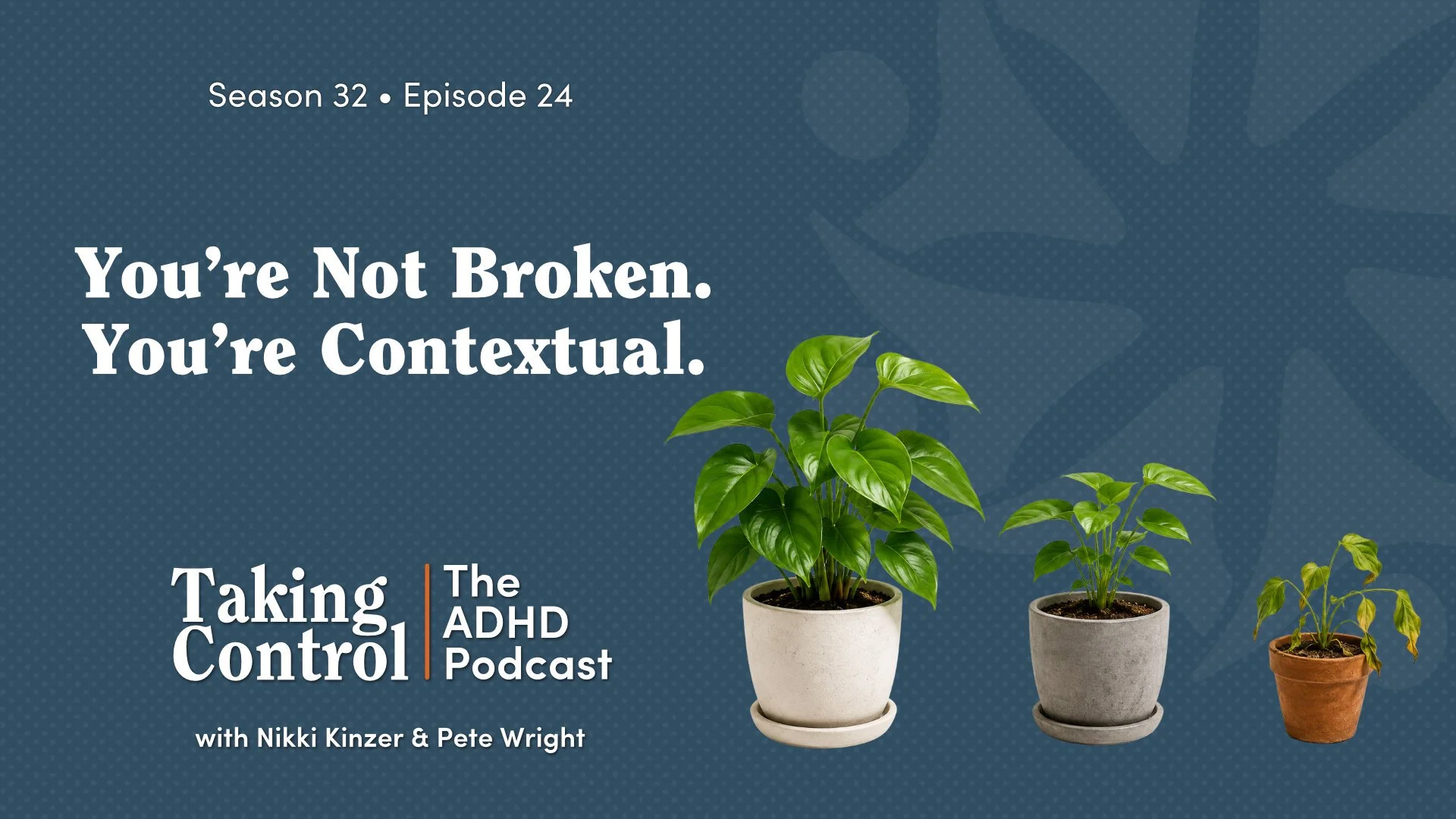
You can lose six hours to the thing that lights you up, then completely stall on a task that takes three minutes. Same brain, different room. In this conversation, Pete and Nikki get into why ADHD shows up hard in one setting and nearly disappears in another, why "broken" is the wrong word for any of it, and what changes when you stop asking how to fix yourself and start paying attention to the rooms where you do your best work. It's the capper on a season-long conversation about living with ADHD instead of fighting it, and a grounded look at the context, fuel, and environment that make hard things doable.
Links & Notes
-
Pete Wright:
Hello, everybody, and welcome to Taking Control: The ADHD Podcast on TruStory FM. I'm Pete Wright, and I'm here with Nikki Kinzer.
Nikki Kinzer:
Hello, everyone. Hello, Pete Wright.
Pete Wright:
Oh, this is it. The penultimate session for this season — this fair season, season thirty-two. What do you think? Are you okay? Are you preparing to experience the grief that is the July break?
Nikki Kinzer:
Well, is this the last one we're doing?
Pete Wright:
The long, dark sadness? No, this is the penultimate — second to the last.
Nikki Kinzer:
Oh, see, I didn't know what that word meant.
Pete Wright:
Oh, okay.
Nikki Kinzer:
You're using big words I don't understand.
Pete Wright:
Okay, so it's the second to the last.
Nikki Kinzer:
Okay.
Pete Wright:
There's one more.
Nikki Kinzer:
That I understand.
Pete Wright:
Okay.
Nikki Kinzer:
And yes, I'm ready.
Pete Wright:
Well, I'm very excited about it.
Nikki Kinzer:
I'm okay. Maybe next week I won't be, because that will be the last one.
Pete Wright:
There will be great sadness.
Nikki Kinzer:
Yeah.
Pete Wright:
Yeah, that'll be the last episode.
Nikki Kinzer:
Yeah.
Pete Wright:
There will be great sadness and many tears. But for now, I think this is the capper on an ongoing conversation we've had in the back half of this season. And I'm excited to get to it. So let's go ahead and do that.
Before we dig into the show, I gotta tell you about Patreon — patreon.com/theadhdpodcast. If you are a regular listener and you haven't explored it yet, that's the place to visit. First of all, members get early, ad-free access to every episode, access to members-only secret channels in our Discord server, and a seat in the live stream recording of this show. You would have gotten to hear us talk about He-Man — Masters of the Universe. That's right. That's not nothin'.
Nikki Kinzer:
Something.
Pete Wright:
I mean, it's close, but it's not nothin'. And you can ask questions directly to us and our guests in the chat as we record, plus we throw in special events along the way each year. But honestly, the thing that we hear people talk about most isn't any of that. It's the community itself. This is a group of real people living with ADHD who show up for each other in a really special way. If you've ever wanted to be more than just a listener, now's the time. Head over to patreon.com/theadhdpodcast to learn more and join us. And if you're not ready for that, that's fine too. Find us at takecontroladhd.com, connect with us on socials, join us on our public Discord channels, or sign up for the weekly email. We'd love to have you wherever you land.
Here's something that probably sounds familiar. There's some corner of your life where you're genuinely, no kidding, good. You're locked in. Your hours just disappear. And then there's the two-line email that has been sitting in your inbox for nine days, and you cannot make yourself touch it. That is the same brain. And in that gap, there's the voice that is constantly pestering you: what is wrong with me?
That's today's show. And here's our spoiler of an answer: of course you are not broken. You are contextual. You light up in one room and stall in the next, and for the ADHD brain, that's the wiring doing just what it does.
I realized when I put this conversation on the outline that it was probably going to come back to me to build the outline itself — the rundown itself — because, what the hell was Pete talking about when he said "you're not broken, you're contextual"?
Nikki Kinzer:
That's exactly what I thought.
Pete Wright:
Am I right?
Nikki Kinzer:
I was like, I'm gonna have him do this one and I'll do the next one.
Pete Wright:
Yeah. And then you Discorded me and you said, hey, you do it. And I said, okay.
Nikki Kinzer:
You said it with actually a lot of enthusiasm.
Pete Wright:
And then I had to go back in time.
Nikki Kinzer:
You were like, absolutely. You were very excited about it.
Pete Wright:
I did. Well, it's partially because of how far we've come on these conversations of sort of interiority — what's going on inside of us and how we relate to the world around us. And I think this is the thing that locks in the overall metaphor for me. I like the idea of rooms — ADHD rooms, or rooms in your ADHD house. Because you can crush it when stakes are real. You can figure out how to get things done, you can hyperfocus, you can engage and do all that stuff, but you can't fold laundry that's been in the chair since Tuesday.
Nikki Kinzer:
Mm-hmm.
Pete Wright:
You know? That's context. And the verdict that we usually hand ourselves is all about the gap. What's wrong with me? Why can't I be consistent? Why am I letting people down? But that space between our success and our perceived failure is not a sign that something is necessarily broken.
And I think it's important to understand why "broken" is the wrong word. Because broken implies a fixed defect. It's a thing that is wrong with you and rides along in a little sidecar next to you into every room, against every text, every task, every day. It's a thing that is unmovable.
Nikki Kinzer:
Yeah, it's just — it's not true.
Pete Wright:
But it's not true.
Nikki Kinzer:
And I remember listening to Sari Solden speak once at a conference. And I remember her saying, you're not broken. You're not a piece of furniture that broke its leg and now needs to be fixed. And I just remember thinking about that. And it's exactly what you're saying — it's not... you're not a piece of furniture.
Pete Wright:
No, right.
Nikki Kinzer:
Yeah.
Pete Wright:
If you were, it'd be the worst furniture.
Nikki Kinzer:
Yeah.
Pete Wright:
It'd be terrible to be furniture. A broken piece of furniture.
Nikki Kinzer:
A broken chair with three legs, yeah.
Pete Wright:
Right, because ADHD doesn't show up that way. It shows up really hard in one setting and nearly vanishes in another.
Nikki Kinzer:
Yeah, right.
Pete Wright:
The way it works — when people observe you in your prime element, in your prime context, they wonder if you have ADHD at all.
Nikki Kinzer:
Right.
Pete Wright:
And this is not a fringe observation. This was written into the early diagnostic criteria of ADHD. The older DSM language flat out said it's unusual to see the same level of difficulty in every setting all the time. Practitioners acknowledged the variability of ADHD performance — that sometimes ADHD made life vastly easier, and sometimes it made it incredibly hard. We focus, as people living with ADHD, vastly more often on the parts that are hard.
Nikki Kinzer:
Right.
Pete Wright:
Agree?
Nikki Kinzer:
Oh, absolutely. And when you're engaged, you can focus all day long.
Pete Wright:
Yeah.
Nikki Kinzer:
When your brain is lit up and it's excited and it's engaged, then hyperfocus can kick in. But it's not even necessarily hyperfocus — it's just really being in that flow.
Pete Wright:
Intentional, yeah.
Nikki Kinzer:
Yeah, you're just in the flow.
Pete Wright:
And — just to lean in on the hard part — it's the brokenness that gets weaponized against us. You can focus on video games for six hours, and somehow that gets used as proof that we're lazy or faking, or whatever the case may be.
Nikki Kinzer:
Sure. Yeah.
Pete Wright:
And that's the part I want to talk about. I'd like to hear you talk about it more — what happens when we flip it, when we say the swing between these contexts is the condition. It's the same brain, it's just different fuel. And what does it mean when we try to shift from "they could do that thing if they wanted to" to "they would do it if they could"?
Nikki Kinzer:
Right. And then I would say there's this third piece — you still have to figure out a way to do some things. Because, as Dr. Hallowell says, we can't use ADHD as an excuse, but it is an explanation of what's happening and why things are hard.
Pete Wright:
Not your fault, but it is yours.
Nikki Kinzer:
And so, "could you do it if you wanted to" is not fair with the ADHD brain, because most likely they really want to. They have the motivation. But motivation is not enough. The executive function of getting started — we need something around that to help, because it's not just going to be initiated because it has to be done, or because I want it to be done. And so that's where we take the ADHD and say, okay, would you do it if you could? Yes — but how can you do it? And that's where you have to rely on, okay, what tools, what kinds of accommodations or scaffolding do I need in order to make this happen?
And we talk about a lot of those tools. We talk about body doubling. We talk about breaking things down. We talk about communication — talking to colleagues and friends and getting clarity about what's expected. We have all of these different things, but we forget about those tools when we're in the middle of it. And so I think that's the reframe: it is hard. It doesn't just feel hard. It is hard. However, we still have to figure out how to get some things done. Some things can probably be let go — maybe the expectations are too high, or whatever that might be. But taxes still need to be paid. Bills still need to be paid. We still have to work to get money to pay those things. We still have to be parents, if you're a parent. All of these things still happen in our lives, whether you have ADHD or not.
Pete Wright:
Right. Now, in the spirit of context, I would push back a little bit on that, because almost everything you just listed assumes one fuel: importance. It's all about deadlines and consequences — this matters, so just do it, you have to figure out a way to do it. But ADHD brains, as we've talked about before, don't run on importance.
Nikki Kinzer:
Oh, right, yeah, for sure.
Pete Wright:
You saying that taxes are important — I can cognitively know that taxes are important, but I don't really care.
Nikki Kinzer:
Doesn't matter, yeah.
Pete Wright:
They run on — and this is to quote our friend of the show, Bill Dodson — they run on interest, novelty, challenge, urgency, passion. The interest-based nervous system. We've talked about it before. Bill's been on the show talking about this stuff. A task, any given task, isn't easy or hard on a willpower dial. It's easy or hard depending on whether any of that fuel is present. Interest, novelty, challenge, urgency, passion. If those things aren't present, it doesn't matter that I have to pay my taxes — it's still going to make it impossible for me to figure out how to do it.
And hyperfocus and the can't-even-start paralysis are the same system seen from opposite sides — either way, some of the fuel is not present. I want to make sure that in this model, we're not just talking about coming up with an excuse, using ADHD as an excuse. I want to make sure we're focusing on what fuel we need for any given task, because this becomes the guardrails in which we operate. It describes how our internal engines run. It explains the pattern without dooming us to it. Because genuinely reframing how we think about something like taxes may also change what's possible for us.
And, you know, taxes — I don't like taxes, but that's not an area where I have challenges, because it's a project with a fixed ending. What I have a problem with is ongoing money management, and having conversations with my wife about our family finances. I don't like having those conversations. They don't have interest, novelty, urgency, or passion. Okay, they have challenge — but that's the only fuel, and I don't love it.
So this is where I think this trait becomes a problem: it's when it meets an environment that's built for a different brain. And that environment can be the emotional environment, the skills environment — it's the room in which your brain is not attuned. So I just want to look at a couple of real examples of the same task that's effortless in one context and physically and emotionally impossible in another. Can you think of any, right off the dome, that you've experienced with your clients that connect this way? What are the tasks that can swing from impossible to absolutely effortless depending on context?
Nikki Kinzer:
We know that the ADHD brain is definitely going to be run, like Dr. Dodson says, on interest, novelty, all of those things. The tasks that are effortless have those things. So I don't see a lot of "sorting the mail is easy in one context and not easy in another." Sorting the mail just isn't fun. And so it's a hard task that tends to be a hard task no matter what.
I think that some tasks, when we're avoiding them, we have to really figure out — what is it about that specific task that we're avoiding? What makes it hard? So as a coach, we have to figure out, what's the fear behind making the phone call? What's the friction? We talk about friction. And once we're able to start to identify what's holding the person back, now we have information that we didn't have before. And now we can use the scaffolding I was talking about to actually help move yourself forward.
So I think what I hear a lot, too, is that it felt impossible — and then when I made the phone call, it took three minutes of my life, and now I feel bad that it took three minutes when I've been avoiding it for six months. We have to deal with that, then — the shame around not doing it sooner. And that's where your ADHD plays in: well, of course you didn't do it sooner, because it didn't have the interest, novelty, and challenge — or it had the challenge, but it had fear and emotion around it. These tasks that aren't getting done, these things that are hard — there's so much emotion around it.
Pete Wright:
Yeah. That's true. I look at the simplest environmental changes as things that I find motivating. To get my brain going, sometimes I'll sit down and play a video game and set a timer for a half hour, and I'll just go explore feudal Japan with a sword for a little while.
Nikki Kinzer:
Sure.
Pete Wright:
That's a nice warm-up, and it's an environmental change. Sometimes I go to a coffee shop and work. Sometimes — the things that are terrifying to me about our financial conversation are that I'm gonna uncover something I don't know how to uncover alone. And so the environmental change is, I've gotta have my wife standing right there, and we need to do everything and discover everything together. And that becomes an environmental accommodation that changes the context of how I do hard things, and prevents me from putting my head in the sand and ostriching around the hard, deeply emotional stuff.
Sometimes I need to go to an actual location that I've never worked in before, that has no previous sense memory, and I can be more proactive than I've been in a year — in two hours — and accomplish things, because I haven't been able to picture how hard the task is in that space. Often my sense memory is based on context. I know what it's gonna feel like to discover that I just got an IRS letter and it's not good — I can picture every detail surrounding it. I can picture myself standing in the doorway, having just gotten the mail, opening it and reading it, and it's miserable, and I don't know what the tasks are gonna be. But if I just take a bundle of mail that I know is gonna be challenging and I go to a location I've never worked before, I can move mountains.
And that's what I'm talking about, because I'm trying to change settings so I can increase the interest, novelty, challenge, urgency, and passion in some way, shape, or form. For me, I also have a keyboard thing. Sometimes all I need to do to change my environment is change out the keyboard I'm using on my computer, because that changes the tactile experience of hard things. I feel more powerful when I have a different sensory, tactile experience with the world around me, because so much of my experience is super tactile.
So the question changes from "how do I fix me, what's broken with me?" to "where is the mismatch between me and the stuff I can actually adjust?" And that's environment, expectations, timing, who's around me in my physical space, and what support really looks like.
Nikki Kinzer:
Yeah. Absolutely.
Pete Wright:
And those are things I can control.
Nikki Kinzer:
Absolutely.
Pete Wright:
Those are the things I can shift.
Nikki Kinzer:
Those are the accommodations. Those are the scaffolding. And I think the listeners who are listening to this — find, experiment with what Pete's saying and some of these other things. Because one of the go-to pieces of advice you're gonna hear about productivity with ADHD is, figure out when your best time of the day is to do work. When has the medication kicked in? When have you exercised? When have you eaten well? When are those things optimized? I can't say that word — optimized.
Pete Wright:
Optimized.
Nikki Kinzer:
Yeah, I can't say that.
Pete Wright:
I totally get it.
Nikki Kinzer:
But all of these things definitely — because they do change — they reframe the way you can look at the things that are hard.
Pete Wright:
They totally do. And that's the big beat off of the things we've been talking about this year. We've been doing a lot of talk about the inner work — the self-worth, the self-trust, dropping all the rules we inherited, the generational language we've inherited. All of that stuff is inside.
Nikki Kinzer:
Permission slips. Mm-hmm.
Pete Wright:
But this is the outer part. And these things have to work together. You address the stuff that is your own interior language of defeat —
Nikki Kinzer:
Right.
Pete Wright:
— and letting go of those messages, and recognizing the agency you have in the world around you to change the context in which you do hard things. That's the other part that should be inextricable from navigating our experience with ADHD, so that we don't have to use ADHD as an excuse for why things didn't get done. Because we're constantly moving through the world in a space that invites change — and invites change in the spirit of warmth and kindness and high value. Change in the spirit of all of the positive internal language we've been practicing this season. That's the context that makes it fit, to me.
Nikki Kinzer:
Mm-hmm.
Pete Wright:
This is a thing we can troubleshoot.
Nikki Kinzer:
Mm-hmm, absolutely.
Pete Wright:
We can adjust.
Nikki Kinzer:
Practice, and pivot.
Pete Wright:
Yeah. And it's what allows us to stop thinking of ADHD as that fixed defect — the thing that's always traveling with us.
Nikki Kinzer:
Right.
Pete Wright:
It is not a fixed defect. It's a thing that is malleable and changes situation to situation. So, what is it about the situations and the context where you are extremely successful? Interrogate those, and figure out what you can take from those experiences and apply to the things that are really hard.
It's not a one-to-one. You have one experience about a thing that's really easy for you, and you apply it — you're not gonna get a full one-to-one accommodation by doing that.
Nikki Kinzer:
Right.
Pete Wright:
Just because it's easy for me to record a podcast here at my microphone doesn't mean that if I take my microphone into the living room, it's gonna be easy to do my taxes.
Nikki Kinzer:
Right.
Pete Wright:
That's not how it works. But there are things that will impact that experience. And I think that's the thing I've been really wrestling with as we've had these last conversations: inconsistent is not a fixed thing. That's not the one thing people think about when they think of Pete — "he's inconsistent." Because sometimes I am.
Nikki Kinzer:
Right.
Pete Wright:
And sometimes I'm very consistent.
Nikki Kinzer:
Yeah, absolutely.
Pete Wright:
And I need to do more work constantly, because that's my job — figuring out what makes the hard things, maybe not lovable, but at least doable. My experience of living with ADHD has never been about becoming a completely different person contextually, but it is about noticing where I am best myself, and trying to build more of those spaces.
Nikki Kinzer:
Yeah, I love that. Great job.
Pete Wright:
I don't know that it was a great job. I'm already reflecting on it, because I love this concept, but I don't know that I explained it well enough up front.
Nikki Kinzer:
Oh, you did.
Pete Wright:
I hope it landed okay. Because I think it's important, and maybe next season I'll come back around when I do it better.
Nikki Kinzer:
I think so too. You did it great.
Pete Wright:
I don't know.
Nikki Kinzer:
There's your little ADHD brain, swirling around, second-guessing. But no.
Pete Wright:
Well, for crying out loud, Nikki, I'm still me.
Nikki Kinzer:
I know, but you're in a good room. You're in a nice, safe room. So don't worry about it.
Pete Wright:
The good room.
Nikki Kinzer:
Yeah. No, this was great. It's a good conversation to have.
Pete Wright:
Yeah. Well, it's a good way to wrap up this part of our conversation. We do only have one episode left this season, and then we're taking our break for the summer. Just a little bit. We'll be back after that. But next week we're talking about progress — and how we measure ourselves without really trying to measure ourselves.
Nikki Kinzer:
Measurement.
Pete Wright:
Without really trying to measure ourselves, right?
Nikki Kinzer:
Right. Yeah.
Pete Wright:
How do we notice change?
Nikki Kinzer:
Let's see how that one lands.
Pete Wright:
I'm very excited about that. So thank you, everybody, for hanging out with us today. Thanks for muscling through this idea with me. We appreciate your time and your attention. Don't forget, if you have something to contribute to the conversation, head over to the Show Talk channel in our Discord server. You can join us right there by becoming a supporting member at the deluxe level or better at patreon.com/theadhdpodcast.
Nikki Kinzer:
Where are we?
Pete Wright:
Yeah, I'll get it. On behalf of Nikki Kinzer, I'm Pete Wright, and we'll see you next week, right here on Taking Control: The ADHD Podcast.
Subscribe to Taking Control: The ADHD Podcast