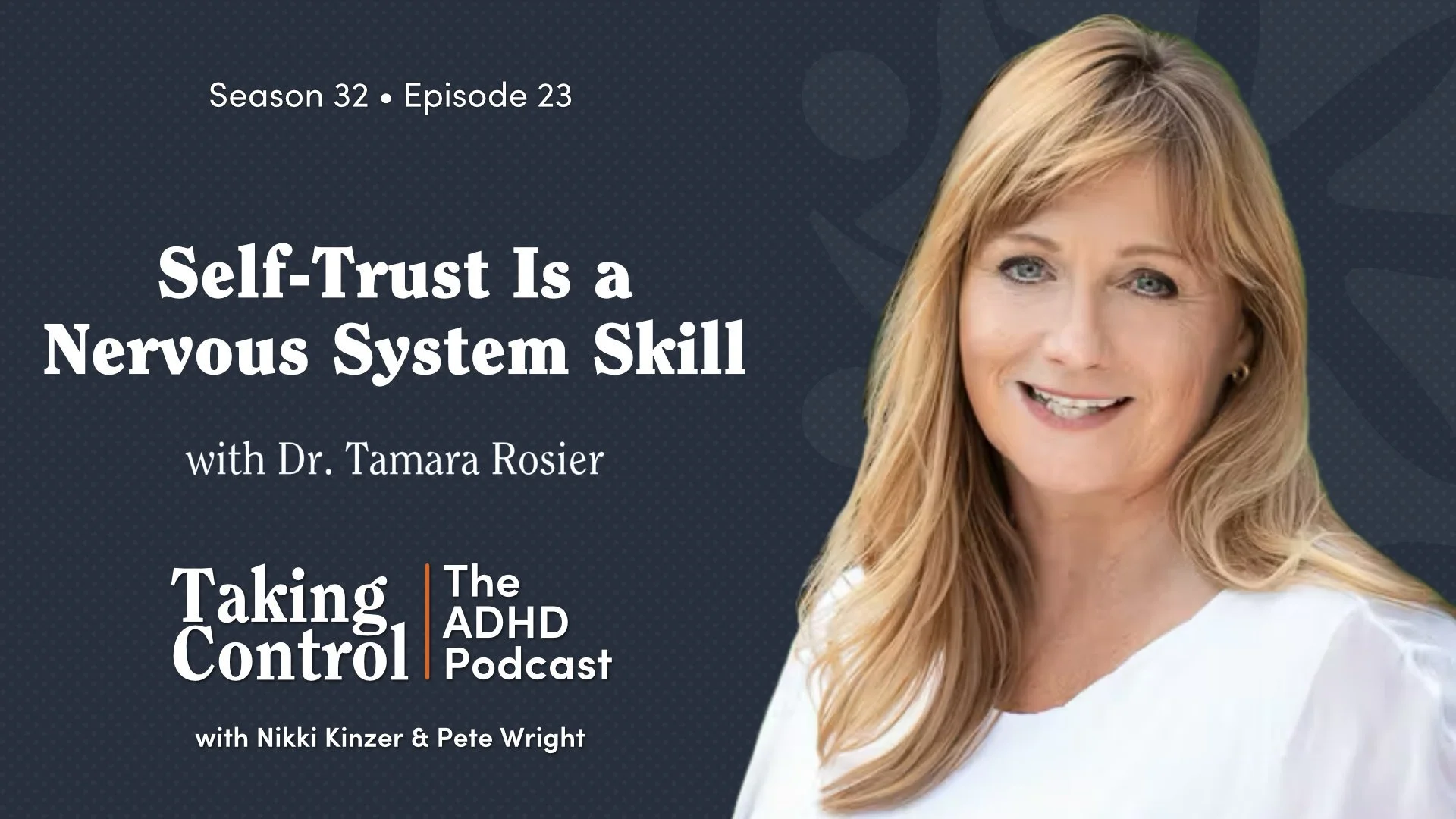
You can have the perfect planner, the right system, and the best intentions, and still not follow through. It isn't a caring problem. After enough broken promises to yourself, some quiet part of you simply stops believing the plan. That's where this conversation with Dr. Tamara Rosier begins, and it reframes self-trust as something closer to a nervous system skill than a mindset you can think your way into.
Dr. Tamara Rosier has written the books and built the center and stood on the stages, and she still wakes some mornings and reminds herself, deliberately, that she is a trustworthy person. The belief underneath — the one she's carried since she was small — is that she's a person who screws things up. ADHD feeds a belief like that. It chips away at your sense of who you are, one forgotten thing at a time, until distrusting yourself stops feeling like a wound and starts feeling like good judgment.
So much of that, it turns out, is happening in the body. An ADHD nervous system can spend its whole life braced — fight, flight, freeze, appease — switched on and calling it normal because it has never known the alternative. For years Tamara sat frozen on the couch, melting into the cushions, sure she was resting, when she was really stuck somewhere below the place where rest actually lives. There's a narrow band where you're calm and awake at once, and a lot of us have never spent much time there. Hearing her describe it, you may quietly start to wonder whether you ever have.
The way back looks like catching yourself mid-loop — Tamara tells it through the week she lost one of her chickens, and the refrain that trailed her around the house, I failed her, I failed her, I failed her — and then learning to talk back to it, to move your body, to put on the Motown, to do the next small thing that nudges you up out of the freeze. It looks like noticing the clever ways we avoid all of that, too: the new app, the next fix, the dopamine that keeps us busy on the surface so we never have to turn toward the thing underneath.
And the hope here is almost disappointingly ordinary. No system is going to fix you by Thursday. What there is, instead, is the small correction, made again and again, the way a sailor nudges the tiller rather than wrenching the whole boat around and tipping it over. There's learning to read your own weather, hour by hour. There's accepting that you may always need the timer, the Post-it, the reminder, and letting that be fine rather than shameful. Self-trust grows in that soil — in the quiet, stubborn belief that whatever goes sideways today, you'll know how to repair it.
Links & Notes
Dr. Tamara Rosier — our guest's author site, where you can find her work and stay connected.
ADHD Center of West Michigan — the coaching and support practice Tamara founded in Grand Rapids.
Your Brain's Not Broken — Tamara's book on navigating your emotions and life with ADHD. A new edition for teens and young adults is on the way.
You, Me & Our ADHD Family — her book on cultivating healthy relationships when ADHD is in the house.
ADHD Coaches Organization (ACO) — the professional body for ADHD coaches; their directory is a solid place to start if you're looking for one.
HeartMath — the heart-rhythm coherence and breathing tool Tamara leans on to drop into a calmer, parasympathetic state.
Vagal nerve resets — Tamara's advice is to find the one that fits you; she points listeners to the many free walk-throughs on YouTube rather than any single "right" technique. Clicking that link saves you a search in YouTube.
Join us on Patreon — early, ad-free episodes, extended editions, the post-show Q&A, the Discord community, and a seat in the Wednesday morning live stream.
-
Pete Wright:
Hello, everybody, and welcome to Taking Control: The ADHD Podcast on TruStory FM. I'm Pete Wright, and I'm here with Nikki Kinzer.Nikki Kinzer:
Hello, everyone. Hello, Pete Wright.Pete Wright:
Hello, Nikki Kinzer. Three down. We're T-minus three episodes to our summer break.Nikki Kinzer:
Yes.Pete Wright:
You've already taken your vacations, so summer is just gonna be, you know, being around the house doing puzzles.Nikki Kinzer:
Summer's just gonna be me working outside, taking the computer on the patio, and I'm just gonna do my work there.Pete Wright:
Working outside. Okay, good.Tamara Rosier:
Nikki, that's what I do too. Love it.Pete Wright:
That's it. That's the secret. Use your summer. But I'm very excited. You just already heard our guest. She doesn't understand the rule. I guess when you've been on the show nineteen hundred times, you take your liberties with our introductions.Tamara Rosier:
I didn't know I was. Oh dear. This is embarrassing now. Guys, I gotta go.Pete Wright:
Look, we'll get to you. Hold on. Hey, before we get into today's show, which is gonna be fantastic — we're talking about self-trust, we're talking about how you look at yourself, and we're talking about your nervous system. I wonder if those things are related. Before we get into the meat of the show, I want to remind you about our Patreon community, patreon.com/theADHDpodcast. If you are a regular listener, we encourage you to take this next step. Give it a shot. Members of our Patreon get early, ad-free access to every episode. They get access to the extended editions, so you get all of our regular ADHD entertainment clutch segment that the public doesn't get to hear, and you get our Q&A at the end of every episode. And I actually wonder if some of our regular members who already listen to the show via Patreon don't even know that they should just keep the thing playing after the closing credits, because that's when really good stuff happens. That's the trick. You get extended episodes as a member. You get access to our member-only channels in our Discord server, and a seat in the live stream recording of the show if you can make it — our Wednesday morning appointment live streaming, where you can ask questions directly to the guests in the chat as we record. Honestly, the thing we hear most from people about their experience in the community is the community itself. It's a group of real people all living with ADHD who show up for each other in a way that is pretty hard to find elsewhere. If you've ever wanted to be more than just a listener, this is where it happens. Again, patreon.com/theADHDpodcast to learn more and join us.And of course, if you're not ready for that, that's fine too. You can find us at takecontroladhd.com, connect with us on socials, join the Discord, or sign up for the weekly email. We would love to have you wherever you land.
You can have the perfect planner, the right system, the best intentions, and still not follow through. Not because you don't care, but because after enough broken promises to yourself, your nervous system has quietly stopped believing in your plans. Self-trust isn't a mindset. Self-trust is a nervous system skill. And for a lot of us with ADHD, that particular skill has taken some damage. Dr. Tamara Rosier is back with us today. She's the founder of the ADHD Center of West Michigan and president of the ADHD Coaches Association, author of two fantastic books that truly level up our field, and she is here to talk about how self-trust breaks down, what it looks like when it's gone, and how you start to rebuild it. Tamara, you may speak now. Welcome back.
Tamara Rosier:
Yeah, I did not know this rule, Pete. You gotta remind me of rules every darn time. So I truly apologize.Nikki Kinzer:
And even if you did, who cares?Pete Wright:
Who cares?Nikki Kinzer:
We want to hear from you. So yeah.Pete Wright:
You made a bit.Tamara Rosier:
No, honestly, I love talking with you guys. It's always so refreshing, and I love what you guys do. So it's just always great to be here.Pete Wright:
Our pleasure to have you back. And we're talking about self-trust today. So let's talk about it. Living with ADHD, we may know a little bit about breaking promises to ourselves and how that might start to influence our own self-image. What does this mean when you approach a concept like self-trust, and our broken nervous systems related to our own self-image? What does that mean to you?Tamara Rosier:
Yeah, so first of all — I just want to say, we're living in a great time, because there's research coming out about our nervous system, about things associated with our nervous system that a lot of ADHD people have, like POTS, EDS, things like that. And I, for the first time in my life, have names for things. A lot of women with ADHD have this MCAS — mast cell activation syndrome — which means my mast cells get confused and freak out. And it's related to the nervous system. So we're finding out so much about this. But there's a darn good reason why we don't trust ourselves.I remember when I was opening up the ADHD Center. My husband kept saying, now, what's your business plan? I'm like, well, I can pay the rent. That's my business plan.
Nikki Kinzer:
I want to help people with ADHD.Tamara Rosier:
I totally did the Field of Dreams thing with it.Pete Wright:
Yeah.Tamara Rosier:
I built it, and now today we have a ton of people working at the center — and I say a ton because it feels like that. And that's not a brag, that's a concern when I say it. And I'm telling you this because I don't trust myself. What am I doing leading a business?Nikki Kinzer:
Right.Tamara Rosier:
Who? What?Pete Wright:
Yeah.Tamara Rosier:
I'm an English major. And I have dyscalculia, which is dyslexia with numbers. So when I was starting the ADHD Center, I kept saying, gosh, I feel like I need some kind of parental supervision while I'm doing this. And a friend said, how about you stop saying that? And I'm like, how about I don't?Pete Wright:
How about you stop saying your face? Yeah, right.Tamara Rosier:
So — it's because the belief is so strong that I screw things up. Tamara is a person who screws things up. And that is a core belief I developed. And why wouldn't I develop that?Pete Wright:
Yeah.Tamara Rosier:
Right? I'm like Lucille Ball on steroids. I know that's dated, but Lucille Ball is timeless. All the shenanigans she got into.Pete Wright:
Timeless. Yeah.Tamara Rosier:
So why wouldn't I distrust myself?Pete Wright:
I can actually level up mine. Starting my own business was not just, I don't have any business running a business — I never want to have someone else's livelihood rely on my ability to run a business or sell.Tamara Rosier:
Exactly.Pete Wright:
Because not only do I not trust myself, I don't think you should trust me either.Tamara Rosier:
Right. Now think about the leadership challenge for that.Pete Wright:
Given all that, how do you define this sense of self-trust that we're talking about?Tamara Rosier:
Yeah. So first of all — and we'll talk about this more later — but every day I have to remind myself I'm a trustworthy person. And I have to deal with my core beliefs that I developed that are unhealthy. So every day I have to do that. Even though — I don't want your listeners to get, well, if Tamara can't figure this out and she's written books on this, then what hope?Pete Wright:
Yeah, right.Tamara Rosier:
So there is hope. But ADHD slowly — and you guys know this — slices away our sense of self-concept, which slices away our self-trust.Nikki Kinzer:
You know, it's interesting that you were saying that about the reminder of what you have to say to yourself every day. There was something that stuck with me a long time ago. It was from Oprah — again, I'm dating myself back into the nineties — but she said something that I just have lived by.Tamara Rosier:
What?Nikki Kinzer:
She was talking about her intention — that as long as her intention is good, she knows she's doing the right thing. That is what is guiding her, is her intention. And I kind of feel that way when you're saying, I can trust myself, I'm a trustworthy person. Your intention is good. Your intention is pure. I just see a connection there.Tamara Rosier:
Let's define it before we go on to what I do to self-trust. But I want everyone to know I still struggle with this. There's times I crawl into bed at the end of the day and go, hey, we're done for today. We're just done. Tomorrow's gonna be better. But we showed up, we left it all in the field, so just crawl into bed, reset.But self-trust actually looks like — you have this quiet confidence. And the reason I say quiet confidence is because those of us with ADHD, either we have big confidence or no confidence.
Nikki Kinzer:
So true.Tamara Rosier:
And it's foolish confidence sometimes that I have.Nikki Kinzer:
Very rarely do you meet the person in the middle. Yeah.Tamara Rosier:
Like, ah, it's all gonna be fine, it's all gonna work out. And that's my ADHD magical thinking. So the quiet confidence comes in at the middle, going, I know who I am, I know what I value, and I'm acting according to those things today. And I have confidence in that. I also have confidence I might mess it up, but that's okay, because I know how to repair.Self-trust is actually like you believe in yourself, but not in the magical way — you anchor yourself to your values. I know who I am, I know what I want to do. I hate to say we have high self-esteem when you have high trust. When I first wrote my first book, people kept going, oh, you're an author. I'm like, please don't say that. I wrote a book. That doesn't mean I'm an author. And they're like, well, in the technical sense it does.
Pete Wright:
Yeah, right.Tamara Rosier:
Right?Pete Wright:
Words do have meanings, English teacher.Tamara Rosier:
Right. In the technical sense.Nikki Kinzer:
You're right.Tamara Rosier:
But my self-esteem around writing was so low. So I'm not talking about high self-esteem, but this quiet confidence of, oh, I am a person who can write books. And that hadn't been incorporated into my self-trust little bubble that I created yet.Pete Wright:
That's really interesting, because when you add to this our inability generally to adapt to change, sudden or slow —Tamara Rosier:
Right.Pete Wright:
— and recognize that it is an act of will to integrate new experiences into our own self-concept that might come naturally for others. I don't think I've ever thought about it in quite those terms. I think we sort of went through the same space in knocking out our book — it was like, this is a change in identity.Tamara Rosier:
Yes. And a scary one at that. Because now I'm public, and I'm going to fail publicly.Nikki Kinzer:
For sure.Pete Wright:
Yeah.Tamara Rosier:
Oh cool. That's great.Pete Wright:
Yeah, awesome.Nikki Kinzer:
That's a great idea.Tamara Rosier:
Brené Brown crap of being vulnerable? No, let's take it all back and not be vulnerable.Pete Wright:
Yeah, out the window.Nikki Kinzer:
Let's stay small.Pete Wright:
How does this — this is where I want to get into the somatic experience of what our belief systems are doing to our bodies when we are unable to imagine ourselves as living in — it sounds all woo-woo — but in the fullness of our identity. What is going on in our bodies and brains?Tamara Rosier:
So — we have to be careful setting this up, but our brains, those of us with ADHD, are set to react. That's our default set mode. And it keeps our nervous system in a protective mode. I mean, I'm gonna shock you guys — I have TMJ issues.Pete Wright:
Not at all.Tamara Rosier:
Because my little body thinks, oh, let's protect her in her jaw. I get all kinds of earaches from it, headaches from it. And it's because my body is always on alert. I didn't understand the nervous system stuff until my forties. So I just wrote checks my body wasn't going to cash. And I was just thinking today, oh, my poor body is so tired, because I've driven it hard, because I've always been in the fight-or-flight, freeze-or-appease mode.So first up, we've got to figure out, what does our relaxed mode even look like and feel like? Most of my clients can't even conceptualize it. So we have to first step into that — what are we going to do with our body? There's two ways we can approach this. With my clients, I approach this one of two ways. And we need both, but there's like a portal to get in. Usually it's through the brain or through the body. And I can usually tell with my clients — are they body people or brain people? If they're body people, we have to train the body first and then the brain will follow. Now, I know there's some people who will go, it's always the body first, or it's always the brain first. I don't think that's true. I think some of us just have a preference and a different way to do this.
So are you brain or body? And you can tell — if you're very cognitive, always trying to figure things out, always trying to overthink everything, guess what, you're probably cognitive-based. If you feel things — for me, I feel things in my gut all the time. My body feels things. And I've learned the somatic experience. So I'm a person who, even though I want to try to figure it out, I have to go, no, stop treating your body like it's just tagging along with the brain. Your body actually knows this one.
So if it's body, then we have to intentionally put the brain, the whole body, into the relaxed system. And that's the opposite of fight, flight, freeze, appease. And one of the ways I found that actually works really well is there's a thing called HeartMath. You breathe with this little mandala kind of thing, and you choose just five minutes — you focus your breath. And the reason it helps me — every time my brain kind of wanders away, the dots disperse, and I broke it, even though I'm breathing right. The research behind HeartMath is quite interesting, but it's a way to put myself into the parasympathetic response. So that's one technique. There's so many techniques, but I found my ADHD clients and me, we need the feedback. Oh yeah, Tamara, you're sitting there breathing, but you're also writing something in your head. Stop that. Just breathe.
Now, some people probably in the comments are saying, well, just meditate. Cool story, bro. My brain — I can meditate better on a paddleboard. And it's not a true meditative state, but it's like I calm my body.
Nikki Kinzer:
It's centering you.Tamara Rosier:
It's very centering. Now, for those of you who are cognitive, we have to start with believing things cognitively. So we start with the belief of, no matter what happens today, I can stay present. I can respond as I need. And if I screw it up, I'll repair it. I just accept I might screw it up. And that's a human thing. That's not just an ADHD thing.Pete Wright:
I think you alluded to what is always my fundamental reaction to finding a rest-versus-relaxation state, which is, how do I get over the hump of not understanding that my body hasn't been capable of finding that state in decades. You ask me what the relaxed state is — let's say I've never felt it, because my relaxed state is always heightened. And I have come to believe that that's normal.Tamara Rosier:
Yes. Can I put it in a different way?Pete Wright:
I dare — I triple-dog-dare you to do that.Tamara Rosier:
Okay, thank you. I love a triple-dog-dare.Pete Wright:
All right.Tamara Rosier:
There's something called the window of tolerance. In the window of tolerance, in the middle — I write about this in my second book — your body's just relaxed. And I'm sure other people are there, but I have a very tiny window that I've had to learn to make wider. This is when my body is just responding. I'm relaxed and alert. Those are the two keywords. Above this window of tolerance is hyperarousal. And that's usually where I camp out for the day, left to my own if I don't work on this. Below the window is hypoarousal. That's the freeze mechanism. And so all these years, Pete, I thought I was relaxing.Pete Wright:
Yeah.Tamara Rosier:
Uh-uh. I was in hypoarousal, just sitting on my couch, frozen, melting slowly into the fabric, calling that rest.Pete Wright:
Yeah, but you look relaxed.Tamara Rosier:
I look relaxed.Pete Wright:
You're right.Tamara Rosier:
And actually — now that I've worked on this, I can feel myself relax, because I can feel the muscles in my head. This is embarrassing to admit. I can feel the muscles in my head relax.Pete Wright:
That's not embarrassing. Why is that embarrassing?Tamara Rosier:
Because I sound like such a little stress puppy. But the truth is, guys, I learned to harness anxiety early on and create fires.Nikki Kinzer:
No.Tamara Rosier:
That's how I survived. That's how I got a PhD. And now — Richard Rohr is a Franciscan priest who is lovely and talks about the second half of life. And he's like, the first forty years, you have to create all this stuff about your personality. The second forty years, you have to dismantle it all. And I'm dismantling it all right now, going, oh, poor Tamara thought she had to survive like that.Pete Wright:
Yes, right. Yeah, here we are.Tamara Rosier:
That's hard.Pete Wright:
Well, I'm not making a joke when I say you look relaxed, because that's how my ADHD, my own spectrum, interacts — because mine is so in my head, it's so deeply inattentive, that I can sit still with the best of them. But I'm not still. I'm not relaxed. I'm wound up tight, and I can feel it in my skin. I can feel it on the texture of my skin. I feel the arousal, but I look totally chill. So figuring out how to take that — I guess that's the hypoarousal — and turn the brain into something that's able to settle is the necessary muscle to build.Tamara Rosier:
Yeah. It starts with — one of the things I work with my clients on is, where are you? I made an emotional ladder, just for my clients to know, where are you on this ladder? There's body signals, there's brain signals — find yourself first. I did that because I didn't even know where I was on this ladder. And then I didn't know how to interact with myself. So the first step is really, where am I? And where is the tightness?Nikki Kinzer:
So that's really paying attention to your body and your mind, and looking inside of yourself to feel where that tension is. Is that what you mean?Tamara Rosier:
Yes. Those of us with ADHD are a bit awkward in some ways — well, many ways, actually, let's be honest. We know who we are. But if we focus too much, a lot of my clients are like, oh, I have this bump, I'm pretty sure it's cancer. So that's anxiety looking inward. And it's why I created that emotional ladder, just to look at it and go, where am I? Oh, I'm feeling a tightness. Where am I feeling the tightness? Oh, no, the tightness doesn't mean I have a brain tumor. The tightness means my body is reacting, trying to protect me. Well, thank you, body. And by the way, Pete, I've gotten really woo-woo in my old age.Pete Wright:
Yeah.Tamara Rosier:
I thank my body. Like, hey, you're doing a great job today.Pete Wright:
Okay. Good. You did great today.Tamara Rosier:
She did great. Allergens are high out there, and you still showed up. Good job.Pete Wright:
Right. And you showed up. You walked to the mailbox. One of the — you just brought something up that I think is important. It's a thing that I've been thinking about. We talk about accommodations all day long. We talk about things that allow us to get done the things that we need to get done. But I have a collection of dark accommodations. They're accommodations for the feelings that are triggering to me. You just said, I have a lump, maybe it's cancer. Now, the accommodation would be exactly what you said — relax and find where the real tension is. The dark accommodation goes toward addressing the actual bump. It goes toward, I'm gonna perseverate on this, I'm gonna hit WebMD first, I'm gonna start doing the dance that allows me to get in with a cancer specialist, because clearly that's the next step.Tamara Rosier:
Well, talk to Claude about it. We've got to talk to our AI bot.Nikki Kinzer:
Right, yeah.Pete Wright:
Oh, definitely talk to Claude. See if I can — because the dark accommodation is what spins me up even more. But it's tricky, because you think you're doing the right thing. I know this feeling so well, and that's what causes me to download new apps and use new tools and find the dopamine triggers that address the surface issue, when not really looking inward, because inward is scary. And, note to the title, I don't trust myself to be able to actually address it at that level. So I better just stay at the surface and go for the dopamine.Tamara Rosier:
And none of this is a conscious effort, right?Pete Wright:
Right.Tamara Rosier:
So —Pete Wright:
It's only conscious when I sit down and I'm working on this outline for our conversation today, and I realize, oh, dude, that's you.Tamara Rosier:
Yeah. So — you guys probably already know a lot about this — the vagal nerve, and the research about resetting the vagal nerve. I do a lot of vagal nerve resets throughout my day.Pete Wright:
Okay, walk through that. For those who haven't listened to past episodes on it.Tamara Rosier:
Well, here's the thing, though — it's like finding the right toothpaste. Everyone has a favorite. So I'm not going to say, hey, this is the right one. But YouTube is full of vagal nerve resets. You're gonna find the one that fits you best. The one that fits me best has to do with my eyes. You can do a lot of different ones, but the one I use is, I tip my head to the left and kind of pull on it a little bit and put my eyes in the opposite direction, as far as they can go. And I hold it there for thirty seconds. Sometimes I can't make it to thirty, because I get super bored. But if I can make it to twenty, great. And then I do the other side.Nikki Kinzer:
It actually feels good, because you kind of are stretching a little bit.Tamara Rosier:
But it's the eye movement that also helps.Nikki Kinzer:
Yeah.Tamara Rosier:
And so then you do the other side. And it doesn't give me energy, it just helps me feel grounded. So I found the ones that — and that one can be done very, very quickly. So I encourage your listeners to find your favorite.Nikki Kinzer:
So I remember watching you at a conference — and you're such a great speaker, first of all.Tamara Rosier:
Oh, that's so nice.Nikki Kinzer:
You do a really great job. And I learned —Tamara Rosier:
I feel stupid after each time. Let's talk about that as a trust issue. I'm not saying that as fake humbleness. I'm saying I feel stupid after each time. And I'm just saying that's a small trust I'm building.Nikki Kinzer:
I've seen you in more than one scenario, and I've learned so much. It's been so great. And one of the takeaways that I got from this one particular one — and I think this is similar to the head tilting, and I use it — you give your head a hug, by putting your palm on your forehead, and you just give your head a little hug.Tamara Rosier:
With your palm.Nikki Kinzer:
I love that so much.Tamara Rosier:
See if we can find this little group of behaviors. And by the way, will we remember? No. Do we have to write them down? Yes. Put them on the Post-it note on your computer. But if we can train ourselves to do it, then, Pete, you don't have to go to your dark tools. You could do a simple reset. And the more research I read — I read a ton of research on ADHD, because I love turning research into things that lay people will read.Nikki Kinzer:
So does Pete. You guys really are from the same little bird.Tamara Rosier:
I know. Every time I speak to it, I'm like, oh, my brother.Pete Wright:
Oh yeah.Tamara Rosier:
Yeah. But I love it. Every time, the research on ADHD is so damning on how hard it is to be ADHD. And it is so hard to be us. I'm not saying we deserve a pity party, but we have to really account for — we have a different kind of nervous system. And we have to live like that's true.Nikki Kinzer:
Mm-hmm.Tamara Rosier:
Every research on how our brain works, every time I hear psychiatrists talk about their research, I wonder how I put pants on that day. It's — we're heroes, Pete.Pete Wright:
And yet somehow we do, right? It's so frustrating.Tamara Rosier:
We're freaking heroes.Pete Wright:
We are. This is the thing — maybe it's because I'm aging into my "I don't give an F" era.Tamara Rosier:
Yeah. Oh yeah, I'm there.Pete Wright:
Like, I'm right there.Tamara Rosier:
We don't care anymore — yes.Pete Wright:
And — yeah, right.Tamara Rosier:
I'm trying to get —Pete Wright:
When I first was trying to adapt to my own diagnosis, there was a lot of that shame loop, that I read the research, and, as your words, it's damning. And then I get stuck in that loop. I already have enough of the inner voices telling me that I am a basket case. I don't need help externally.Tamara Rosier:
Right, yeah.Pete Wright:
So I look at this — at some point, we, if you're new to your diagnosis, have to stop reading the stuff that reminds us what we already know — that it's hard. And yet somehow you're here. Your pants are on, you're listening to a podcast, you are present, you are capable, you're able, and you get to choose what to care about. And that's part of, I think, what gets my nervous system stuck — is when I forget that I get to choose what to care about.Tamara Rosier:
Mm-hmm. So I hear that. And by the way, I said I joined the "we don't care" club. Well, that's not really true, because I don't trust myself fully to join it.Pete Wright:
Yeah, fair.Tamara Rosier:
Right? And I still will do a presentation and go, well, I don't know how that landed.Pete Wright:
Right. Yeah, I mean, we still have ADHD, but it's a nice badge to say I don't care.Tamara Rosier:
Right. So I have to — I look at it as a balancing. I have to balance myself. Yes, this is true, this is all true, my brain works this way. And look how amazing I am, because I can accommodate. Does it take me more energy? Yes. Do I need more naps? I really do, guys. I've always needed naps my entire life.Nikki Kinzer:
Yeah.Tamara Rosier:
I was the only teenager I knew who napped, because my brain runs hot.Pete Wright:
Yeah, and the rest of them are missing out.Tamara Rosier:
So I need to understand the parameters, and then balance myself, but look at what I can do. And I stop focusing on what I can't do, for some reason. I have this really crazy belief that things will work out. And it's a crazy belief I have, and it's solid.Nikki Kinzer:
Well, and it goes back to you believing that you can repair anything that goes wrong, or goes the way that you didn't expect. Because everything goes differently than what we think it's gonna go. So having that little belief that I can repair it. But I also think, in what I remember from listening to you talk about the nervous system — it's these little things that you can do right away. The head tilting, giving yourself a hug. I remember you talking about putting cold water on your face to stop that freezing and anxiety loop. What else could you recommend, just these little things that people can do right now as they're listening?Tamara Rosier:
Yeah. So you have to know if you're in hyperarousal — you're running hot. That's the fight-or-flight, that's kind of a hot state. Or you need to know if you're in the cold state of freeze.Nikki Kinzer:
So being self-aware of how you're feeling.Tamara Rosier:
You have to know where you are.Nikki Kinzer:
That goes back to that ladder you were talking about.Tamara Rosier:
Yes. So you have to know where you are. And then, if you're in the hot, you have to bring yourself down. So bringing yourself down, Pete — I'm positive you can think of some too — it's calming. That's when I'll do a polyvagal. It's calming. I might do a couple stretches, just to remind my body that a tiger is not chasing me, really. If you're in the low, you've got to build energy up, because you're in a frozen state. So if you're below the window in this glued-to-the-couch state, and you're just scrolling on your phone, then you've got to do something to build energy. A little thing — you can hold an ice cube in your hand. You can put the ice cube on the back of your neck. Or something I do is I put on music. You just have that feel-good music that you're like, ah, that feels good.Nikki Kinzer:
Mm-hmm.Tamara Rosier:
I'm a Motown girl. I live close enough to Detroit, love Motown. So I put on some good old Motown. And it really does affect — and we know this — energy is kind of built through music. So that's a way to get me back into — if I'm having looping thoughts —This is an example of one of my looping thoughts. I had six chickens. And I lost one last week.
Pete Wright:
Oh, past tense is rough.Tamara Rosier:
Yeah, I lost one last week.Pete Wright:
Oh my goodness.Tamara Rosier:
First one I've lost in six years. I knew she had been struggling, but my looping thought was, I failed her. I failed her. I failed her. It's not that chickens die. And if you've ever had chickens, chickens are weird, because they're hardy and they're not hardy at the same time. So my loop was, I failed her. I failed her. I failed her. What could I have done differently? How did I fail her? And you hear the cycle of this — it's all Tamara's fault. And that's something I was raised with, that I've had to look at and challenge. So I was in a frozen state with that looping thought. I failed her.Pete Wright:
Yeah.Tamara Rosier:
And I can't fix it. By the way, Nikki, you know how my belief is — well, I can't fix this one. I failed her.Nikki Kinzer:
Yeah.Tamara Rosier:
And so that was really hard. The first step was, oh, I'm looping. I'm looping on this old loop that you were raised with — this is all your fault, how did you let this happen? And then I had to have a straight talk with myself. That is not fair that you're doing that. You've done everything you know. And even veterinarians lose animals.Pete Wright:
Yes.Nikki Kinzer:
Animals die, unfortunately.Tamara Rosier:
And so release that guilt. And I get teary-eyed talking about it — it was such a strong... And I wasn't sad about her death. I mean, I was sad, but the loop was the shame loop.Nikki Kinzer:
Right.Tamara Rosier:
So I was below the window of tolerance, frozen, not wanting to do anything. So I had to have the courage to face myself and go, okay, seriously, we're going to combat this with different thoughts. You're gonna move the mood up and try to get the energy going. So I did active things. I like to paddleboard. I didn't paddleboard, because that brings me — that's when I'm in the hyper.Pete Wright:
Down.Tamara Rosier:
Brings me lower. So I had to do a more active thing. Now, I'm not a runner. I don't run unless I'm being chased. And even then I might sit down and just go, just kill me.Nikki Kinzer:
Me too.Tamara Rosier:
We're done.Pete Wright:
Yeah, I'm done.Tamara Rosier:
What do you need? But I did some yard work. I did things to actually move my body, and that helped.Pete Wright:
Is it possible — because everything we're talking about, I agree with all of them, I am right on board with the things that can help me on those days where I need an immediate impact, an immediate intervention, a somatic intervention — is it even possible for us to think longer-term, that we can build a practice to the point where we don't have to have as many intervention days? Or is this just one of those things that researchers say, you know, you're this bleak?Tamara Rosier:
I'm gonna sound like a smart aleck. It's possible, but not probable. And here's what I mean. It's possible, but you have to become so good and work so hard. And with my clients, I say, how about we do this instead? How about we increase our awareness to do these small self-corrects all through the day. Self-correct, self-correct. I don't sail, but one of my clients said, oh, like in sailing — you're just making these small little corrections while you're sailing. You're not trying to turn the whole boat, because you could capsize. You're just making a small correction. So instead of trying to build that magic practice that we've all been looking for — I mean, unless you guys want to go to India, become a monk.Pete Wright:
Yeah.Tamara Rosier:
I think those people have it locked down. Maybe some monasteries will teach different things. But for me, I want to get things done during the day. So I'm making these little corrects. And there are times on my calendar I will look and go, you know you're going to need an autocorrect here. And I literally put "do a polyvagal exercise" on my calendar. My admin at the center looks at my calendar and just laughs at all the things I have to put in it. Otherwise I'll forget to autocorrect. I have to watch my thoughts. And Pete, I'm wondering if we're similar like this too.Pete Wright:
Yeah.Tamara Rosier:
My thoughts get dark. Not suicidal-ideation dark — let's just be clear. But dark, like, the world sucks, I suck, everything's bad.Pete Wright:
Yeah.Tamara Rosier:
And I truly believe that I need to correct that, because then I start looking around for things that suck. So it's like the yellow car.Pete Wright:
And that becomes the practice.Tamara Rosier:
Yes. It's like the yellow car experiment. When you start looking for yellow cars, they're everywhere. It's because your brain is looking for it. So this isn't magic. This isn't even woo-woo. This is just, if I start to look for good things — so every day now I wake up while I'm still kind of dealing with some theta waves, and I'm like, today's gonna be great. Look for the great things, Tam. Look for the great. And I do. And I start looking. So that's one little habit. Do I forget? Yeah, I forget. But it's remolding how I want to think. Thank you for bringing us back to that, Nikki.Nikki Kinzer:
And that starts to build that root — that trust.Tamara Rosier:
That was clever. Yeah, that's quite good.Nikki Kinzer:
But it does — I mean, in all seriousness. Because it captures that belief that everything's gonna be okay. It's gonna be okay. I'm gonna look for the good. Everything's gonna be okay. And, to Pete's point — it's interesting. I had a client long, long time ago who told me that she really wanted to have a goal where she didn't have to set a timer to remind her to go pick up her kids from school. And I said, oh, that's so nice.Pete Wright:
That's so sweet.Nikki Kinzer:
But you're always gonna have to have a timer to remind you to go pick up your kids from school. And I was talking about, but that's okay. That's the structure, that's the system you're putting in place, the scaffolding that you need to manage your ADHD around time, because you're not gonna necessarily know that it's two-fifteen. And being able to lean into that — that's okay to have to have that.Tamara Rosier:
I love that you said that, Nikki. Part of self-trust is that we accept our brain as it is.Nikki Kinzer:
Mm-hmm.Tamara Rosier:
I have no idea — if you guys said, hey, two hours have passed, I'd be like, wow, that flew by. If you said fifteen minutes has passed, I'd be like, oh, okay. I could be gaslit into time, you know.Pete Wright:
Time is meaningless, it's a flat circle.Tamara Rosier:
Time is — which is why I like Doctor Who. He gets that concept.Pete Wright:
Yeah, absolutely.Nikki Kinzer:
Yeah.Pete Wright:
I asked this question about thinking long-term, and you said possible, not probable, and then built an able case for how it's actually quite possible, and that it is all made in the tiny choices and habits that we make — both in learning to read ourselves, our somatic and emotional experience at any given moment, which is absolutely possible, and being able to make the tiniest self-correction, and do it repeatedly and often.Tamara Rosier:
Yes. To be clear, it's not a magic system. And that's why I answered a little bit tongue-in-cheek, going, possible but not probable, because my clients are looking for this magic thing. Okay, every morning I am going to do this. Well —Pete Wright:
Yeah, and this is gonna help me fix whatever it is.Tamara Rosier:
I will be fixed after this.Pete Wright:
Yeah, right.Tamara Rosier:
So that's why I answered that way — because we just have to slowly understand that our brain needs these slow corrects throughout the day.Pete Wright:
I love it. And I'm actually left with more hope than I was worried we were going to have on the show today.Tamara Rosier:
Oh.Nikki Kinzer:
Good.Pete Wright:
This is actually really great. And I think it goes back to the stuff that is in our control. I've said before on the show, my first therapist, my first best therapist when I was a teenager, said, your power ends with your skin. It ends with what you can touch and relate to. And I have carried that for forty-five years, because of just how impactful that notion of agency is in my life — that when I'm feeling at my lowest, I just remind myself what I can do, the tiny change that I can make next. Maybe it's put a cold washcloth on my eyes, maybe it's an ice cube on the back of my neck — whatever it is — to remind myself that I'm the captain now. I'm not going to relinquish my agency. And this is normal, and it's okay.Tamara Rosier:
It's normal for you.Pete Wright:
Right. This is my Tuesday. It's fine. This is my Thursday. It's fine. Okay, Tamara, we gotta wrap it up. But where do you want to send people? What can we shout from the rooftops about how great you are?Tamara Rosier:
Oh, dear. So first of all, I just want to say a closing word to your listeners. Pete said it so well — there's always hope. And sometimes when we're talking, we get into the nitty-gritty, and we might be saying, yeah, this is tough, this is not an easy life. But I want people to be able to hold the hope for themselves. And I think that's the key to self-trust — when you can hold the hope for yourself, that you're not so broken that you're going to be forever feeling like this. So I just want to leave with that spark for people. So — what was the question?Pete Wright:
It was —Tamara Rosier:
Oh. Hey, I am coming out with a new version of Your Brain's Not Broken this fall. And it's for teens and young adults. And I actually had teen and young adult readers, because, well, let's face it, I might be super old. So I'm excited about that, because I want teens and young adults to know their brain's not broken. So that launches this fall. And otherwise, you can go to my author's website at tamararosier.com.Pete Wright:
It's so brave of you. I'm terrified — I have teen and young adult readers working through my book right now, and I just want them to like me, so badly.Tamara Rosier:
I got in my head so bad. I mean, I used the word "allowance" in my manuscript, and the reader's like, well, actually, we don't use the word "allowance" anymore.Pete Wright:
Yeah, that's generational language, and we've abandoned it.Tamara Rosier:
I'm like, what?Nikki Kinzer:
What do they use?Tamara Rosier:
Yeah.Nikki Kinzer:
What do they say? Or do they just get money now? Can you Venmo me?Pete Wright:
Yeah, they call it their Venmo.Tamara Rosier:
And bless their hearts, they're like, well, actually, Gen Alpha would say it this way. I'm like —Pete Wright:
Oh, that's good. That's good. You're writing for today's teens and young adults.Tamara Rosier:
We'll see. But the heart is there. You know, I was supposed to just make it a Your Brain's Not Broken version — I rewrote the whole book.Nikki Kinzer:
Of course you did.Tamara Rosier:
So —Pete Wright:
That's outstanding.Tamara Rosier:
I mean, you guys know that. Like, you knew where I was going. So I added things, I took out things.Pete Wright:
Okay, so people can find out more information about that at tamararosier.com. Definitely check that out. If you haven't read the other two books, they're fantastic, and you should definitely have them on your shelf. I just wish my shelf was closer so I could flex by showing you I have them both. My shelf is in the other room, so you'll have to take my word for it. It is really, really great to see you again, Tamara. Thank you so much for joining us today.Tamara Rosier:
Thank you. I love you both so much. I love what you do.Pete Wright:
Such a treat. And thank you, everybody, for downloading and listening to this show. Thank you for your time and your attention. Don't forget, if you have something to contribute to the conversation, we're heading over to the Show Talk channel in our Discord server. And you can join us right there by becoming a supporting member at the Deluxe level or better at patreon.com/theADHDpodcast. On behalf of Nikki Kinzer and Tamara Rosier, I'm Pete Wright, and we'll see you right back here next week on Taking Control: The ADHD Podcast.