Motivation Comes From Emotion, Not Discipline with James Ochoa
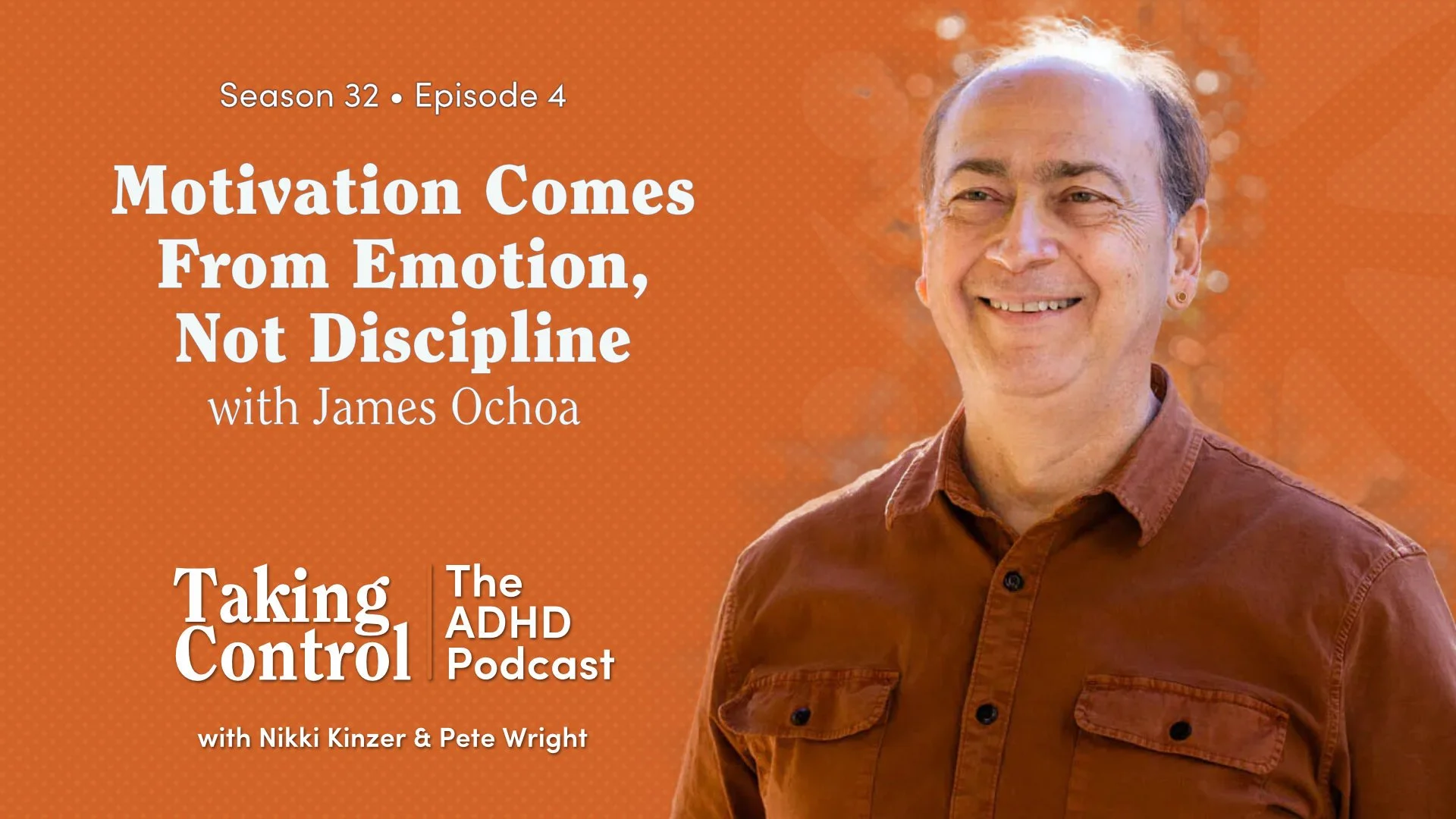
This episode turns into a stealth self-care intervention when James Ochoa joins Pete and Nikki and immediately drags “motivation” out of the tidy, planner-friendly realm and into the messy, bodily reality of fear, avoidance, and chronic stress. They start with the familiar ADHD paradox—knowing exactly what to do and still not being able to do it—and James reframes that stuckness as normal rather than shameful, then introduces “resourcing” as the practical antidote: not a single trick, but layered supports (internal and external) that make motion possible even when meaning, willpower, and good intentions aren’t showing up.
From there, the conversation gets uncomfortably specific in the best way, as Pete uses a long-avoided dermatologist appointment to walk through what “functional pressure” and relationship-based accountability can look like in real time. They explore why the hardest part is often the moment before the call, why eight-out-of-ten certainty is a workable target, and how to build a personal “wind-making” kit—scripts, sensory cues, body movement, tiny rituals, and other anchors that help you cross the threshold from uncertainty to action. The live chat brings in real-world complications (sleep issues, pain, dental trauma, AuDHD scripting and emotion tagging), and James offers concrete, compassionate ways to get support without muscling through alone—because the point isn’t to never fall off the wagon, it’s to get better at restarting.
Links & Notes
-
Pete Wright
Hello, everybody, and welcome to Taking Control: The ADHD Podcast on TruStory FM. I’m Pete Wright, and I’m here with Nikki Kinzer.
Nikki Kinzer
Hello everyone. Hello, Pete Wright.
Pete Wright
For people listening as these come out, we’re on a tear. We’ve recorded like 500 podcast episodes in the last week.
Nikki Kinzer
It feels like it, yeah.
Pete Wright
And all of them, I feel like, have been leading up to this one because, as it airs, it’s the first of our 32nd season to have a guest.
James Ochoa
Oh wow.
Pete Wright
And the guest joining us is Hall of Famer James Ochoa. Holy cow. ADHD Pathfinder and friend of startle responses everywhere—James Ochoa.
James Ochoa
Oh my god.
Pete Wright
I’m excited you’re here, buddy.
James Ochoa
Wow. Yes. I’ve started at times being speechless in spaces like that. I’m not speechless anymore—I’m really jazzed. I’m like, let’s go.
Pete Wright
Yeah.
Nikki Kinzer
Yeah.
James Ochoa
I am 64, and if folks haven’t listened to your Headstone podcast of my life history, they need to go do it. It was a double “drop the mic” moment. Beyond a shadow of a doubt. It rocked solid.
Pete Wright
I am deeply honored, James.
James Ochoa
When you introduce me like that, I’m like, let’s go. I’ll start your 32nd season.
Pete Wright
There you go.
James Ochoa
You’ve got some great listeners.
Nikki Kinzer
Awesome.
Pete Wright
We’ve got great listeners, great community. And speaking of that, before we dig in, I gotta be straight with you, listener. This show exists because of listeners who support it through Patreon. If these conversations and these guests have helped you feel more understood, less alone, or given you a new way to think about your ADHD, we’d love to have you in this community—the community that makes this possible. A few dollars a month means we can keep showing up every week. We keep growing. We keep investing in this community. Visit patreon.com/theadhdpodcast to learn more. If you’ve been sitting on the stairs waiting to come into the gym to join that eighth grade dance: we are your eighth grade dance, and we’re welcoming you. Come on in. It’s okay. It’s not awkward at all—because we’re all awkward—and you’re joining your people.
Nikki Kinzer
It’s not awkward because eighth grade is pretty awkward.
James Ochoa
Yeah—and you’re joining your people.
Nikki Kinzer
Right.
Pete Wright
You can also head over to TakeControlADHD.com to listen to the show on the website or subscribe to the mailing list and get each episode delivered to your inbox. Connect with us on Facebook, Instagram, Pinterest, or Bluesky at TakeControlADHD. And you can jump into the free part of our community by visiting TakeControlADHD.com/discord. Whether you’re a Discord user or not, it’s easy to jump in. It’s the eighth-grade dance thing all over again. It’s just great. A lot of weirdos dancing funny who will like you. It’s okay.
Pete Wright
Look, we are beyond thrilled to welcome James Ochoa back to the show. If you’re new—if this is the first Ochoa episode you’ve listened to—James is a licensed professional counselor. He spent over 30 years helping adults with ADHD live meaningful lives. He wrote the book on emotional storms with ADHD, Focus Forward. He’s been a guest on the show many times, and every conversation with him goes deeper than the last. He’s working on his second book, When the Shiny Wears Off: Navigating the Lifetime Storms of Adult ADHD, which focuses on handling the chronic stress that comes with ADHD—something I know resonates with so many of us in this community. James, welcome back.
James Ochoa
Thank you for having me. It really is an honor. I’m looking at the clock—it’s 11:11. That’s my fun time. I’ve been playing with numbers this year. 11:11 is my number, so I’m appreciating that moment. And yes, let’s go deep today. We’re talking about… I think motivation? You tell me. I’ve got lots of things to play with.
Pete Wright
This is sort of a part two. Nikki and I have jumped into this conversation before—this idea that motivation is kind of a mercurial animal. We talked about how connecting tasks to just a desire to be productive isn’t enough. We have to attach the work of our lives to emotional meaning, environmental design, body doubling. And the question that keeps circling is: what happens when you’ve tried all that, and the work of your life still feels impossible? I want to talk about what’s happening in those moments when even the meaning doesn’t move us.
James Ochoa
Yes. When you’re stuck, or the meaning doesn’t move you, or you think you have the meaning—one of the first questions to ask yourself: does meaning stop time for you? Does meaning hit passion for you? Because if it’s not lighting up your brain in an enthusiastic, excited, interested way immediately—something you don’t have to think about—then your “meaning” needs more sifting. Keep filtering. Keep looking. When you find that light-up—what you’re going after—that’s what drives us on the ADHD spectrum. You ask me the questions and I can tell you how it sets up top to bottom.
Pete Wright
I want to hear it, but I want to give Nikki a shot at this, because Nikki brought the topic to our community. Nikki—how have you been processing that conversation since we had it?
Nikki Kinzer
It’s interesting. I was reading through your notes earlier, Pete, and something really struck me: we know how, we know what—but we can’t quite get ourselves to do it. I had a conversation yesterday with a new client—an inquiry—and that was exactly what we talked about. “I’ve got the books. I understand what’s going on. But I still feel behind all the time, and I can’t do the things I want to do.” And that motivation piece comes up so often, even when we talk about strategies. It still feels like: “I know, but I still can’t get myself to ask someone to body double,” or “I still can’t show up to the accountability session I said I would.” There’s still something missing.
Pete Wright
Yes. This is why James is so important today. Those of us trying to figure this out spend a lot of time thinking about task durations—where in my day can they go, how do I structure my life.
Nikki Kinzer
How long is it gonna take?
Pete Wright
How long is it going to take? And then we arrive at the task and we kick it down the curb because we just can’t do it. We think we know why we need to do the work. But maybe we don’t. I’m hearing you tease: maybe that’s the biggest question. James—when you work in this space of marshalling inner resources to discern the “why” in a way that resonates… what do you mean by inner resources? And how do you help someone who’s been running on empty for so long they may not even know they have resources inside anymore?
James Ochoa
Where do I start? It’s like a kid in a candy store—so many pieces to pick up. When we hit these distressed lack-of-motivation moments—“I’m stuck, I’m frozen again, I kicked it to the curb again”—over and over, that creates the EDS of ADHD: Emotional Distress Syndrome. I know it, ad nauseam. The last seven or eight years—this is synergistic—the big thing I’m working on is resourcing.
Resourcing isn’t just inner resourcing. It’s external resourcing too. It’s what nurtures, protects, motivates, connects, helps you take action. You want to layer that through the rest of your life. I tried to count mine a few years ago and stopped at 75 or 80—and I hadn’t even left my room. You want your life surrounded so you feel like it’s there at the drop of a hat.
Now, Nikki—when you were saying “I know everything I need to know and I’m still stuck”—here’s the hard truth: normalize that. That is what happens. That is my hair color, height, and weight. That’s not a nail in a coffin. If we don’t normalize and accept that resistance and disruption are part of the process, we’re already in trouble. You can know as much as you know and still get stuck. I still get stuck. But then: what do I do? I resource, and I keep moving. The question is: how do I keep moving?
Nikki Kinzer
So true. The underlying part is: even though you “know,” do you really know? What do you think you know? Let’s dive into that too. We want to keep moving forward—we don’t want to just stay where we’re at.
James Ochoa
Sure. Because we’re organic, evolutionary beings—dynamic balance. We’re constantly moving. So: motivation starts in the mind. You’ve got to have a big picture. Where do I want to go? What is it? And people say, “I don’t know what it is. I can’t even picture it. I just know I’m stuck.” I say: guess at it. When you guess, you circumvent the defense mechanism of the mind because the guess is still coming from your beautiful mind. Your guess is a whole lot better than “I don’t know.”
When you can get that picture, we drive it down to detailed action immediately. You’ve got to wash dishes. Fold clothes. Call the Department of Public Safety to renew your license. And those things drive you crazy and you keep kicking them to the curb. So you look for some motivating personal meaning factor that’s going to light you up. You start sifting: “I wonder how I can do this in a way I’ve never thought about before.” Put on essential oils. Put on music. Call a friend. Start layering pieces. Suddenly I discover my friend Carl has to renew his license too—boom, now I’ve got a buddy to go with. But if I don’t start sifting and keep looking, we stop. We get frozen.
Nikki Kinzer
Something doesn’t resonate, then we stop.
James Ochoa
Right.
Pete Wright
I do that too. I’ll guess to figure out my motivation—my why—and then I’ll stop and think, “Well, that must be why.” But I never question: do I know what I think I know? Does it really resonate?
James Ochoa
If you think you’ve found your why, ask: does it excite you? Does it connect you? Does it feel like a kid in a candy store? If not, go back to sifting. “I wonder what would really light me up. I wonder what I could connect with this.” The mind is an unbelievable search engine, but if you don’t put the open-ended question in front of it and keep it circling, you don’t move toward insight, aha, epiphany.
Pete Wright
We deal with this at a very practical level. I need to do the smallest thing, and I can’t move it down the field. I’ve had on my calendar: make a dermatologist appointment.
James Ochoa
Great.
Pete Wright
I haven’t been to a dermatologist in years and I’m terrified—what I might find out. So it’s easier to ostrich and kick the can down the field. But you’re making me think about what happened with dentistry. I was paralyzed, didn’t go for 17 years, then had acute pain, and it ended up being unrelated. But I learned how to do the dentist. I just went yesterday and fell asleep in the chair.
James Ochoa
Yes. The brain is crazy until it’s not. Accept it’s crazy and chaotic. And for us on the ADHD spectrum, the default mode network can lock us into a groove where we get stuck. To get out of it, you’ve got to move. Get up, walk around, sway your body, put music on—anything. That helps the body move through these spaces while you’re guessing and looking for insight and action.
And even when you find the energy and meaning, you’re not out of the weeds. Motivation doesn’t last. You didn’t sleep. You’re exhausted. That’s real. So you keep moving forward: “I can’t do this today, but I’m doing it tomorrow, and I’m going to call my friend Carl and say, ‘Text me in the morning—we go together at 7:30.’” You make a deliberate plan while you have the motivation and energy. But we can get thrown off at the drop of a hat. So don’t set yourself up to think, “Everything should be fine now,” and then feel crushed when you get distracted again.
Nikki Kinzer
You keep moving though. That’s the point. It’s going to happen, but we keep moving through it.
James Ochoa
Yes. And resourcing and “keep moving” is a cadence—push and pull, flow states. It’s okay to stop and rest. Micro-meditations. Breathing. If you’re too amped: deep straw breathing to calm yourself. If you need energy: quick breaths. Simple: breathe out short and fast, you amp up. Breathe out long and slow, you calm down. Don’t make it more than that. But yes: keep sifting, keep moving.
Pete Wright
I want to transition into imagination and reframing. Imagination can be a double-edged sword for me. It helps me get unstuck—and it can also get me stuck because my imagination runs wild. We talked on a past show about pirates. Long story—I love pirates. The Caribbean pirate ships. Really love them.
Nikki Kinzer
He wants to be Johnny Depp.
James Ochoa
They’re super shiny. He looks a little bit like Johnny Depp.
Pete Wright
I’ll take it. One metaphor I struggle with is the tall ship: when there is no wind, you just sit. How do you marshal resources as tools to create your own wind?
James Ochoa
That’s a wonderful way to ask it. If I’m stuck, by myself, on my ship, and there’s no wind—how do I create my own wind? It starts with little pieces. I’d go to my imagination world. I’d start thinking: what would I do? Swing in my hammock. Fly around with my dragon. Sit in hot baths coming down from the freezing mountain. I start thinking in ways that resource me by how I’m thinking.
Then I go back to the open-ended question: “I wonder how I’m going to create wind or motivation for myself right now.” And if I’m exhausted—on the verge—crying for days—don’t know which way is up—I’m going to look for something that connects me. My emotional safe place. A little bead my grandmother gave me. It doesn’t matter what it is. Look for a connector. Hold it. Remember the story. Tell the story. “This was from my grandmother. My grandmother believed in me.” Here comes the wind. Past stories that are generative and nurturing and connective—that’s wind. We have too much failure. Yes, failure creates resilience. Great. I don’t need to practice failure. That’s going to happen on its own. I do need to practice picking up the bead and remembering: “Thanks, Grandma. Let’s go.” Does that make sense?
Nikki Kinzer
Mm-hmm.
Pete Wright
It does. Let’s bring it back to my dermatology example.
James Ochoa
Great.
Pete Wright
Because it’s a phone. It’s a quotidian task. For most people it’s pick up the phone and dial. I already know the number. I have it in the task. But I need an example of how to take one of these really simple—non-derogatory—stupid tasks. It’s just a thing that needs to get done. What is my grandmother in this situation?
James Ochoa
Let’s go. You know you need to go. Do you know who you’re going to?
Pete Wright
Yeah.
James Ochoa
Do you have their number?
Pete Wright
I do.
James Ochoa
When are you going to call and make the appointment? After this show? Where’s the point today you’re going to make that appointment?
Pete Wright
This is where I get to dance, right? I can tell you I’m really busy. So many important client tasks.
James Ochoa
You are busy. How long is that phone call going to take?
Pete Wright
My imagination says an hour.
James Ochoa
Two minutes? Five minutes?
Pete Wright
They’ll want a whole history.
James Ochoa
Great. Then block out an hour. Where’s an hour in your day? Lunch hour? Something that pops open?
Pete Wright
I have a lunch hour. There is time that isn’t blocked.
James Ochoa
Good. And you might be on hold, so it might not take the hour, but take the hour. You can eat while you’re waiting. Dual task. Is your lunch hour traditional?
Pete Wright
In this case, I’ve got freedom from 12:30 to 1:30.
James Ochoa
Doctors’ offices can be closed at lunch. So 1:00 to 1:30 might be better. Also: can you get online to make an appointment?
Pete Wright
I’ve never looked. I’ve never checked.
James Ochoa
So you’ve got two paths: online or call. Do you believe that you’ll be able to get an appointment by taking those actions?
Pete Wright
Yes. Fundamentally.
James Ochoa
Do you believe you’re going to either get online or make the call today, within 24 hours? Where’s the target?
Pete Wright
My lunch hour is today. But here’s the dancing part: I’ve been in exactly this place before. What’s going to keep me from doing what I’ve done before?
James Ochoa
We don’t know yet, but that’s okay. So: what might stop you from that slide? Might a commitment on a podcast you’re central to give you enough functional pressure? Your dear friend James is going to text you after this and say, “Where’s that dermatologist appointment?” Would that get you over the hump today?
Pete Wright
That is traitorous behavior on your part, Ochoa. Betrayal. But… I think I might have just gotten it. Not everybody has a podcast they can be called out on. But everybody has something like a podcast they can be called out on.
James Ochoa
Yes. Functional pressure—pressure you’ve agreed to, in loving kindness of yourself, in your highest good.
Pete Wright
Because what’s more uncomfortable: the act of calling, or having to address this again in a text with you in an hour?
James Ochoa
And the future doesn’t matter to me right now. It’s the action right now, in relationship. This is what matters: loving caring support—“you can do this, you can do this.” So: beyond the shadow of a doubt, will you do it?
Pete Wright
I don’t want to say yes to you right now.
James Ochoa
That’s okay. How close are you?
Pete Wright
As close as I’ve ever been.
James Ochoa
Eighty percent?
Pete Wright
Easy.
James Ochoa
Ninety percent?
Pete Wright
Ninety. That last ten percent is that moment at like 12:58.
James Ochoa
That’s okay. I’ll take 90% because we’re not done yet. Beyond the shadow of a doubt, are you going to call your dermatologist?
Pete Wright
Beyond the shadow of a doubt… legit. Yes, I’m going to call my dermatologist. I’m terrified of the moment before I call—that moment where I’ve historically let myself talk myself out of it.
James Ochoa
So how might you support yourself in that fear? Blanket? Picture of a loved one? Remember your skin is the biggest organ and this is compassion and self-care. How are you going to care for yourself when you pick up the phone?
Pete Wright
What’s interesting is I’m genuinely motivated by fear, and it can be productive. What might get me over the edge is pulling up photos of horrible skin conditions.
James Ochoa
That’s fine if it’s functional pressure by choice. You’re not trying to traumatize yourself. You’re motivating yourself toward care. So: beyond the shadow of a doubt—will you call your dermatologist?
Pete Wright
Yes.
James Ochoa
What’s the rest of it?
Pete Wright
There are two commitments. I’m 90% I’ll call today. Beyond the shadow of a doubt, I will call my dermatologist. There’s still 10% that says I might not call today.
James Ochoa
Are you willing to live with a 10% risk factor? It’s okay to have 10%. I’ll take a nine out of ten chance.
Pete Wright
Yeah.
Nikki Kinzer
That’s true.
Pete Wright
That’s a really good point.
Nikki Kinzer
You don’t have to be at 100.
James Ochoa
No. When I build strategies with people, I build to eight out of ten. Eighty percent is good enough to get moving. Ninety to 100 is cream-of-the-crop and may not be realistic. One out of ten times, things drop. When my world of unmanaged ADHD was chaos, it was the flip: maybe 10% success. So yes.
Pete Wright
Wow.
James Ochoa
This “beyond the shadow of a doubt” stuff is going in book two. It tweaks the brain. It’s motivation and relationship with self.
Nikki Kinzer
That was great.
Pete Wright
There’s a 90% chance I’m going to be your guinea pig when you’re on this show.
James Ochoa
Nikki set you up a few years ago.
Nikki Kinzer
It’s all good.
Pete Wright
Let’s transition to handling chronic stress and adult ADHD. It can feel like a chicken-and-egg problem: tasks create stress, stress makes it harder to do tasks, the cycle deepens, and eventually we’re immovable under the weight of stress. Weigh in on that.
James Ochoa
It’s normal. It’s going to happen. I don’t get a gold card because I’m an expert—this is my 36th year. When you begin to resource yourself and actively use it, you’re setting up a wave—an inertia—that counterbalances more and more of the time. I crossed a threshold around 2007 or 2008 where I started seeing things brighter more often than not. You cross that threshold when you keep adding resource. The storms aren’t going away. We identified something like 85 storms that felt significant. So we knew the book needed resourcing to counteract them. That’s my work: strategies that keep us resourced and moving.
Nikki Kinzer
This was wonderful to witness. I’m in awe. James, you’re amazing. Pete, you’re amazing too for being vulnerable. What you experienced is a daily occurrence for people.
James Ochoa
The listeners are like, “That happened to me yesterday.”
Pete Wright
And I think what we uncovered is that when I stopped guessing, I stopped finishing the process. I never imagined I’d feel so much weight around picking up the phone to make a dermatology appointment. Once the appointment is made, I’m beyond the shadow of a doubt going to attend. I don’t miss appointments. It’s the act of taking the uncertain and making it certain that is so hard.
James Ochoa
Yes. Practice it. You will get better. And it won’t be the same every time. You might find a pattern for a while, but we’re consistently inconsistent. Be okay with the adventure.
Nikki Kinzer
You talked about this in your first book. Strategies have to be customized. They have to be for you. They’re not one-size-fits-all.
James Ochoa
Which is why I loved Unapologetically ADHD. It gives systems to customize.
Pete Wright
How’s your writing process going? When am I going to see this book?
James Ochoa
I have a meeting next week with my writing coach. She’s been putting my material together, helping me get concepts out in a voice that works. I’m an 11:11 guy. I’m shooting for November 11th, 2027. I want to release it on 11/11/27—11 years after my first book. We’ll see, but I believe it’s true. I’ve got my consultant on board, art director ready—the same art director who did Focus Forward. I’m excited.
Pete Wright
It’s going to fall together. Fifteen months is too much time. It’ll be done sooner. I can’t wait.
James Ochoa
It’s possible. And I’ll be pre-selling and all that.
Pete Wright
I can’t wait for the audiobook.
James Ochoa
Oh yeah, the audiobook. I talked to her about that yesterday. I’m already interviewing people for it. Or my son will do it. We’ll see.
Nikki Kinzer
Your son’s a good idea.
James Ochoa
Jules would be really good.
Pete Wright
He’s good.
James Ochoa
I’m going to tease Pete and Nikki with my favorite: season three of the podcast The Complex.
Pete Wright
Come on, man.
James Ochoa
We have a plan for that. This summer we’ll write it ahead of the first of the next book. I wanted it to lead into the book. I tied it to something highly meaningful: I can’t publish the book if season three isn’t out. That’s my commitment.
Nikki Kinzer
Smart.
Pete Wright
Excellent.
James Ochoa
I’m practicing what I preach. It’s not easy. I’m 90% certain it’s going to happen.
Pete Wright
I’ll take those odds.
Nikki Kinzer
I will too.
Pete Wright
James Ochoa, you’re the best. Thanks for being here.
Nikki Kinzer
Yeah, thank you so much.
James Ochoa
The platform you guys started—how long ago did you start this?
Pete Wright
2010, 2011, somewhere in there.
Nikki Kinzer
2010.
James Ochoa
You’re the early birds in this space, and it shows.
Nikki Kinzer
And we keep showing up every week.
James Ochoa
Because there’s more to show up with.
Nikki Kinzer
There’s so much to talk about.
James Ochoa
More people to help, more people to understand this. The way you’re doing it and the way we’re reaching for it together—it’s a wonderful team. I love being on here.
Pete Wright
Thank you so much, James. Everybody, go check out JamesOchoa.com. I’m going to put in the show notes the Headstone episode if you want to hear more about James.
James Ochoa
Probably a lot more.
Pete Wright
There’s a lot more about James in Headstone. Really appreciate you doing it, and you have such a fascinating story.
James Ochoa
Yeah, yeah.
Pete Wright
On behalf of everybody, thank you for downloading and listening. If you want to add to the conversation, we’re going to be over in the Show Talk channel in our Discord server. You can join us by becoming a supporting member at the Deluxe level or better at patreon.com/theadhdpodcast. On behalf of Nikki Kinzer and James Ochoa, I’m Pete Wright, and we’ll see you next week on Taking Control: The ADHD Podcast.
Subscribe to Taking Control: The ADHD Podcast